
Amur honeysuckle is added to Kansas Noxious Weed List. Here’s what that means
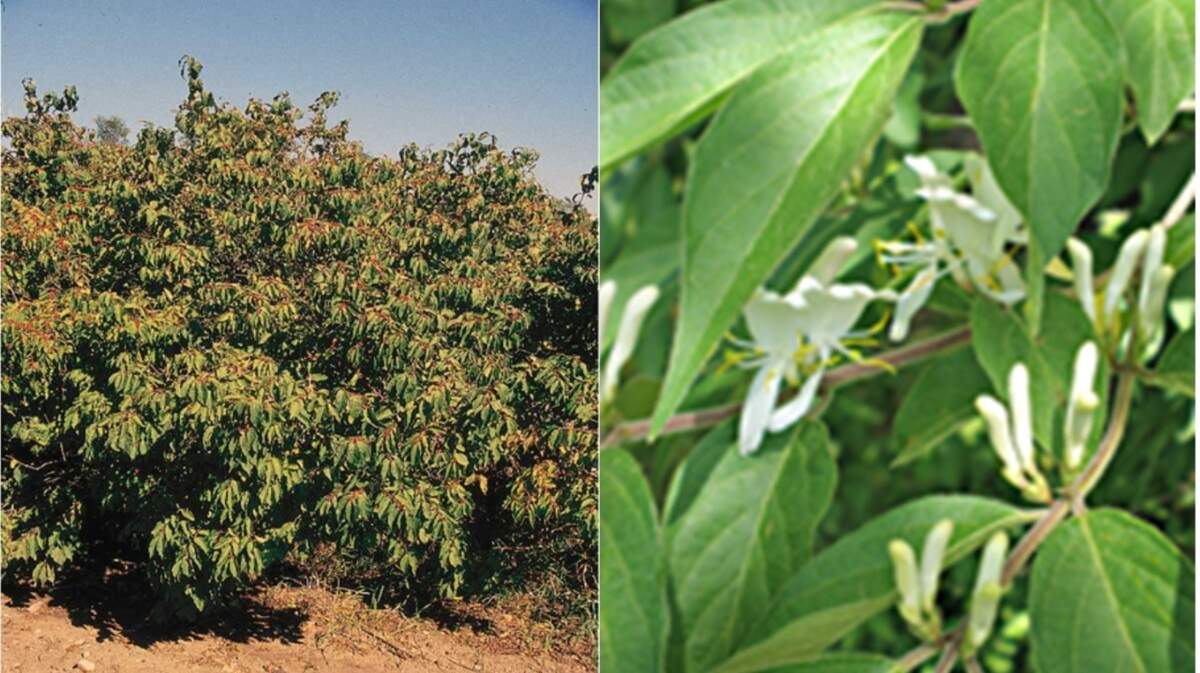
A woody shrub first introduced to the U.S. in the 1800s, and sold as a flowering ornamental plant that provided wildlife habitat and erosion control, has officially been added to the Kansas Noxious Weed List.
The Amur honeysuckle was one of five weeds added to the list in May and the only weed to be added as a Category C noxious weed, meaning it is well-established across the state and exists in large populations.
There are now 16 weeds on the list, six of which are classified as Category C.
“Noxious weeds are one of the greatest threats to the Kansas environment because they displace native plant species, interfere with the production of agricultural crops, increase erosion, destroy wildlife habitat and decrease property values,” according to the Kansas Department of Agriculture.
Under state law, landowners are legally responsible for controlling the spread of and eradicating noxious weeds using official methods approved by the Kansas Secretary of Agriculture.
What is Amur honeysuckle?
Amur honeysuckles are one type of Asian bush honeysuckle shrub, according to the Kansas Forest Service. They are invasive and woody shrubs that grow dense, then outcompete native plants for sunlight and other natural resources.
“These adaptable shrubs are commonly found on disturbed sites, forest edges and interiors, floodplains, fields, pastures, and roadsides,” state forest experts said. “While their presence is most concentrated in the eastern third of Kansas, significant infestations have been documented throughout the state.”
The shrubs can grow up to 15 feet high, and they have light brown stems that become hollow as the plant matures. Amur honeysuckles have leaves that are rounded at the base and tapered at the point. It has white, tubular flowers from April through June and produces small clusters of red berries starting in September.
How do I get rid of Amur honeysuckle?
Under the Noxious Weed Act, landowners must work to control and eradicate Amur honeysuckle on their property.
“Amur honeysuckle control means that both the roots and the flowers must be destroyed,” state officials said.
The weed can be controlled with cultural, mechanical and chemical control methods.
“While there may be costs associated with herbicide use or other control measures, effective weed management can improve land productivity, increase crop and forage yield, enhance overall property value, and reduce future costs of weed control if invasive weeds continue to spread,” the KDA said in a May 14 news release.
Cultural methods mean using land and vegetation management techniques to control existing populations, including by using sheep, goats and cattle to graze the shrubs during the growing season. This would need to be done annually.
Mechanical control means physically removing all reproductive parts of the weeds, but state officials warn it is challenging to control Amur honeysuckle mechanically.
“The only mechanical option would be to physically dig out the entire root mass of the individual plants,” the KDA said. “In larger, well-established sites, this would cause significant damage to the native understory species. If an area of infestation is cleared, care must be taken to replant desirable species to prevent erosion and provide competition against re-infestation.”
Landowners may also control Amur honeysuckle with chemicals. The herbicides labeled and registered for use of controlling this weed in Kansas include 2,4-D, glyphosate, imazapyr, picloram and triclopyr.
“Chemical controls should be used in a way as to minimize damage to native and desirable species,” the KDA said. “Applications should be made early in the spring after Amur honeysuckle has leafed out but before other species do. In the fall, applications should be made after other species drop their leaves but before Amur honeysuckle does. Cut-stump treatments can be performed throughout the year.”
Amur honeysuckle is now eligible for reduced cost herbicides purchased through county weed departments.
What are the other noxious weeds in Kansas?
Sixteen plant species are classified as noxious weeds in the state of Kansas. They can be listed as Category A, B or C.
Category A weeds, which are generally not found in the state, include:
- Hoary Cress
- Leafy Spurge
- Quackgrass
- Russian Knapweed
- Kudzu
- Diffuse Knapweed
- Spotted Knapweed
Category B weeds, which “have discrete distributions throughout the state and shall be subject to control wherever populations have become established,” include:
- Canada Thistle
- Cutleaf Teasel
- Common Teasel
Category C weeds, “well-established within the state and known to exist in larger or more extensive populations,” include:
- Field Bindweed
- Musk Thistle
- Sericea Lespedeza
- Johnsongrass
- Bur Ragweed
- Amur Honeysuckle