
Did the Wichita Wind Surge break promises on its new stadium? Here’s what the CEO says
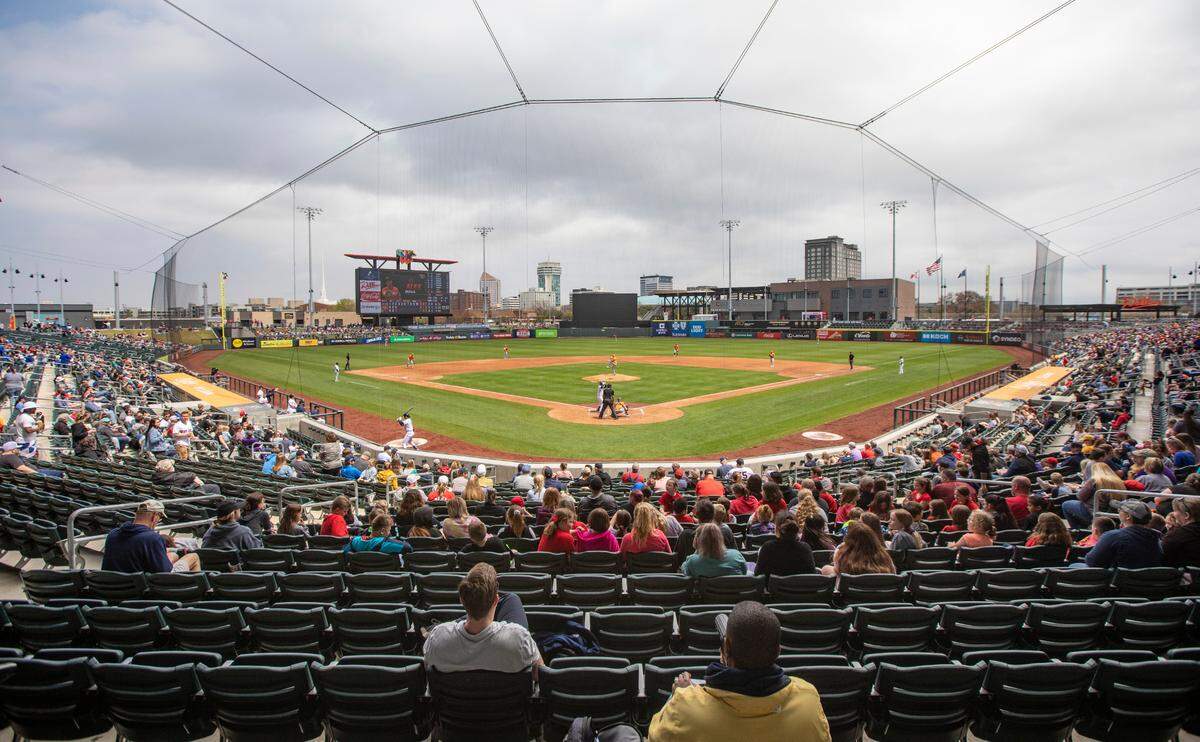
On an cold and dreary April day, rain threatens to interfere with the Wichita Wind Surge’s fourth home game of the season.
Then the clouds part, the rain stops and brilliant sunshine illuminates the green playing field of Riverfront Stadium. It’s as if Mother Nature herself is saying, “Play ball!”
Still, it’s not all joy in Mudville these days.
Ill feelings linger from a mostly taxpayer-funded $85 million ballpark ($75 million of which taxpayers paid, almost $10 million of which the ball club paid) that some feel was forced upon them. That was compounded by the perceived giveaway of nearby land to the club for development — a condition for the team coming. More recently, the Wichita City Council drew criticism for approving $10 million in public incentives for the stadium district along with tax breaks for its developers.
The 2-year-old ballpark has not held the many concerts, festivals and other non-Wind Surge events that were promised. Attendance isn’t what some expected it to be, and the club slapped an 8 percent charge on all ballpark purchases for those who are going.
The criticisms have left Wind Surge CEO Jordan Kobritz and some of his fellow owners feeling a bit beleaguered.
“It’s clear that not everybody is happy with the decisions I make or the decisions I need to make,” said Kobritz.
He took over after the team’s founder, his close friend Lou Schwechheimer, died of COVID-19 in July 2020 during what should have been the team’s first season.
The comparisons between the personable Schwechheimer and the matter-of-fact Kobritz are stark.
Kobritz said Schwechheimer wanted to be loved.
“The easiest way to be loved is to say, ‘Yes,’ to everybody — any question, any demand.”
He said former team president Jay Miller was the same way. Kobritz said Miller and Schwechheimer believed they could deliver on their promises, but he feels there was some overpromising.
“There’s also the word called reality,” Kobritz said.
Miller, who resigned in late 2020, didn’t return calls for comment.
There are agreements — including a lot of handshake agreements — with sponsors, people hoping to use the ballpark for events and the city of Wichita, that Kobritz is now having to postpone, renegotiate or deny.
From interviews with more than two dozen people for this story, two common themes emerged:
The club doesn’t want to do business with anyone outside of it, and Kobritz is rude, arrogant and unwilling to play ball.
Kobritz, who describes himself as committed, driven and focused, disagrees with the characterization.
“There’s a difference between rude and arrogant and direct, OK?” Kobritz said. “I am direct. If you ask me a question . . . you’re going to get an answer.”
A multiuse stadium without many uses
Most people familiar with the club’s agreement with the city remember the promise of 200 or so non-Wind Surge events to be held annually at the stadium.
Former Mayor Jeff Longwell, who had the original idea for the new ballpark, sold it as a multiuse stadium.
“I still want to see lots of activity down there,” he said. “I want to see development happen all along that area, the river corridor.”
But for that to happen, Longwell said, “You need to activate the ballpark for more than just baseball games.”
Longwell said he is not second guessing the city’s agreement or the fact that a specific number of events wasn’t put in writing.
“That’d be so hard to put in contractually, right? Because of all the moving parts. How do you contractually say you have to have 200 events or you default?”
The National Baseball Congress tournament’s lack of play at the stadium led to some of the harshest criticism of Kobritz and the ball club. The NBC had been held at Lawrence-Dumont Stadium, the 1934 ballpark demolished to make way for Riverfront Stadium, for the better part of a century.
Longwell said the tournament has rarely made money and the Wind Surge “can’t afford to lose money on the NBC.”
City Council member Becky Tuttle, who is on the NBC board, said she understands disappointment regarding the tournament but said attendance has to be sufficient to cover costs.
“I don’t think everybody understands that.”
Kobritz said he wants more events at the stadium “when we’re in a position to be able to do that financially.”
“Lou never included a time frame on when we were going to do these kinds of things.”
Kobritz said he first has to build a solid financial foundation for the team.
“If you’re building a house, you don’t start with a roof. You start with a foundation.”
‘Nobody really gave me an answer’
Kobritz said he can’t address why some events planned for the stadium didn’t happen because he wasn’t the one doing the negotiating. Many of the top employees in the club’s short history are now gone.
Casey Walkup is a former Wichita State baseball player and former commissioner with the Sunflower Collegiate League, a summer collegiate baseball league affiliated with the NBC.
Walkup wanted to have the league’s all-star game at Riverfront Stadium last spring.
“We were trying to get a price, and they couldn’t give us a price,” he said. “From what I was told, the owner did not know what they wanted to charge, and this was in April of last year.”
Kobritz is a Wind Surge partner along with Schwechheimer’s widow, Jane, and numerous other local and out-of-state investors.
Walkup took the game to Wichita State’s Eck Stadium instead.
“We also tried to host our season kick-off event last year, trying to utilize one of their hospitality areas, but again, we were unable to get a price for that,” Walkup said. “So, consequently, we had to go to a different venue.”
He said he doesn’t know why the ballpark would turn down money.
“That’s kind of what I was wondering. Nobody really gave me an answer.”
Kobritz said he can’t explain what happened.
“I don’t know who they talked to.”
Last year, a limited number of NBC games were held at the stadium. Walkup said the teams involved “kind of felt like they weren’t necessarily very welcome there when they had to play. There were a lot of rules, I think, put in place that I think are not general rules that a baseball park has.”
Hutchinson Monarchs owner and general manager Marc Blackim said during warm-ups, players couldn’t wear metal spikes, and no one could go on the infield before games. There were ropes from home plate to past first and third base.
“I’ve never seen it in my life.”
Still, he wants the NBC to be back at Riverfront Stadium. He said it was “a great experience for my guys . . . to be able to play on that beautiful of a facility.”
“But we’re not playing there this summer are we?”
Blackim said it’s an interesting situation.
“We can’t play in a stadium that the people of Wichita paid for? I think that’s crap,” he said.
“We paid for that stadium. The NBC ought to be playing there . . . especially when it’s a tradition that’s been there almost 90 years.”
Walkup said he feels the same way.
“It is kind of frustrating to see the lack of . . . inclusion that this group is allowing Wichita and our community.”
Not so beneficial, or flexible
Other events that previously were held at Lawrence-Dumont are no longer at the new stadium.
Nnanna Okpara, founder of Festive ICT and creator of the Wichita Taco Fest, had previously held Taco Fest at the old stadium.
“We had such a good time there in 2018,” Okpara said. “It worked out very well.”
He said Schwechheimer was a supporter of the festival.
“Lou told me personally, ‘I want your festival. . . . We have to figure out a way to make that happen.’ ”
It hasn’t happened, which is why the 8,000-person Wichita festival is now held at an amphitheater in Andover.
“The basis of it was we couldn’t work out a deal that was . . . beneficial to both parties,” Okpara said.
He said he came away thinking that the new management “may be just not as flexible as the old management.”
Kobritz said he’s not sure what happened during negotiations with the festival.
“I have no further comment because I have no further information.”
Okpara said since he pays taxes as a resident of Wichita, “I feel like I should have been able to do it there,” but he added that “at the same time, I’m a businessman, and I understand it’s not always black and white.”
Kobritz said he’s open to talking to the Sunflower league and Taco Fest.
“If our costs are met, we certainly would take a look.”
Forgive him if he’s skeptical
When Kobritz points to events that have been held at the ballpark, they tend to be smaller ones not open to the general public, such as the Wichita Regional Chamber of Commerce and Great Wichita Partnership events, free tours of the stadium, events for companies potentially moving to the city and some gatherings or free or discounted tickets for disadvantaged youth.
There was a large Fourth of July party the club and the city threw last year, and there was one football game last fall featuring teams from the Kansas Jayhawk Community College Conference.
“We felt an obligation to prove to everybody that we had in fact built a multipurpose facility,” Kobritz said. “The fans didn’t embrace it to the extent we had hoped.”
He said the club lost $35,000 on the game.
There were two concerts and a show scheduled at the park last year for Old Dominion, Midland and Nitro Circus, but none happened.
“The promoters withdrew those concerts because of a lack of advance sales,” Kobritz said.
There was one concert planned for this year, but the artist canceled his entire tour, Kobritz said.
Another festival he negotiated with presented too much of a risk, he said.
“They had no track record,” Kobritz said. “They wanted us to take 100% of the risk financially.”
A high school team that wanted to play at the stadium claimed it could bring 1,500 fans, five times its normal attendance.
“Forgive me if I was skeptical.”
One group hoping to use a meeting room at the stadium was surprised to learn it would cost $1,500 for 10 to 15 people to meet.
Kobritz said Major League Baseball dictates much of what can happen at the stadium.
At the minimum, the ballpark has to supply staff, security, a waiting EMT that the club’s insurance policy demands and two full-time groundskeepers. It all takes money, Kobritz said.
“As much as this is a sport, and it’s fun and games, it’s also a business.”
‘That is 100% we screwed up’
Some of the Wind Surge’s biggest supporters — including sponsors and luxury suite holders — also have had problems with the club.
“With the change in personnel, frankly, some things fell through the crack,” Kobritz said. “That is 100% we screwed up.”
Kobritz, who won’t address personnel changes, said that in cases where the ball club has not met its commitments, “we’re going to make it right. There’s no excuses. Explanations, but no excuses.”
In one case, Kobritz’s solution to a problem with a suite holder was to kick him out of the box. The former box holder, who asked that his name not be used, said his main complaints were with the food ordering system and concession credits. After much back and forth with other employees, some of which Kobritz termed abusive on the businessman’s part, Kobritz surprised him by calling to say it was clear he wasn’t happy, so he planned to refund his $50,000 for the box and $10,000 for a field advertisement.
The former box owner wonders whether someone else’s desire for the box was behind the decision. He has shared his story with others in the community, including audio of the call with Kobritz.
One of the biggest challenges for Kobritz has been dealing with sponsors’ expectations.
“People come to us and say, ‘Well, Lou said,’ or, ‘Jay said,’ and those things don’t exist in the sponsorship agreement,” Kobritz said. “We have had to work those situations out on a case-by-case basis.”
‘This was his deal’
In addition to investing in the team, Kobritz was a consultant during the club’s formation and later agreed to lead development around the ballpark. Now he’s orchestrating that while also running the team and park in Schwechheimer’s place.
“This was his deal,” Kobritz said. “I shouldn’t be here. Sometimes I think of it that way. He should be.”
He gets emotional discussing his friend.
“I miss him every day. You can’t help but miss him. He was larger than life.”
Kobritz sidesteps when asked if he’s frustrated with how his friend left things.
“I would say that when I make a deal with somebody, I write it down,” the former lawyer said. “They know what the terms are. I know what the terms of the deal are. . . . That’s the way I believe in operating, and not everybody thinks like I do.”
Longwell said he is hesitant to say much about the ballpark since he’s no longer part of discussions about it.
He did, though, say, “There’s no question Lou was an incredibly important piece to all of it. Not having Lou anymore has changed everything.”
The community’s stadium
There’s a difference in how Schwechheimer finessed things versus how Kobritz bluntly states something without qualifying it.
He raised eyebrows recently by saying he doesn’t think Riverfront Stadium is a public park.
When asked about it for this story, Kobritz said, “I don’t think this is a public park in the nature of the parks and rec parks around the city where anybody can show up” without reservations or fees.
“That’s what I mean when I say it is not akin to a public park.”
That’s not how his comment was taken.
“We sold this to the community that it was their stadium, so I’m going to stand behind that,” said Council member Jeff Blubaugh.
“I personally am going to push hard that we open this up for public events because that’s a promise we made to the constituents of the city of Wichita.”
He recently requested a meeting with Kobritz and City Manager Robert Layton to discuss the lack of events.
“They certainly want the events,” Blubaugh said. “They know that that’s what the city wants. It’s just been a lot slower than what we anticipated.”
Council member Tuttle said the lack of events to date is understandable in light of the pandemic.
“If we didn’t have COVID, then I probably would be looking at this from a different lens than I am,” she said.
“All of us on Council are going to carefully monitor, and we’ll see.”
Layton said discussions with Kobritz have been along the lines of, “Don’t forget this. We know you’re trying to keep your head above water, but we want to see more community use of the facility.”
Though no one expects the club to lose money on events, Layton said a coherent pricing structure must be in place for potential stadium users.
He said it’s a complicated issue because prices depend on a variety of things, such as whether concessions will be used or not.
Everything about the city’s agreement with the club has been complicated from the start, he said, with representatives from both sides, Major League Baseball and, at the time, the Pacific Coast League weighing in.
If the city had stipulated a certain number of events, Layton said, “I don’t know if I would have ever gotten it through.”
He said Schwechheimer “wanted to make this a play area and a living room for Wichita, and I think there was an element of trust.”
Layton appreciates Kobritz’s straight-talking approach, too.
“Jordan’s under a lot of pressure,” he said. “I will say he’s not the promoter that Lou (was), but he understands the community connection.”
If Kobritz succeeds, that may allow the ball club to underwrite the costs of nonprofits using the stadium in the future, Layton said.
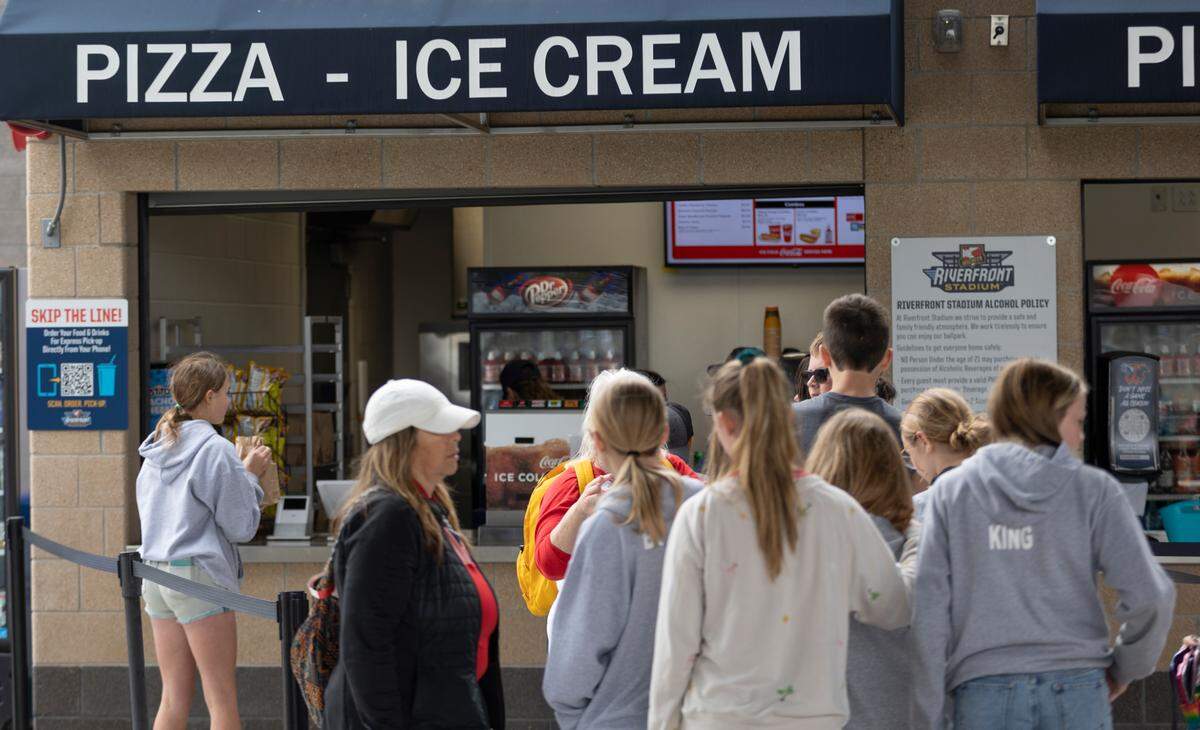
Council member Brandon Johnson said the chief complaint he hears is that the ballpark “can be pretty expensive and that people thought it would be more affordable than what it currently is.”
If people keep pressing that issue, he said, “Hopefully it puts some pressure to lower those costs.”
Kobritz said there are $4 tickets available along with half-price tickets and reduced-price concessions on certain days, too. Also, members of the Kids Club, which is free to join for children 12 and under, get in free on Sundays.
He said the club’s planned sports museum will be a place where nonprofits can meet at the stadium for free in the future.
Hopes for development
As for the public money the club will use for development, Kobritz said it’s all money that will be generated by the new development and wouldn’t exist without it.
“I realize it’s a tough situation to understand.”
The $71 million project, which is a public-private partnership, includes an eight-story hotel, a six-story office building with an adjoining 283-spot parking structure and riverfront improvements.
Layton said he understands all of the concerns.
“I understand that we probably have to win people over,” he said.
“What I’m really excited about is we’re starting to realize the vision of associated development, and there will be an energy along the river. . . . In the long term, you’re going to see a really substantial entertainment district and development that Wichita’s really going to be proud of.”
Layton said he knows of ballpark skeptics who attend a game or two “and then I hear them rave about the facility, about the time that they had and how excited they are that it’s here.”
“I think they’re starting to create memories.”
Contributing: Taylor Eldridge and Chance Swaim.
This story was originally published April 28, 2022 at 4:47 AM.