
When Wichita State’s physical edge vanished, things unraveled fast in Tulsa loss
Wichita State spent the first half of Sunday’s game in Tulsa trading punches with arguably the best team in the American Conference.
For 20 minutes inside the Reynolds Center, the Shockers looked capable of matching Tulsa’s offensive firepower.
Then the game turned — fast — when Wichita State’s physical identity disappeared.
Tulsa overwhelmed the Shockers after halftime and rode that surge to a 93-83 win on Sunday, snapping WSU’s three-game winning streak and exposing how fragile the margin is when the Shockers don’t dominate the glass.
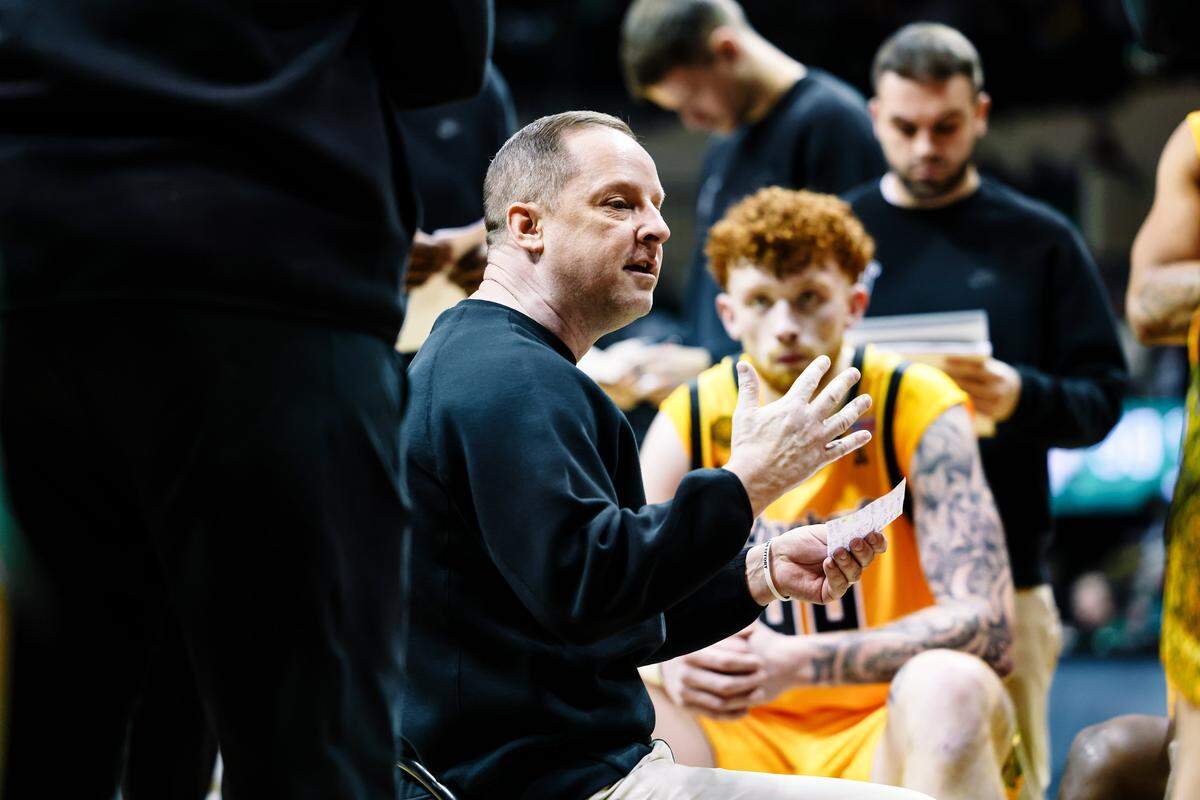
The shift in physicality after halftime wasn’t subtle. It showed up in rebounding, defensive switches, box-outs and paint finishing. Over a decisive 11-minute stretch to open the second half, Tulsa delivered a clinic in force and urgency. WSU (13-9, 5-4 American) couldn’t match it.
“We didn’t switch with the physicality that’s necessary in order to prevent them from being able to make the 2s that they made,” WSU coach Paul Mills said. “You can see that stuff on film, but when you watch it translate in person, I don’t think I did a good job of getting across the urgency to our players.”
Where the game was lost for the Shockers
For the majority of the first half, Wichita State leaned into its usual strength. The Shockers rebounded eight of their first 17 misses for an elite 47% offensive rebounding rate and consistently created extra possessions and second-chance points. That effort helped keep the game level through most of the first half.
Then the foundation cracked.
Over the final three minutes of the first half and the first 11 minutes of the second — a 14-minute window that decided the outcome — WSU rebounded just one of 15 misses. That’s a 7% offensive rebounding rate. During that same stretch, Tulsa outscored WSU 43-22 and turned a tight game into a runaway, building a 75-56 lead that effectively put the game away.
The possession math tells the story. Without its usual batch of second chances, WSU’s offense dried up to just 0.85 points per possession in that stretch. Tulsa, meanwhile, erupted for 1.54 points per possession by pairing efficient shot-making with the relentless rebounding that WSU is used to.
Tulsa controlled nearly every rebound after halftime. Across the first 11 minutes of the second half, the Golden Hurricane grabbed 14 of a possible 17 rebounds at both ends — securing 10 of 11 defensive rebounds and four of six offensive rebounds. Each of those four offensive boards turned directly into a basket.
“They picked up their physicality, hats off to them,” WSU guard Kenyon Giles said. “They did a good job of picking up on what they were trying to do in the first half, then our shots just weren’t falling like they were in the first half.”
How Tulsa made Wichita State pay
Tulsa didn’t just play harder. It attacked smarter.
Coming out of halftime, the Golden Hurricane scored twice in the first minute on back cuts. The trigger was simple and repeatable: run offense through center Tyler Behrend on the perimeter and pull WSU rim protector Will Berg away from the basket.
With Berg out of the equation in the paint, Tulsa exploited WSU’s aggressive top-locking on the perimeter. Instead of running head-first into WSU defenders waiting for them on the 3-point arc, Tulsa guards started slipping screens and cut behind defenders stuck on the high side. With no shot-blocker waiting and some slick passing from Behrend, the result was an assembly line of clean looks at the rim.
“I thought they were able to cut and have way too much in regards to space via their opportunities, rather than us limiting it,” Mills said. “The lack of physicality from a defensive standpoint, I think it came back and caught us.”
WSU managed just five defensive stands in the first 11 minutes of the second half, as Tulsa racked up 32 points on its first 21 trips up the floor.
Tulsa ranks No. 4 nationally in 3-point percentage, which only translated to eight triples on Sunday, but the constant perimeter pressure stretched WSU’s defense and helped create a virtual layup line. Tulsa punished that space inside, shooting a season-best 71.4% on 2s, while the Shockers allowed their second-most made 2-point field goals (25) and their second-worst opponent 2-point percentage of the season.
“When you have a number of guys you’re concerned with as a defensive team, it does absolutely pull you,” Tulsa coach Eric Konkol said. “The way they were guarding, the defense was stretched to the 3-point line. So we’ve got a lot of really good shooting from a number of different guys and we want to utilize that, not just when they take the shot, but to be able to space the floor.”
A closer look at Wichita State’s rebounding failures
The breakdown on the glass wasn’t on WSU’s big men. In fact, the leaks came from guards and wings failing to finish possessions with physical box-outs and pursuit.
Even in the first half, small warning signs appeared.
After Berg forced a miss at the rim, redshirt freshman T.J. Williams was caught ball watching and failed to box out, allowing Romad Dean to slip in for a tip-in. On another play, Kenyon Giles failed to make contact on a box out, allowing Ade Popoola to keep the possession alive. Late in the half, Karon Boyd — typically WSU’s most reliable physical presence — was driven forward when a shot went up and allowed K.J. Martin Jr. to slap the ball out to Tulsa, which led to a 3 just before the buzzer.
Those issues multiplied after the break.
Popoola overpowered Mike Gray Jr. for an offensive rebound and score early. Gray was beaten again on a perimeter box-out that led to a David Green putback. Boyd failed to complete a box-out that let Myles Rigsby extend another possession. Rigsby also ripped away a 50-50 ball from Dillon Battie after an airball and scored. Williams again lost track of his man on a miss that turned into a putback dunk.
Each play shared the same theme: Tulsa initiated the contact, leaving WSU stuck reacting instead of dictating terms like it usually does.
“We did a poor job coming out of half being physical,” Berg said. “They were able to crash the boards and we simply didn’t box out properly. At the end of the day, they were tougher and played better than us.”
Wichita State’s finishing problems resurfaced in the loss
The physicality gap showed up offensively, too. WSU once again struggled to convert in the most important area of the floor.
The Shockers finished just 17-of-37 in the paint (46%) and 16-of-32 around the rim (50%). Those numbers mirror a season-long problem: WSU ranks No. 357 nationally in finishing percentage at the rim. Usually, WSU offsets its poor finishing by piling up offensive rebounds and generating second-chance points. But that weakness was magnified Sunday when the offensive-rebounding pipeline dried up.
Some of the misses were from point-blank range. Others stemmed from poor shot selection, as WSU had an array of forced attempts through contact, rushed angles and low-quality looks that never had a chance. The lack of paint efficiency stood in sharp contrast to Tulsa’s execution, as the Golden Hurricane converted 17 of 22 shots around the rim, most coming off cuts, slips and second-chance buckets.
Without putbacks and kick-out 3s generated by offensive boards, WSU’s offensive flow stalled. Giles, who scored 17 points, went 0-for-6 after halftime and couldn’t bail the offense out.
That quickly left WSU with no answers to keep up with Tulsa’s high-octane attack.
“I hate to use the word panic, but we were just more deliberate than what we needed to be,” Mills said. “There wasn’t a flow to it organically, like we needed to get out and do in order to get ourselves back in a game like that.”
WSU learned what happens when identity doesn’t travel
Wichita State’s blueprint to success is built on defense and rebounding, which are both anchored in physical play. On Sunday, both pillars eroded at the same time.
Tulsa shot 72% from the floor in the second half, dominated the rebounding exchanges that were available and punished nearly every defensive mistake.
The result was WSU’s second double-digit defeat of the season. It was also a clear example of how quickly games can swing when WSU’s physical edge disappears, particularly against a top-tier offense.
“It’s important that we learn that each half is a new game,” Berg said. “We can’t fall asleep like that. It’s hard, especially on the road, to dig yourself out of a hole if you’re down and they get momentum. It was an uphill battle from there, so we have to keep our foot on the gas.”
The next test comes against the other team at the top of the American Conference standings in Charlotte in a 6:30 p.m. game Wednesday at Koch Arena.
The Shockers will surely be looking for a piece of revenge after blowing an 18-point lead in a double-overtime loss to the 49ers one month ago. But they should be more concerned with returning to their roots, as Sunday offered a blunt lesson: When the physicality drops, everything else follows.
This story was originally published February 2, 2026 at 6:58 AM.
.jpg)