
Wichita State basketball takeaways: Tulsa runs away from Shockers to snap streak
In what had been a one-sided rivalry this century, Tulsa has flipped the scoreboard lately on the Wichita State men’s basketball team.
After the Golden Hurricane’s 93-83 win over the Shockers on Sunday at the Reynolds Center, Tulsa has suddenly won four of the last five meetings in the series, including three straight on its home floor. Sunday marked the first time Tulsa scored 90-plus against WSU since 1984.
Up against a high-powered machine like Tulsa’s offense on its home floor, the Shockers weren’t disciplined enough to hold up defensively, as Tulsa raced away to extend its winning streak to six games and move to 19-3 overall and 7-2 in American Conference play, tied for first with Charlotte.
WSU (13-9, 5-4 American) had its three-game winning streak snapped with its second double-digit defeat of the season.
“Eighty-three points is enough to win a basketball game,” WSU head coach Paul Mills said. “We just didn’t defend at a level that we needed to in order to give ourselves a chance.”
WSU was led by 17 points from Kenyon Giles, although he went scoreless after halftime and finished 6-for-18 shooting. Will Berg scored a career-best 16 points off the bench, while T.J. Williams (11), Dre Kindell (11) and Karon Boyd (10) all finished in double-digit scoring.
For just the third time this season and first time in conference play, WSU was outrebounded, as Tulsa racked up a 38-29 advantage on the glass. The minus-9 performance was the worst on the season for the Shockers.
“I knew the battle on the glass was going to be pretty significant,” Mills said. “So to be minus-9 is pretty disappointing.”
Here are three key takeaways from Wichita State’s performance and where the game ultimately tilted.
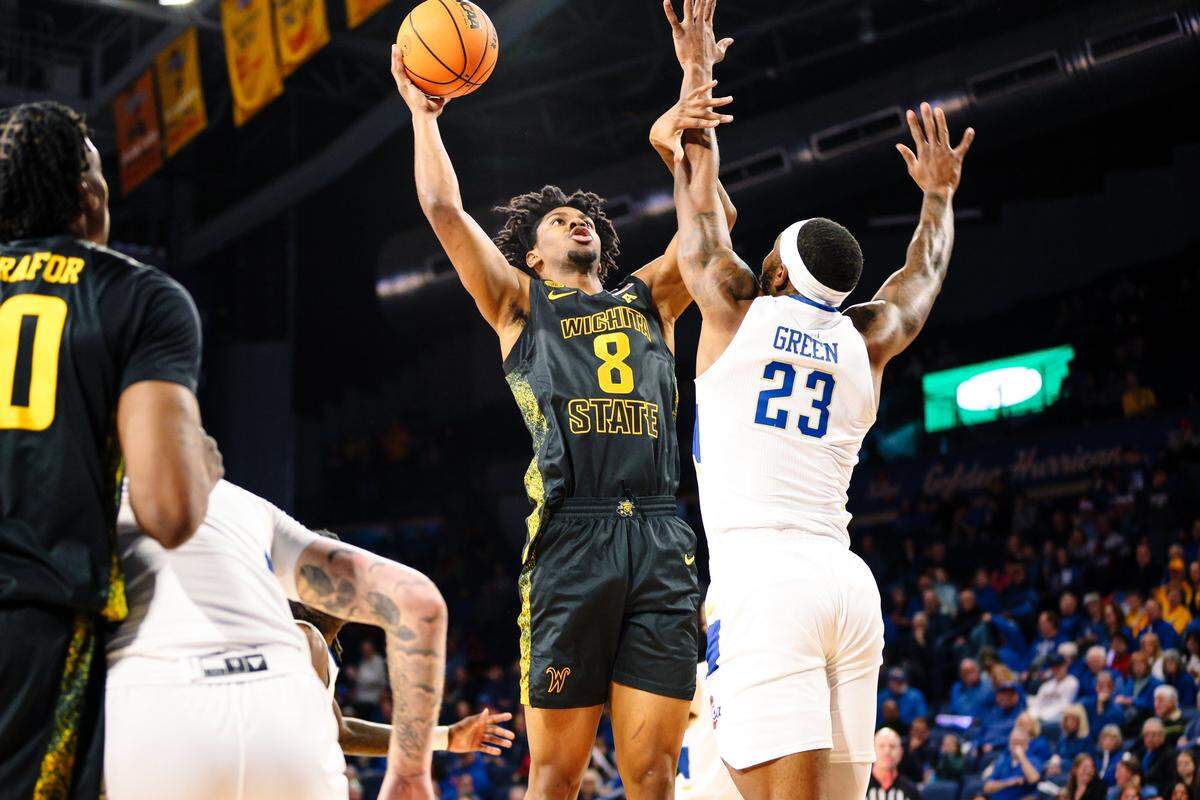
1. Tulsa’s elite offense overwhelmed the Shockers
WSU’s offense was solid enough by its usual winning standards, but Sunday demanded more than solid. On the road against one of the nation’s most explosive scoring teams, the Shockers needed a gear they couldn’t quite reach.
Tulsa, which averaged 89 points per game in its first six conference wins, looked every bit like that kind of attack. The Golden Hurricane wasted little time seizing control after halftime, pushing ahead 55-46 before the first media timeout and forcing WSU onto its heels with relentless pace and downhill pressure.
The decisive stretch came a bit later. Tulsa ripped off a 10-0 run while holding the Shockers scoreless for nearly four minutes, blowing the margin open to 69-53 with 10:30 to play. What had been a manageable gap quickly turned into a steep climb.
From there, the lead swelled to 19 at 75-56 as Tulsa dictated terms on nearly every possession. Wichita State struggled to generate stops or disrupt rhythm, and without defensive resistance, even a respectable offensive output wasn’t nearly enough to keep pace.
“Twenty minutes is not going to cut it,” Giles said. “We have to come in and bring that same physicality for 40 minutes, the whole 40 minutes.”
WSU’s lone rally trimmed the deficit to 88-78 with 1:18 remaining, but the Shockers never clawed to within single-digits again in the final 13 minutes.
Tylen Riley scored a career-high 30 points on 9-of-11 shooting from the field and 11-of-13 shooting from the foul line, as Tulsa’s top-25 offense looked the part on Sunday. The Golden Hurricane made 60% of their shots from the field and scored 1.37 points per possession.
2. Rim finishing once again proved fatal for WSU
If there was one statistical window into why Sunday’s game tilted Tulsa’s direction, it was what happened at the rim. Wichita State simply couldn’t convert enough of its closest looks, while Tulsa turned those same chances into reliable offense.
The Shockers finished just 16 of 32 chances at the rim (50%), a number that mirrors a season-long issue. Entering the game, WSU was converting only 52.7% of its rim attempts, ranking in the second percentile nationally. That places the Shockers among the least efficient finishing teams in the country, and the trend held under pressure on the road.
Even clean looks didn’t guarantee points, as several point-blank chances rolled off.
Tulsa, meanwhile, consistently created better driving lanes and interior angles and capitalized when it got there. The Golden Hurricane went 17-for-22 at the rim, a sharp 77.3% conversion rate that kept the scoreboard moving and stress on WSU’s defense.
The missed opportunities didn’t stop there. Wichita State also left points at the foul line, going 20-of-32 and missing 12 free throws. In a game decided by margins and momentum, those empty trips proved costly.
3. Back-and-forth first half favored Tulsa
The first half unfolded like a tug of war, featuring eight ties and eight lead changes as neither side could create real separation. Wichita State found its sharpest groove during a 9-2 burst midway through the half, sparked by a Giles 3 that ignited the run. Berg followed by asserting himself inside, finishing a basket in traffic and then adding two free throws to give the Shockers a 34-30 edge and momentary control of the tempo.
But Tulsa never let the game settle. The Golden Hurricane countered with perimeter firepower, closing the half with three 3s in the final four minutes. The last, a deep one from David Green, sent Tulsa into the locker room with a 43-39 lead.
Tulsa’s efficiency told the story: 50% shooting overall and 7-for-15 from deep. WSU created extra chances with eight offensive rebounds, but 40.6% shooting and a rough 6-for-16 mark at the rim were costly.
Against a high-powered offense like Tulsa’s, those missed point-blank looks stacked up as costly wasted opportunities.
This story was originally published February 1, 2026 at 3:19 PM.
.jpg)