More ticks. Shrinking autumns. Stronger storms. This is Kansas’ future under climate change.
The average summer temperature in Wichita has increased by 1.3 degrees since the 1970s, according to NOAA data analyzed by Climate Central, a non-profit science news organization.
“What’s one degree? Well, you raise your temperature in the average one degree and you’ve got a whole bell curve of averages,” said Sean Sublette, a meteorologist with Climate Central. “You shift everything just a little bit this way, and all of a sudden you’ve got a whole lot more extremes, whereas you might’ve had a day that had reached 105 once every two or three years, but now you might reach 105 seven times in a year.”
Here are 10 ways that climate change and this new “normal” will continue to affect Kansas.
“With climate change, places that are dry are going to tend to get drier, and places that are wet, are going to get wetter, but everybody’s going to get hotter,” Sublette said. “The temperature is going to go up.”
There was a downward trend in heat-related deaths for a few decades, according to a recent meteorological study, but as climate change caused an increase in heat, that downward trend stopped.
“It’s predictable, but it’s complex,” said Dr. Grady Dixon, a geoscience professor and dean of The Werth College of Science, Technology and Mathematics at Fort Hays State who studies heat deaths in the state and across the nation.
“It’s predictable in that the elderly and the young, who have less ability to thermoregulate, and those who work outside and are homeless are more exposed to the elements, so they would be at the highest risk,” Dixon said.
An analysis by the Union for Concerned Scientists found that throughout the U.S., temperatures above 90 degrees Fahrenheit will become more common. They looked at humidity and heat projects and calculated how the heat index was likely to change under different conditions, such as no action on climate change, slow action by mid-century and rapid action that would meet the Paris Climate Agreement Goals.
“Kansas is certainly an area with one of the highest levels of change,” said Dr. Rachel Licker, senior climate scientist and co-author of the heat study. “The Southeast, Gulf states and the southern plains popped out as areas with significant change.”
If the world limits emissions, slowing down warming by mid-century, Kansas’ 2nd Congressional District, which contains Topeka, Lawrence, northeast and southeast Kansas, and Kansas’ 4th Congressional District, which contains Wichita and south central Kansas, could have 46 days above 100 degrees, up from 13 days, historically.
“The farther south you get, the hotter and hotter the projections are,” Licker said. “The ‘feels like’ temperature combines heat and humidity, and humidity is something that Kansas is already familiar with and makes these temperatures feel even warmer.”
The 3rd District, containing the Kansas City area, could have 43 more days, up from 12, and the 1st District, which contains north-central and western Kansas, could have 34 more days above 100, up from 6.
“Along with the need for federal protections for outside workers, we need to lower emissions,” Licker said. “If we invest in renewable energy, it will reduce emissions, which will reduce the number of high heat days.”
Less time to cool down
Warmer summer nights can be more dangerous than higher temperatures during the day, as people, animals and plants have less time to cool off and recover, according to the EPA.
“The ability to cool themselves at night is the most important,” Dixon said. “It’s not the heat during the day that tends to be the most stressful, but the night when you don’t have recovery time. So Day 2 is not another Day 1. It’s worse. That’s when it starts compounding.”
It is the utility’s job to understand and handle any point of congestion on the grid, according to Linda Berry, a spokesperson for the Kansas Corporation Commission. The KCC does not have any plans to deal with future impacts of climate change or to modify the grid to prevent what happened in February when the electric grid in Texas came within 5 minutes of total collapse after a winter storm.
As global temperatures rise, insects like ticks and mosquitoes can expand their geographic regions and lengthen their season.
Mosquitoes have higher rates of transmitting disease when temperatures are between 61 and 93 degrees Fahrenheit, according to a 2017 peer-reviewed study.
When Climate Central looked at the number of days within that “risk zone,” they found that 94% of the 244 U.S. cities they analyzed had an increased number of “disease danger days.” Wichita had an increase of 18 days a year since 1970.
Carbon dioxide is increasing in the atmosphere due to fossil fuels and causing climate change. That stimulates plant growth and can cause increased pollen concentrations.
A 2014 peer-reviewed study found that levels of grass pollen doubled when carbon dioxide levels did.
As the planet warms and spring-like temperatures arrive earlier and fall-like temperatures later, the growing season is longer, according to the EPA. A longer growing season means a longer allergy season.
As climate change causes more extreme variations in weather, heat waves can cause illness and death and increased numbers of storms can kill people, damage property and interrupt essential services, such as electricity, water and transportation, according to the EPA.
More flooding ...
Heavy rainfall is an indicator of climate change. As the oceans warm, more water evaporates into the atmosphere; it then moves over land and results in more rainfall, according to the EPA.
Most states, especially in the Midwest, have seen an increase in the amount of rainfall on their rainiest day.
When comparing the single rainiest day each year in different cities, Climate Central found that 70% of cities are seeing wetter rainy days than they were in the 1950s. They chose to compare these days because floods are especially common on the rainiest days of the year.
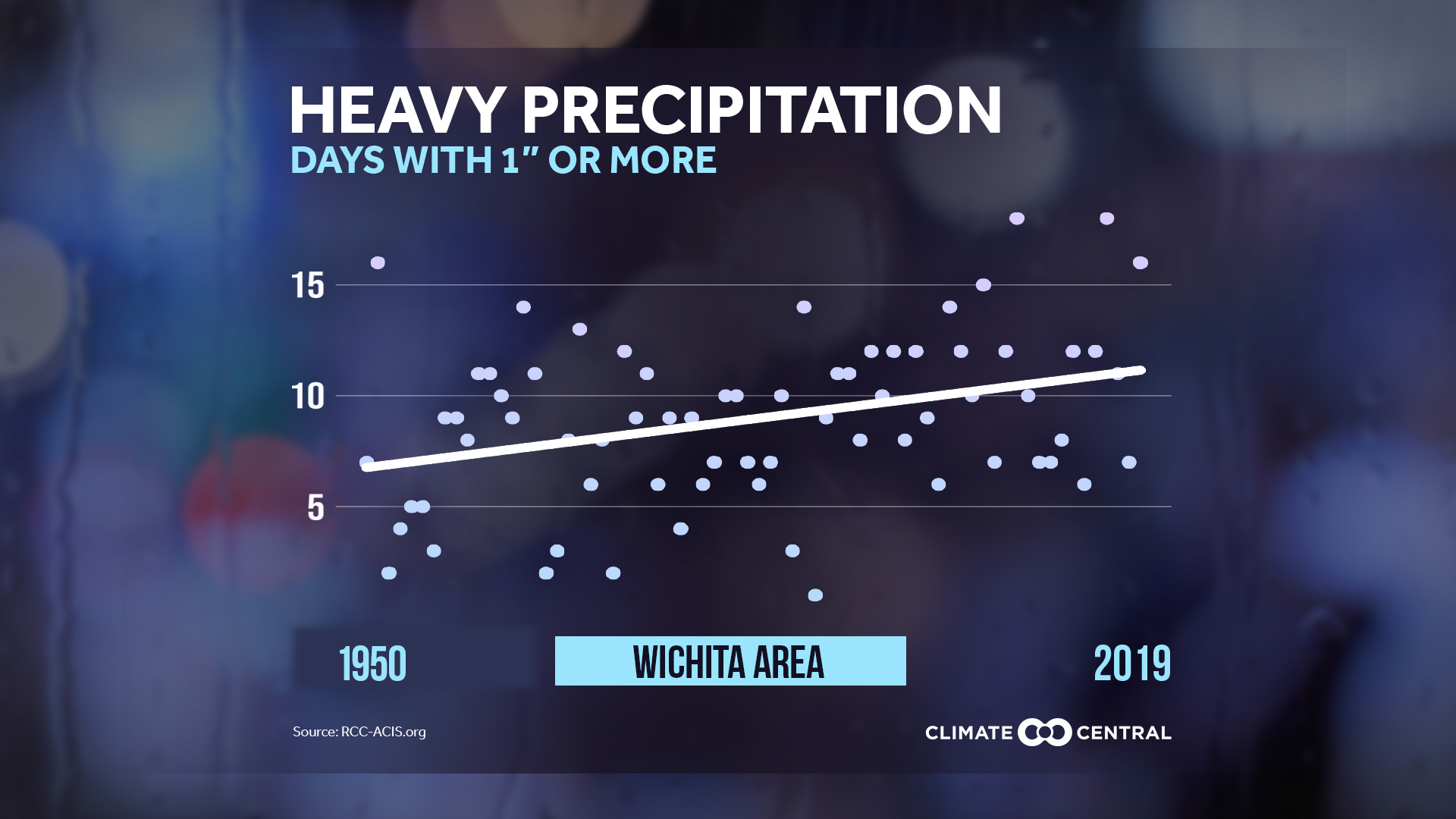
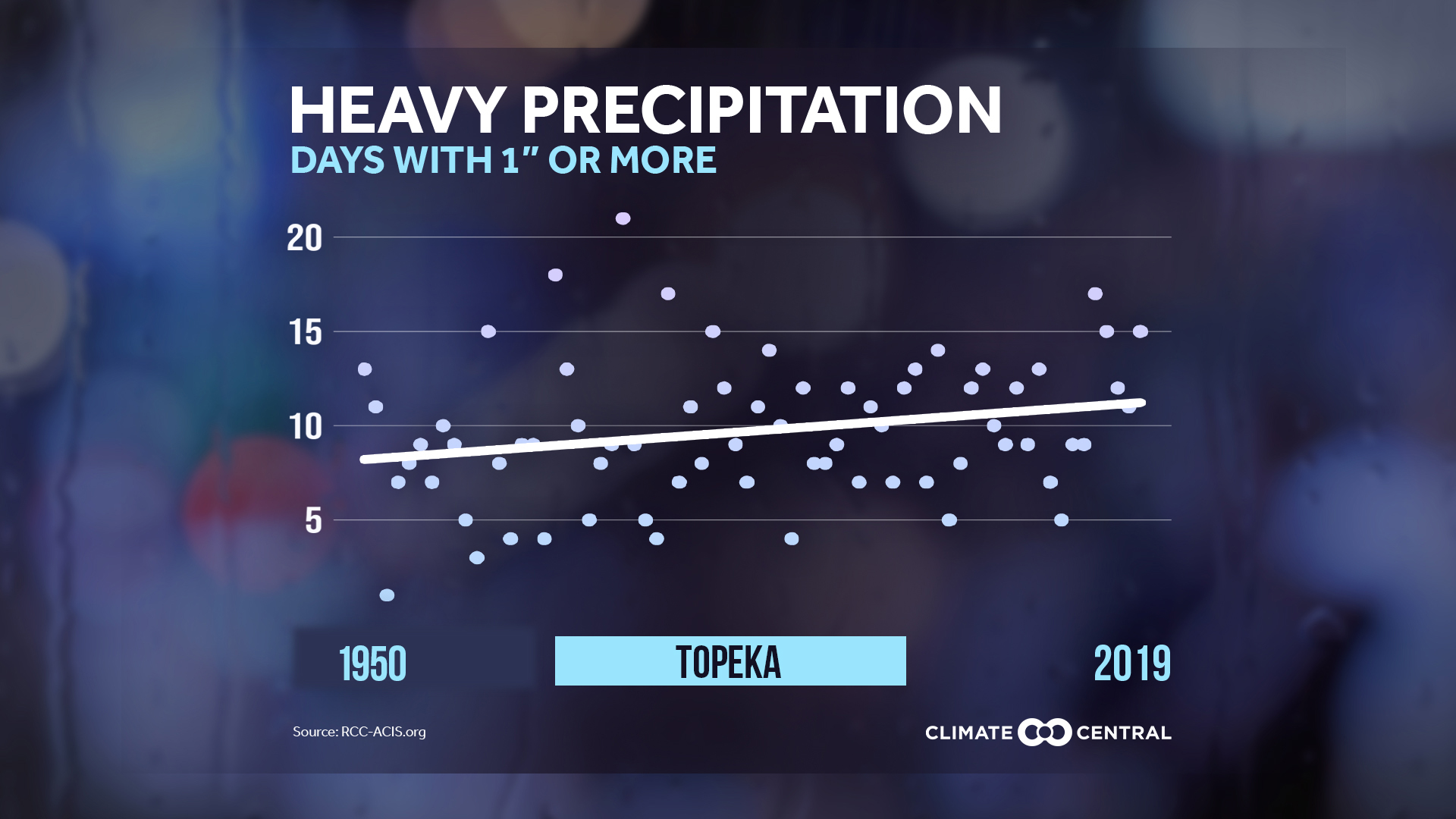
In Wichita, the amount of rainfall on the rainiest day has increased from 2 inches to 3.5 inches, since the 1950s. Both Wichita and Topeka have seen a rise in the number of single days where an inch or more of rain occurs.
Increased rainfall can cause a host of problems, such as flooding, overflowing sewage and increased conditions for mosquitoes.
“We try to be proactive in storm drain maintenance, but it seems that we clean a bridge of trees and we have to come back in two years because a big rain event will wash more trees against the bridge,” said Scott Lindebak, stormwater manager for Sedgwick County.
Wichita hasn’t seen as intense a rain event as it did Oct. 31, 1998, when between 8 inches and 9 inches fell over the western part of the county. But Lindebak said the county stormwater management team has noticed more extreme events with lots of rainfall over short amounts of time, the most recent happening in mid-June with a series of thunderstorms.
To prepare, they’re trying to develop projects that will offset the effects, such as the Dry Creek Overflow project. They will build a retention pond at 13th and 167th streets that they hope will catch water and divert it downstream before it can affect the more than 100 homes and businesses nearby.
... And higher vulnerability to drought.
While it might seem counterintuitive that climate change could cause both heavier rainfall and increase Kansas’ vulnerability to drought, that’s what happens. Climate change intensifies current weather patterns. Too much rain at one time can cause erosion, as the soil can’t absorb it all at once, which can actually make drought conditions worse.
“We like to think ‘Well, but it all just equals out,’ but it doesn’t because if you have very heavy rain on a very dry ground, that runs off into the rivers and streams and doesn’t soak back in the ground,” Sublette said. “If you have a dry sponge, and you turn on the spigot, the sponge will get a little bit damp, but the water’s just running right off.”
From 1980 to 1990, five drought events cost over a billion dollars, compared with nine events in the most recent decade.
A recent study found that Kansas has a high vulnerability to drought. It is one of four states with the highest potential to be negatively impacted by drought, especially as it affects agriculture and water recreation.
Jeff Hatfield cuts wheat in Sumner County in 2018. Summer heat is starting earlier each year, cutting into springtime and intruding on the fall season. Jaime Green The Wichita Eagle
A change in seasons with longer summers ...
Summer heat is starting earlier each year, cutting into springtime and intruding on fall.
A Climate Central analysis found that 77% of the 242 U.S. cities they analyzed recorded their last day of summer-like temperatures in 2020 three or more days later than they did in 1970. More than half of those cities were recording summer temperatures a week earlier than they did in the 1970s.
“It’s not going to turn into Kuwait City anytime soon, but you’re going to have trouble growing the stuff that you used to grow,” Sublette said. “If you’re a farmer or a cattle rancher, you’re going to have trouble feeding cattle, or you’re gonna have trouble growing the same crops that you used to.”
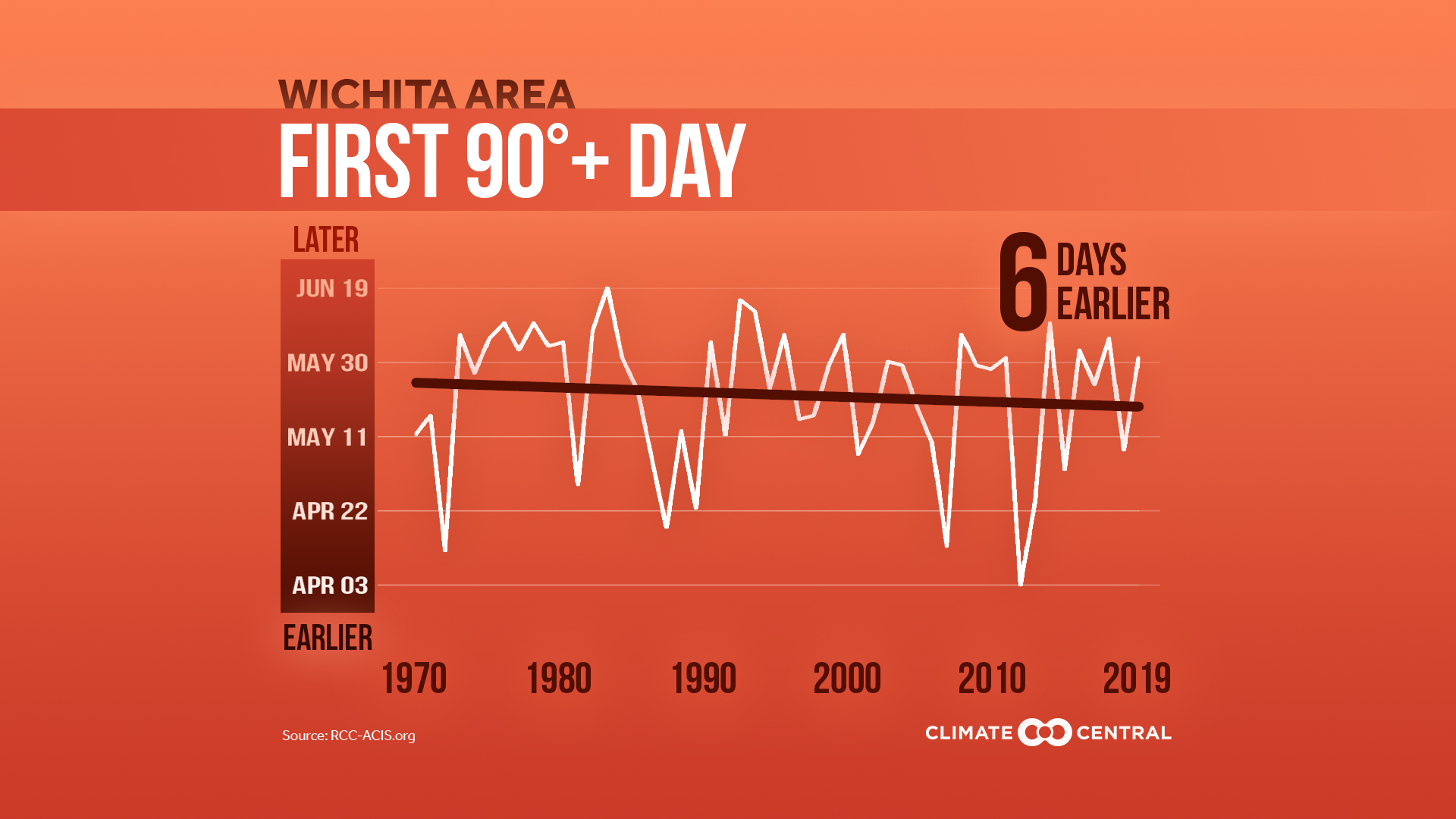
In Wichita, the first day above 90 degrees Fahrenheit is occurring six days earlier than it did in 1970. In Topeka, that day occurs 17 days earlier.
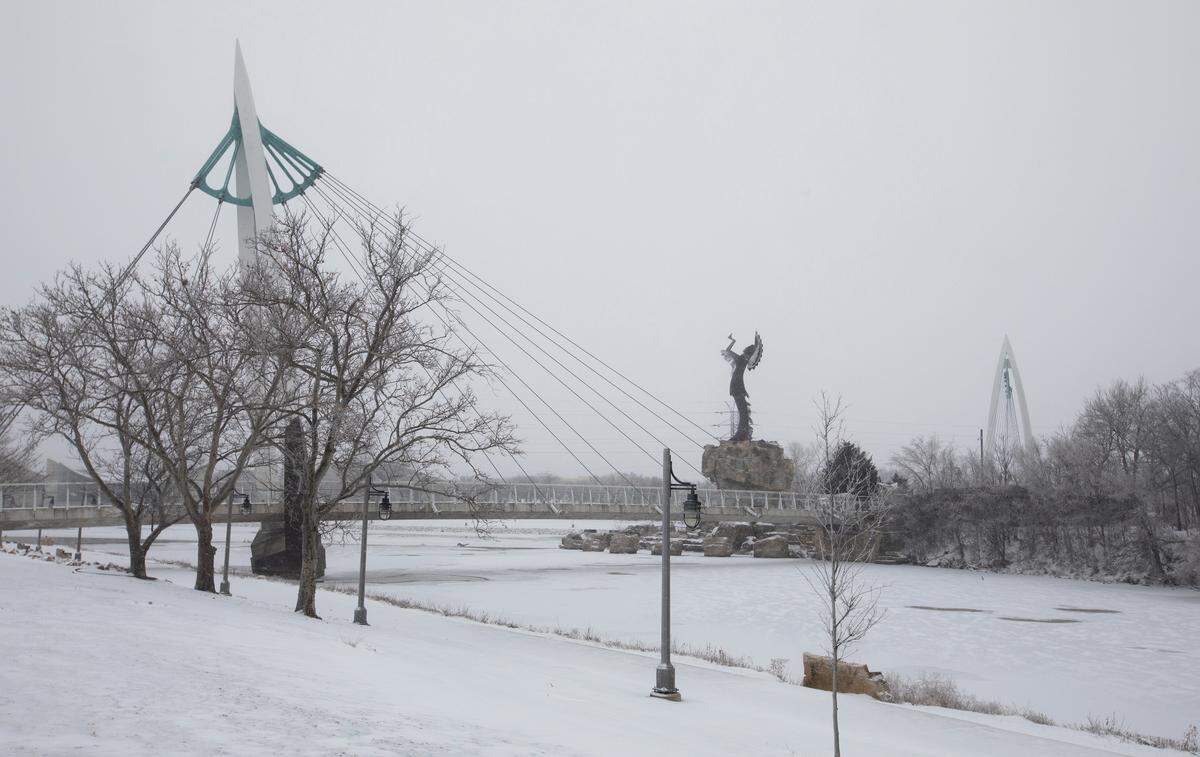
The Keeper of the Plains covered in snow in 2021. The average winter temperature across the continental U.S. has warmed 3 degrees Fahrenheit, since preindustrial levels, according to the EPA. This has resulted in reductions in snowfall and shorter ice seasons. Jaime Green The Wichita Eagle
As the Earth warms, not all seasons are changed the same way at the same rate. Winter is more vulnerable to rising temperatures, according to the EPA and these minimum temperatures have increased at a far higher rate than the maximum temperatures.
Across the United States, spring temperatures have increased by 2 degrees Fahrenheit and fall temperatures have increased by 1.4 degrees, according to the EPA.
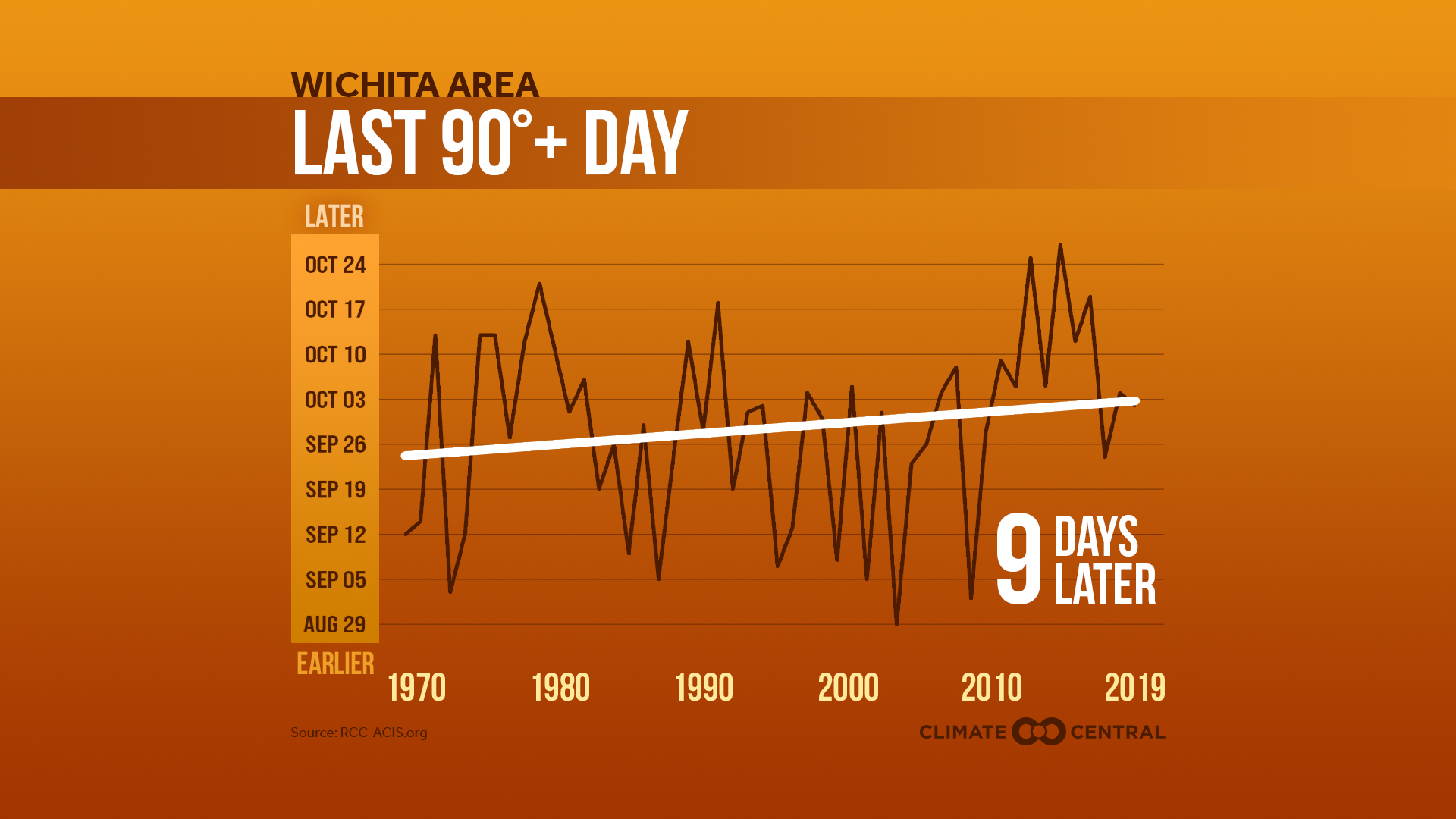
Wichita has been experiencing its last 90 degree Fahrenheit or higher day nine days later than it would have in the 1970s.
Now, Wichita sees this last day around Oct 3, generally when Kansas is beginning to see fall foliage, meaning these higher temperatures are encroaching on fall.
“It’s not like you wake up and every day is suddenly 10 or 12 degrees warmer,” Sublette said. “If we don’t go in another direction, it’s going to be a very different environment than we’ve gotten accustomed to. Kansas may end up a lot more like Del Rio, Texas, or Laredo.”
Help us cover your community through The Eagle's partnership with Report For America. Contribute now to help fund reporting on the effects of climate change in the Midwest, and to support new reporters.
Sarah Spicer reports for The Wichita Eagle and focuses on climate change in the region. She joined the Eagle in June 2020 as a Report for America corps member. A native Kansan, Spicer has won awards for her investigative reporting from the Kansas Press Association, the Chase and Lyon County Bar Association and the Kansas Sunshine Coalition.