Why are Wichita men dying preventable deaths at higher rates than surrounding states?
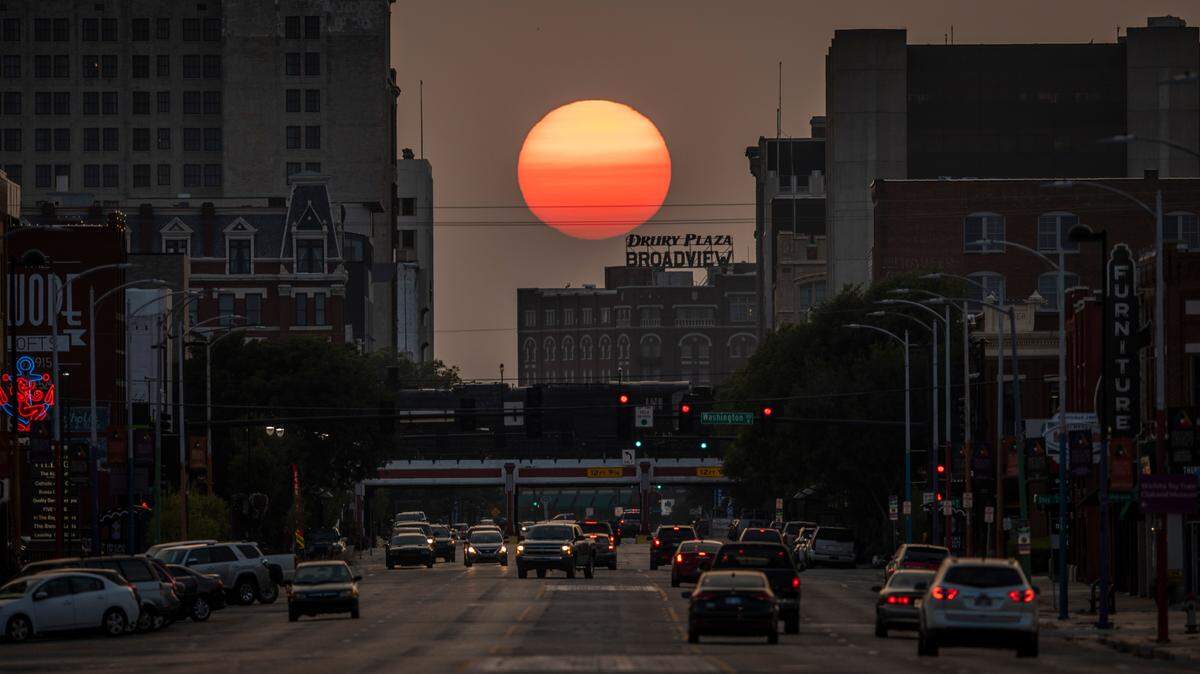
While Wichita doesn’t see many heat-related deaths, and the city is seeing fewer than it used to, middle-aged Wichita men are two to three times more likely to die because of heat than anyone else, a recent study by a Fort Hays State University researcher and others found.
Heat is one of the leading weather killers in the U.S., according to the National Weather Service. While everyone can be vulnerable to heat, young children, older adults, pregnant women and those with chronic medical conditions are at higher risk.
While the study found a decrease in the number of people 65 and older who died because of heat, the number was offset by men ages 45-64, particularly in the south and the southwest U.S., dying from heat at higher rates.
The study appeared in Weather, Climate and Society, a peer-reviewed scientific journal published by The American Meteorological Society. It was written by a team of researchers, including Dr. Grady Dixon, a geoscience professor and dean of The Werth College of Science, Technology and Mathematics at Fort Hays State.
Wichita men died at surprisingly high rates
The study looked at the nation’s largest cities and ran statistics based on their locations and general patterns of death. Wichita was the only city from Kansas represented.
One of the smallest cities in the study, Wichita had fewer excess deaths and a much smaller percentage of its excess deaths coming from heat.
However, when looking just at men ages 45-64, Wichita is the worst city in the central region of the U.S. and had rates comparable to large cities in the Southwest, such as Las Vegas, Phoenix and Southern California.
“In the southwest, it makes sense because those places have extreme heat that’s just getting hotter and they have a lot of people moving to those locations from other places, so they’re not accustomed to the heat,” Dixon said. “Wichita is not that hot and it doesn’t have a huge influx of immigrants from other parts of the country. So that’s why Wichita stands out to me as a problem that’s not expected. We don’t know exactly what’s causing it.”
Nearly all the cities that had the highest rate of vulnerability for middle-age men also had relatively high percentages of low-skill immigrants, undocumented migrants, and large and increasing homeless populations, according to the study. While Wichita was in the upper half of cities analyzed with high immigrant and undocumented migrant populations, the city didn’t have high records of homeless populations, according to Dixon.
“Really this pattern is being driven by cities like Las Vegas, Phoenix and Southern California,” Dixon said. “Those are the ones that are not surprising. We are surprised by Wichita.”
However, these similarities don’t have any proven correlation on the heat-related death rates. To maintain continuity within this multi-year study, Dixon and his team look solely at age and sex statistics, instead of race, ethnicity or income.
The study was researching preventable deaths, which do not make up a large percentage of deaths. The Environmental Protection Agency estimates there are more than 1,300 heat-related deaths each year.
“We are not arguing that this is a driving force behind mortality patterns in a city,” Dixon said. “But my goodness, it is very easy to avoid certain kinds of death, and a lot of them are related to weather. . . . We think these are lives that can be easily saved with proper warnings and communication, and so that’s why we are putting in this effort.”
It could get worse
For two decades prior to 2005, there was a downward trend in the number of heat-related deaths, probably due to improved messaging and awareness, according to the study. But since climate change is causing an increase in the number of heat events, this downward trend has stopped.
“We know it’s going to get worse as the climate warms up and climates shift,” Dixon said. “Maybe they don’t warm up, but they just become different than people are used to, and we have to teach them adapt a little bit.”
Although the paper came out this year, the data is from 2018, as there is a two-year lag time to get the data, according to Dixon.
U.S. cities are experiencing three times as many heat waves in the 2010s as they did in the 1960s, according to EPA data released earlier this month.
“Everybody has a story about the hottest time they experienced,” Dixon said. “Those usually happen in August and by August, we’re pretty used to dealing with warm weather. . . . Just because you survived the highest number ever two years ago doesn’t mean you’re ready for 95 degrees in late April. It’s all about how your body has adjusted recently.”
This study is part two of a 2017 study, where the researchers found that people in the U.S. were taking heat warnings more seriously, and therefore dying less frequently from heat. But at the time, they had predicted there was going to be a turn for the worse because the U.S. had hit a point where most people have access to air conditioning, there has been a proliferation of heat warnings in media, meaning they had hit their peak in communication, and climate change is going to cause more heat events.
However, the new study, published this year, suggests that there is still room to grow where communication can help because they believe an increase in communication is what has dropped the number of people over 65 who have died from heat-related illness. In contrast, middle-aged men have become more at risk.
What can be done
Vanessa Pearce, a forecaster with the Wichita Weather Service, has been working with the National Weather Service on a unified heat strategy, developing messaging around heat and creating more tools to use to help people understand the risks.
“One of the tools is heat risk, and we don’t have heat risk available in Wichita,” Pearce said. “Right now it’s primarily used on the west coast, but it will be used across the Weather Service more.”
Heat Risk is an experimental tool that the NWS has started using. Like air quality risks, it measures how risky it is for individuals to be outside based on their different vulnerabilities and reports it on a scale from 1 to 5.
“We’re doing multiple steps within this to try to better how we communicate heat because it is defined as the silent killer,” Pearce said. “You can’t see it. It’s not necessarily taken seriously all across the country.”
The National Weather Service has information on how to stay informed and to stay safe during excessive heat events, which can be found on their website, and include recommendations to minimize sun exposure, such as wear loose-fitting clothing and eat light and cool foods, such as salad and fruit.
“Everybody is really vulnerable to heat, and it’s a matter of you, making sure that you’re taking the proper precautions, you’re avoiding being out in the heat of the day, if possible,” Pearce said. “If you’re working making sure to take adequate breaks and hydrating.”
Dixon and his colleagues will continue to work on the project, releasing more studies as they can get the data.
“We certainly hope to update this, but also in the meantime try to do more questions in a different way so that we can maybe gain some insight into what we’re seeing,” Dixon said.
This story was originally published May 24, 2021 at 4:23 AM.