
Wichita has new rules for reporting contributions. So far, candidates haven’t followed them

AI-generated summary reviewed by our newsroom.
- All seven Wichita council candidates missed or misfiled new city finance reports
- Candidates filed state reports but some failed to list LLC owners required by city
- Delays and unclear guidance hampered enforcement ahead of Nov, 4 election.
All seven candidates on the November ballot in Wichita City Council races have failed to follow the city’s campaign finance ordinance, The Wichita Eagle has found.
The candidates filed their typical, state-required reports showing campaign fundraising and expenses with the Sedgwick County Election Office. But they have not followed new city rules that were supposed to add transparency to elections, specifically about donations from business owners who “stack” contributions by giving the maximum amount to candidates multiple times using different limited liability companies, or LLCs.
That wasn’t the only problem. From missed deadlines to incorrect filings, to not reporting at all, the lack of compliance with the city ordinance underscores a lack of clarity surrounding City Hall’s new role in policing political contributions.
The Wichita City Council adopted changes to the campaign finance ordinance in 2024, reversing a shortlived ban on corporate money in local politics. The council voted unanimously for the changes after reaching a compromise on stricter reporting requirements that would allow the public to see who was behind typically pseudo-anonymous contributions from limited liability companies.
But, in the first city election cycle with the new transparency rules, the LLC donors largely remain a mystery without extensive additional research of state business filings.
Candidates who have accepted LLC money have failed to file reports listing by name business owners who gave money this year.
And even if they had filed, the city didn’t make them available to the public until Oct. 15, after The Eagle requested them Oct. 3, a month before the November election. The only disclosure that lists LLC owners — filed by council member Maggie Ballard — is from 2024, an off year for city elections.
City officials say that will change and that they are prepared to begin enforcing the city ordinance for the first time this year. Candidates must now file additional campaign disclosures with the city clerk.
Megan Lovely, city spokesperson, said the city is poised to enforce the ordinance for violations if candidates fail to respond to city requests for compliance going forward. But, given the confusion, the city is more focused on education.
“At this point, we’re really looking at education and compliance,” Lovely said. “We’re not looking to be punitive. We just want the information transparent and available to the community.”
What Wichita City Council candidates filed, and didn’t file
LaWanda DeShazer, a candidate in District 1, appears to have most closely complied with the city ordinance, which differs slightly from state law. DeShazer filed reports covering all of 2024 and the first half of 2025. But she didn’t turn in her January report to the city until late June. It was due Jan. 11. She did not accept any LLC contributions and could follow the city ordinance by simply filing with the city what she submitted to the election office.
“I have a qualified treasurer, and I entrusted her to take care of my finances,” DeShazer said. “I’ve been very happy with her services.”
Joseph Shepard, the other candidate in the District 1 race, filed a July report with the city more than two months after the due date. The report failed to include the name of the principal owner of a business — The Monarch — that donated to his campaign, as is required by the ordinance change.
“My understanding was that we would be able to do that for this final finance report from the primary to the general,” Shepard said. “I may have misread that, but yes, 100 percent, if that is something that needs to be done, we will do it. It’s not a question whatsoever.”
At least Shepard filed a report.
Outside the District 1 race, no one had submitted a campaign finance report to the city for funds raised and spent in 2025, according to copies of filings provided by the city.
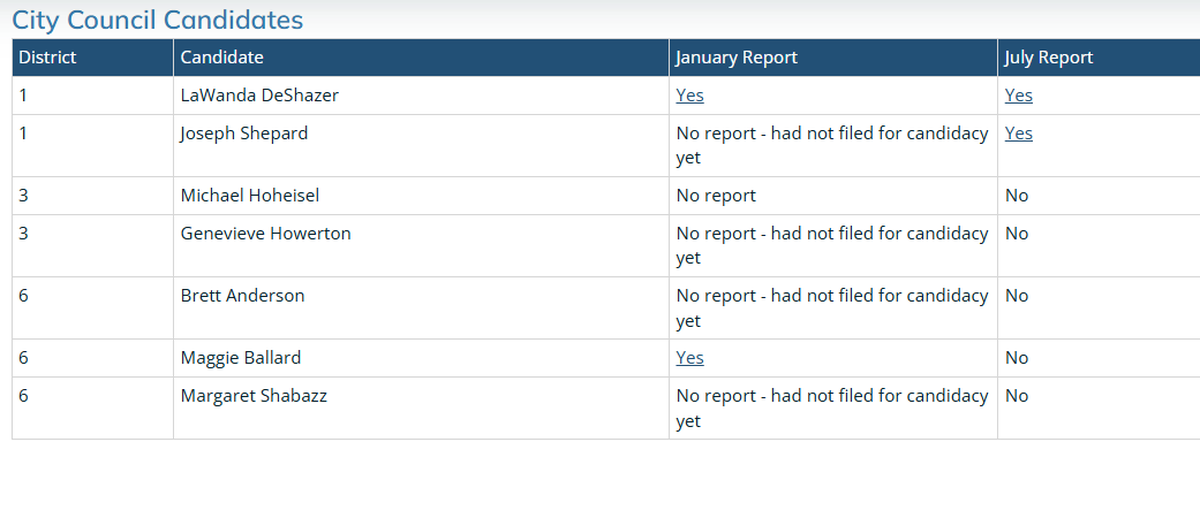
Candidates have filed reports with the Sedgwick County Election Office in compliance with a state statute. But the city’s rules require candidates to also submit reports to the city clerk within 24 hours of state and county deadlines. The city filings require more detail, including the names of principal owners of businesses giving to campaigns.
City Council members voted for changes, have not followed them
Incumbent council members Mike Hoheisel, District 3, and Ballard, District 6, both voted to ban corporate money from city council races. Then they both voted to allow it again in March 2024 with the new reporting requirements.
They both appear to have failed to follow the rules they voted for last year. Neither appears to have filed a required report with the city listing contributions and expenditures covering the period from Jan. 1 to July 24, 2025. The reports were due to the city by July 29.
Ballard said she believes she filed her reports properly and that a personnel change in the city clerk’s office may have led to her form being misplaced.
“I will check ASAP,” she said in a written statement. “If the report was not received, I will have this corrected, but I filed it timely.”
Hoheisel said he thought his campaign needed to file a report with the city clerk only if he received money from an LLC, which he did not during the January-to-July fundraising period.
“It was such a muddled discussion when we had it,” Hoheisel said of changes to the campaign finance ordinance in early 2024. “I was under the impression that we would submit our reports to the county (election office) and it would be shared from there, and only if we had any LLCs on our list was when we needed to report to with the city.”
Ballard is the only candidate who has listed business owners’ names in a filing. She filed a report with the city clerk for contributions received in 2024. The report was due by Jan. 11, 2025; Ballard submitted it in June 25, more than five months late, according to a June 25 stamp of receipt by the city clerk’s office. That report included $5,000 in donations from developer Jay Russell on Sept. 17, 2024. He was able to legally contribute ten times the $500 limit by giving through ten different limited liability companies.
Within four months, in January, Russell had business before the council for a project in Ballard’s district. With Ballard’s support, the city committed to spend at least an additional $1 million on the Crystal Prairie Lake park project near several of Russell’s housing developments in northwest Wichita in exchange for Russell giving the city $1 million to help fund the project.
Ballard said in her written statement responding to questions that the contributions from Russell had no effect on her decisions as a council member.
“No contribution to my campaign ever influences my vote,” Ballard wrote. “I will vote against a donor easily if it doesn’t help my district.”
Hoheisel and Ballard’s opponents have also failed to submit their campaign finance reports with the city clerk.
Genevieve Howerton, who is challenging Hoheisel in District 3, and Brett Anderson and Margaret Shabazz, who are challenging Ballard in District 6, had not yet filed to run when a January finance report was due for the 2024 period. They did not turn in a report for 2025 that was due to the city on July 29.
Howerton, Anderson and Shabazz did not respond Friday afternoon to phone calls and emails.
‘Whatever the rules are, candidates have to follow’
A violation of the city’s campaign finance ordinance can carry penalties, including up to $2,500 in fines per violation and up to a year in jail, according to the city ordinance.
Lovely said the city was not actively monitoring or enforcing the ordinance until questions arose earlier this month about candidates accepting more than $500 from a donor (a new state law says candidates can accept $2,000).
“Up until now, it has been complaint-based, which is why we’re now doing this process,” she said. “We’re looking into ensuring that staff is, to the best of their ability, ensuring that this is accurate. But any information we’re given by candidates we trust and assume is correct.”
The city’s new web page includes a complaint form residents may fill out if they suspect a violation of the city’s campaign finance ordinance.
The next filing deadline is Oct. 27 for the county election office and Oct. 28 for the city clerk’s office.
DeShazer said the fact that she filed complete forms as required by law “says a lot” about how she will conduct herself as a council person while Shepard said he thinks the problems say more about the lack of clarity from City Hall.
“I think people have honest learning moments,” Shepard said. “I’m going to assume all seven of us did not purposefully violate this.”
DeShazer said it’s up to candidates to know the rules for the office they’re seeking, whether they’re clear or complicated.
“People are relying on us,” DeShazer said. “And if we can’t do things in an ethical manner, we hear people make excuses. ... ”
“At the end of the day, we need to make sure that whatever the [law says], it needs to be adhered to,” she said. “Whatever the rules are, candidates have to follow.”