
Wichita City Council candidate returns campaign cash amid confusion over finance rules
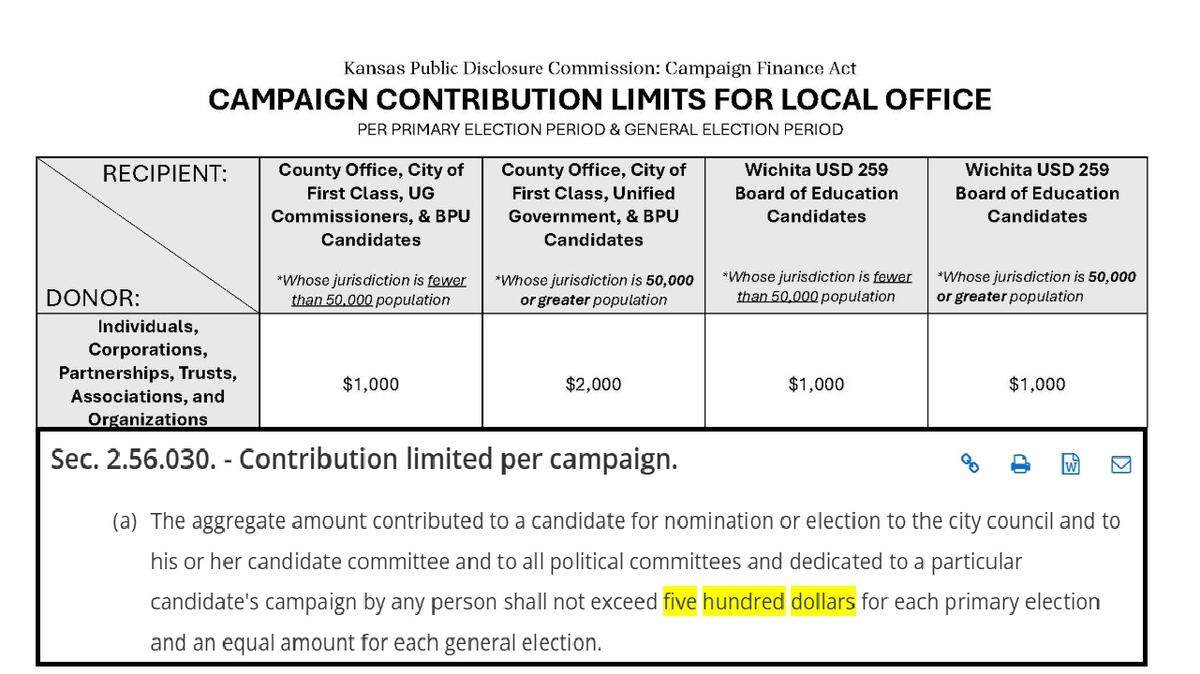
Confusion over changes to Kansas campaign finance law has led to accusations of wrongdoing and a return of campaign donations in a Wichita City Council primary.
The Kansas Legislature voted in March to increase limits for political contributions from $500 to $2,000 for large city elections, and Gov. Laura Kelly signed it into law in early April.
But a Wichita city ordinance that was in place before the changes caps contributions for city council candidates at $500.
The conflicting rules have led to controversy: Wichita City Council District 1 candidate Joseph Shepard returned $620 in campaign donations and made other changes to his disclosure forms after City Hall watchdog Celeste Racette, who is supporting his opponent in the race, accused him of violating campaign finance laws during the primary election by accepting more than $500 from donors.
None of Shepard’s contributions approached the state’s new $2,000 limit, and he said he is now in compliance with the city ordinance’s lower limit after filing an amended report.
Shepard said he made the changes out of an abundance of caution and to alleviate any concerns voters might have, although he believes he was operating well within the limits of a state law. And he pointed out that he’s not the only candidate who took more than $500 from a contributor.
District 6 incumbent Maggie Ballard accepted a $1,000 donation from Robert Foster a week after the governor signed the new limits into law. She accepted a separate $25 from the same donor. She said she has no plans to return the $1,000 donation after consulting with City Attorney Jennifer Magana and the state’s Public Disclosure Commission. After this story originally published on Kansas.com, Ballard said she plans to return the $25 donation.
“(The Public Disclosure Commission) left it to me to know what our local ordinance said but did tell me that under the new state law, we can take the maximum contribution from an individual during the primary as long as we don’t spend it until the general,” Ballard said.
Ballard said she believes her campaign is in compliance.
“We used to have to refund the contribution and the person would have to give again after the primary,” she said. “With the state law change, we just kept note of contributions that couldn’t be spent until after the general. Since local law is silent on this, I don’t think there’s a conflict.”
How does Wichita’s home rule play into finance debate?
Candidates have long relied on the Kansas Public Disclosure Commission — previously the Kansas Governmental Ethics Commission — to advise them on campaign finance rules. Sometimes they call the local election office, where they have to file campaign finance reports.
But this year, the city of Wichita could take on a more active role in enforcing election law, because its own ordinance no longer mirrors state law.
Shepard says state and county election officials told his campaign $2,000 was the contribution limit. It wasn’t until Racette raised objections on Facebook that the city law department set up a complaint form and enforcement process for any violations.
Magana, the city attorney, said candidates were put on notice of the city’s $500 limits when they filed for office.
“The city ordinance is in effect,” Magana said on Friday. “An ordinance is presumptively valid. Candidates were given notice of the city’s ordinance after they registered or filed in June. So it’s the city’s position this ordinance is in effect.”
The ordinance says any violations could result in a fine up to $2,500 and up to one year in jail.
It’s unclear whether that ordinance would stand up to legal scrutiny.
Cities in Kansas have home rule power that allows them to pass more restrictive laws than the state, but that typically requires adoption of a charter ordinance with a two-thirds majority vote by the council. A charter ordinance requires more legal publications and is subject to a protest petition that could force a ballot question on the changes.
The city’s campaign finance ordinance — last changed in 2024 — was passed by a simple majority with no opportunity for the general public to protest.
Magana said the regular ordinance remains in effect until the council changes it or someone successfully challenges it in court.
“There is a framework for home rule in Kansas,” Magana said. “There is a series of questions and processes, and I can’t really speculate on how this would play out until and unless there was a challenge in court. So it just depends on how someone would frame any petition.”
Shepard said he didn’t want to be a “litmus test” for challenging the city ordinance in court.
Shepard carried nearly 48% of the votes in the five-candidate primary and was the top fundraiser in the crowded field, raising $39,682.94 from January 1 to July 24. Second place finisher LaWanda DeShazer received 20% of votes in the primary while raising less than a quarter of Shepard’s funds during the same fundraising period. They will face off in the general election on Nov. 4.
‘We’ve amended our report,’ Shepard says
Between March and July of this year, Shepard accepted more than $500 from seven individual donors, Eagle research found. That’s two more than Racette found in her check of Shepard’s campaign disclosures. None of the donations totaled more than the $2,000 allowed by state law.
The city says that’s not allowed while state election officials have been telling some campaigns that a new state law allows candidates to accept up to $2,000. Shepard said he was not aware of the option to hold on to some funds until the general election, as Ballard said she planned to do.
“We’ve amended our report to reflect what is in alignment with the city ordinance,” Shepard said in a phone interview. “(The city’s $500 limit) — It’s not a charter ordinance, and certainly if the city were to take action, this could result in, like, a legal battle and, long story short, I knew that, and I knew I could say I’m not going to do anything with my report.”
“The reason why we decided to move forward with amending the report is because I would much rather bring ease to the hearts and minds of folks who are concerned and focus on this race and focus on the issues that are at stake here. And if that means I have to return money to do that, to remain in compliance with the city ordinance, I will do that.”
Shepard’s amended report shows he returned $120 to LaTasha St. Arnault and $500 to Johnathan Hutton. Total expenditures increased by $620 as a result, and the cash on hand amount decreased by the same amount, with more than $4,000 remaining at the close of the primary fundraising period.
“When we went back and amended the report, what we were able to do is go back and and check to ensure that it was in alignment with city ordinance,” Shepard said. “And those individuals whose dollars were not returned are married, and so it’s $500 per person. And so the individuals whose dollars we did not return and their spouses did agree to make sure that those donations were also part of their give.”
Additional donations above $500 were reallocated among the spouses of Amy Cox, who gave $645, John Gregory, who gave $690, Danielle Johnson, who gave $620, Jennifer Ray, who gave $525, and Jamie Schmaltz, who gave $1,000.
This story was originally published October 7, 2025 at 9:47 AM with the headline "Wichita City Council candidate returns campaign cash amid confusion over finance rules."