Kansas Democrats think Kelly can boost their 2020 candidates. But will she help?
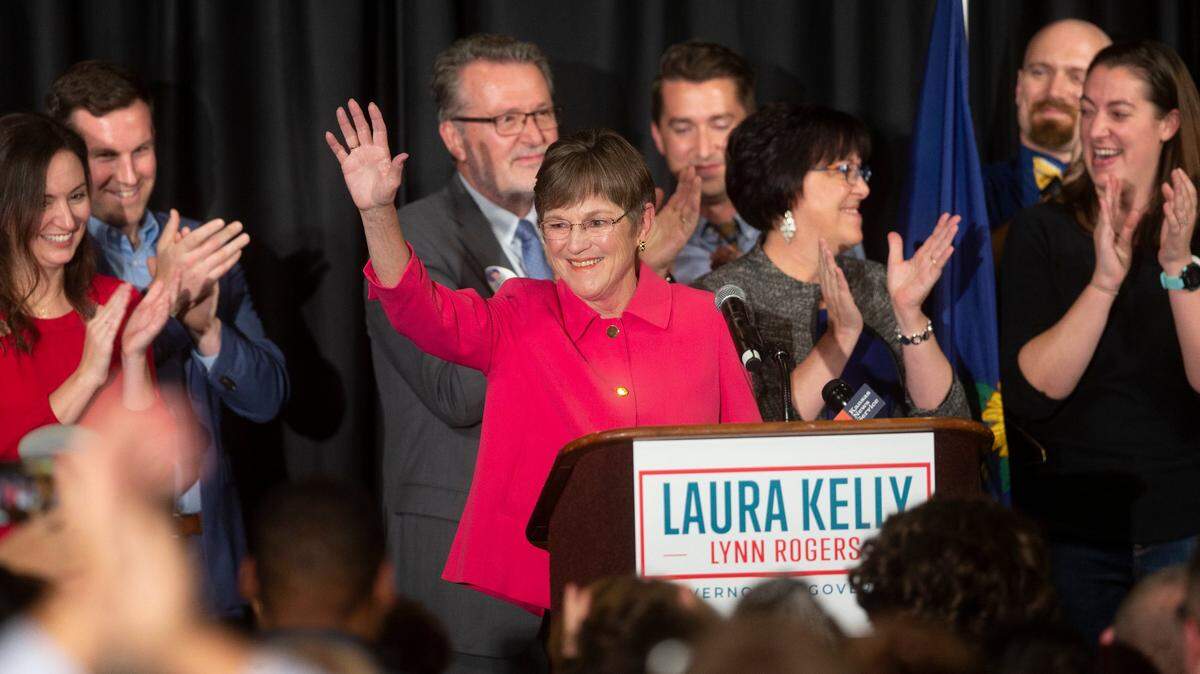
Laura Kelly decisively won the Kansas governor’s election in 2018, returning the office to Democrats after eight years of conservative Republican control.
Kansas Democrats are hoping she can do it again – this time for lawmakers. But Kelly isn’t saying whether she’ll help.
For the first time in eight years, a Democrat will be sitting in the governor’s office when voters head to the polls in November. Democrats believe Kelly can deliver a boost to the party and its candidates heading into a critical election.
Every House and Senate seat is on the ballot and, as always, Democrats aspire to cut into the Republican majorities in both chambers. Democrats hold 41 of 125 House seats. In the Senate, 11 of 40.
While no one expects the party to take control of either chamber, Democrats are close to denying Republicans a veto-proof majority.
Adding to the election’s importance, Kansas is about to enter the once-a-decade process of redrawing legislative districts. November’s results will determine which lawmakers will vote on new district maps in 2022. The more Democrats who win this year, the more influence the party will wield.
Past governors have made a difference in legislative races. Gov. Sam Brownback and fellow conservatives helped purge moderate Republicans from the Legislature in 2012. Democrats acutely felt the absence of Govs. Kathleen Sebelius and Mark Parkinson after they left, said Bob Beatty, a political scientist at Washburn University in Topeka.
“You can’t overstate how vital it is for the Democrats to have Laura Kelly there,” Beatty said.
Kelly so far isn’t willing to commit publicly to any level of involvement in legislative races this year.
In an interview, the governor said her focus is on helping fix the state. She called herself “probably about the least political governor you’ve ever had” in Kansas.
“I’m realistic enough to know that I will be asked to be involved in a variety of those (races) and no decisions have been made about how or if I will do any of that,” Kelly said.
She added that she’s interested in “thoughtful, reasonable, motivated folks to come into the statehouse so that we can work together regardless of which party they are.”
“If I do anything, it will be to get folks like that elected,” Kelly said.
Kelly’s own gubernatorial campaign remains active. It regularly sends “Team Kelly” emails soliciting contributions, including one as recently as Friday focused on the Medicaid expansion deal she announced the day before with Senate Majority Leader Jim Denning.
Pressure on Kelly to help legislative candidates will likely only intensify as the election approaches.
“I think because this is an election year and both houses are up, it’s increasingly important that the governor get behind recruitment, get behind helping raise money for coordinated campaigns and legislative races,” said Joan Wagnon, a former Kansas Democratic Party chairwoman.
Vicki Hiatt, the current party chairwoman, said Kelly “has a lot on her plate.” She said she doesn’t see stumping or fundraising for candidates as a priority for the governor.
But there are signs that Kelly is open to becoming involved. In November, she appeared at a news conference hosted by Johnson County Democrats that highlighted more than two dozen women running for the Legislature. Women currently hold less than 30 percent of legislative seats in Kansas.
Hiatt said having Kelly in office has by itself helped candidate recruitment and generated enthusiasm.
“For me, personally, as a woman I am extremely pleased to see the number of women stepping up to run and I think they just see with the election from last year, having some strong and confident and thinking, thoughtful women win elections has been extremely helpful,” Hiatt said.
After a full year in office, Kelly has built a list of accomplishments. She’s reinstated protections for LGBTQ state employees, worked with lawmakers to resolve a long-running lawsuit over school funding and just reached a compromise on Medicaid expansion.
She remains relatively popular with voters. After defeating Republican Kris Kobach by 48 percent to 43 percent, Kelly has an approval rating of 52 percent, according to polling released this fall by Morning Consult, the political news site.
Democrats want to harness those accomplishments and popularity to propel their legislative candidates forward. One way they can do that is by telling voters that their candidates will protect Kelly’s agenda.
“Having the governor means that you get to make a pitch ... the pitch is going to be: elect just a couple more of us and every veto that Gov. Kelly (issues) you know will stand,” Chris Reeves, the state’s Democratic national committeeman, said.
Republicans currently hold 84 seats in the House – the exact number needed to override a veto. Democrats would only need to a net gain of one seat to ensure Kelly’s vetoes stand.
The winners in November will also be asked to vote on new legislative maps. The stakes are considered high enough that the last round of redistricting ended up in federal court.
If Democrats can deny the GOP its veto-proof majority, it will give the governor much greater influence over the redistricting process.
The election is 11 months away, but Democrats are already pointing to signs of energy on their side. On Friday, the House Democrats’ campaign operation announced it had raised roughly $130,000 in 2019, more than the last two off-election years combined. House Minority Leader Tom Sawyer, a Wichita Democrat, called the figure “an incredibly strong start to 2020.”
For their part, Republicans dismiss the idea that a Democratic governor will cause difficulty for them in legislative races.
Kansas Republican Party chairman Mike Kuckelman said going into an election year with a Democratic governor won’t hurt the party, but acknowledged it means the party won’t have the help it would normally have from a GOP governor.
“It’s not going to hamper us in a significant measure,” Kuckelman said. “Of course, I would prefer to have a Republican in the governor’s office, that would be helpful to us.”
House Majority Leader Dan Hawkins, a Wichita Republican, said there are pockets of the state where Kelly might affect races, such as in the 3rd Congressional District, which Democrat Sharice Davids won in 2018.
One contest where Kelly is already a factor is in the Johnson County state Senate race between Democrat Cindy Holscher and Denning, the Senate Republican leader. Denning just cut a high-profile Medicaid expansion deal with Kelly. Holscher, a state representative, reacted to the plan by praising Kelly but didn’t mention Denning by name.
Asked if the Democratic governor may help some Republicans, who could make the governor into a campaign issue, Hawkins indicated it might.
“That’s the one I thing I would say about the governor: she’s the gift that keeps on giving,” Hawkins said. “She just keeps coming out with more and more stuff.”
Star reporter Sarah Ritter contributed reporting
This story was originally published January 13, 2020 at 11:32 AM.