‘Fast and Furious crowd’: Illegal racing on Wichita roads a growing problem, cops say
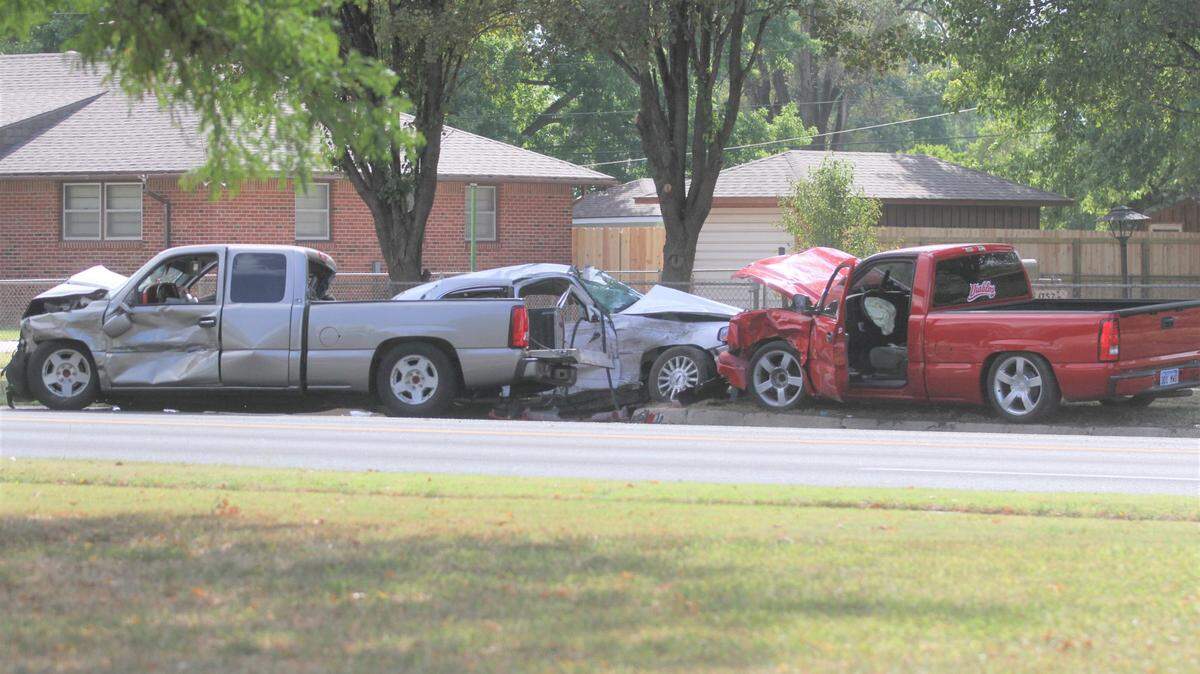
Brandon Carrera had just gotten a new set of tires on his red Chevrolet Silverado when a tan truck pulled beside him on the curved stretch of 21st Street that turns into West Street on Aug. 29, 2020.
The 22-year-old recognized the other driver, a teenage friend, and exchanged words with him.
Then they mashed on the gas and took off. The authorities say it was a case of illegal street racing.
Moments later, 94-year-old Ralph Hunt Jr. — a dairy farmer, trash service founder and local pastor — was dead, his white Lincoln Town Car reduced to mangled wreckage on a four-lane city street that has a posted speed limit of 40 mph.
Police say both trucks were moving twice that fast when they slammed into Hunt at West and 17th, their engines full throttle. The force of the crash was so great that in addition to killing Hunt, it left a 15-year-old boy in the Lincoln’s passenger seat with a broken neck, ribs and hips and ruptured internal organs.
Hunt is one of at least four people who have died or been injured in Wichita over the past year in traffic crashes involving illegal racing on city streets, prompting police to place renewed attention on an old problem. Many more unsuspecting drivers, pedestrians and racers have been seriously hurt or killed in illegal racing wrecks over the past four decades, The Eagle’s news archives show.
But the exact death and injury toll is hard to quantify because local law enforcement agencies don’t track those incidents specifically and racers often aren’t cited under the local and state laws that forbid these illegal shows of speed because other crimes carry stiffer penalties. Although racing is a misdemeanor, a conviction under the city ordinance is punishable only by a fine of up to $500. The state statute doesn’t mention any specific penalties.
Street racing data hard to pin down
Exactly how often street racing occurs is also unclear. Complaints are often tagged as miscellaneous reports in the police department’s record keeping system and crashes tend to be classified under the broader umbrellas of speeding and reckless driving. The Kansas Department of Transportation, which collects data on injury and fatality traffic crashes statewide, similarly lumps racing incidents into its reckless and careless driving category instead of breaking them out.
Yet, local officials say the number of illegal street racing incidents in Wichita is growing, fueled by social media and popular culture that makes it look like a cool pastime to thrill seekers and showoffs, with alarming results.
“It’s kind of an underbelly thing that has been growing slowly for the last couple of years,” Sedgwick County Assistant District Attorney Aaron Breitenbach said, adding that the recent uptick may also be due to teens and young adults having “extra time on their hands” since the COVID-19 pandemic changed their school and activity schedules.
“The one thing they have access to is a car or motorcycle,” he said.
But catching violators is often difficult, police and other officials say, because many races are either spontaneous or word about planned events is shared in social media groups or message threads shortly before they take place. Sometimes police don’t know about a race until video of it shows up online later.
In cases where the authorities receive a complaint about racing as it’s happening, those involved are often long gone by the time officers get there. Some racers and spectators also won’t seek medical help if they’re hurt, aren’t truthful about how they were injured, won’t call 911 or cooperate with law enforcement investigations, contributing to the lack of complete data on the frequency and reducing the chance of successful prosecutions.
There are also cases where prosecutors haven’t filed charges “because the only people who are witnesses are participants, so they’re not going to cooperate,” Breitenbach said.
In one local case he recalled, motorcyclists took off after a race participant got into a wreck bad enough to lose a limb. “They just left him there.”
In others cases, “they pick themselves up, their friends load them in the back of the car and nurse them back to health on their own or take them into a hospital and lie about how they got injured,” he said.
Although the Wichita Police Department has no statistics on illegal street racing incidents that show any trend over time, traffic division supervisor Sgt. Keith Fort said the city’s crash fatalities since Jan. 1 “have been more related to the racing.” He mentioned three cases involving injuries or deaths.
Where racing is happening in Wichita
While complaints have sprung up across the city — stoplights on downtown streets and busy roads flanked by homes and apartments are popular takeoff spots for spontaneous contests — authorities say racers mostly stick to the city’s outskirts, where long stretches of flat, unbroken blacktop let them reach high speeds with the fewest distractions.
Racing vehicles can hit speeds of 50 to 90 mph, or more, within seconds.
“At that type of speed, it puts everyone at risk, not just that particular driver,” Fort said.
Twenty years ago, parts of West Street and industrial and county roads that were mostly empty at night were among epicenters for illegal racing in the area. More recently, Greenwich, Rock and Webb roads between Central and 13th and stretches of K-42 highway have become favored spots.
Usually street races last a quarter or a half mile, Fort said. They can be planned events or occur spontaneously when drivers who might not know each other but want to challenge their cars’ performance pull up to a stoplight simultaneously and give a “let’s race” signal, like nodding or revving engines.
A solo driver might also race against the clock.
Many races happen in the evening and nighttime hours on weekends, but not all — causing further worry about the risk to innocent bystanders. The racing-related crash that killed Hunt, for example, happened in the mid-afternoon on a Saturday. Carrera and the other driver, whom The Eagle is not naming because he is a minor, were charged with involuntary manslaughter and other crimes earlier this year in connection with the crash.
A 9-year-old boy who was injured on April 1 by two trucks racing down Meridian near 31st Street South as he crossed the street was hit on a Thursday around dinnertime. Both of those drivers, minor teens at the time of the crash, have each been charged with aggravated battery, court records show.
The “Fast and Furious crowd”
Although speeding in the city in general has been a concern for police, they’re particularly worried about illegal racing because of the preventable injuries and deaths tied to recent cases, which overwhelmingly involved drivers who are young and male.
The racers in the Meridian collision that hurt the 9-year-old in April and those involved in a fatal collision on March 20 at Central and Greenwich were all teenagers. Brennan Peshek, 18, who was racing his yellow Mustang against a 19-year-old in a silver Pontiac Grand Prix died in the March crash after the lane he was racing in ended. He struck a curb and slammed into a tree and pole, police said previously. As of Friday no charges had been filed in Sedgwick County District Court in that case.
The drivers in the crash that killed Hunt also fit the young, male demographic.
Breitenbach calls the young racers the “Fast and Furious crowd,” after the popular multiple-movie franchise that has captivated audiences with its romanticized take on illegal street racing since Hollywood released the first installment in 2001.
“I’m always amazed by the young men that I know who are like, ‘Oh yeah, I watched all eight of them, or however many (Fast and Furious movies) there are,” he said.
“It’s their Star Wars.”
One of the problems with racing on city streets at those speeds is that it’s difficult for other drivers and pedestrians to judge exactly how quickly racing vehicles are moving because they’re used to the slower, posted speed limits, Fort said.
An unsuspecting motorist might think they have time to cross a street or turn without getting hit by oncoming traffic.
Or a child might think they have time to cross the street on foot or a bike.
“But in reality, they don’t,” Fort said. Staying aware of surroundings is the only way for bystanders and other motorists to protect themselves, other than calling 911 when they see speed contests going on, he said. But even that sometimes isn’t enough because the crashes happen so fast.
Racers who aren’t familiar with the condition of the roads they’re traveling down adds to the concern because they don’t know what to watch out for.
“Just the minutest shift in a road or a hole can cause you to lose control of your vehicle at that high rate of speed,” Fort said.
“If you lose traction or you run off the road, you’re going to come to an abrupt stop and get yourself hurt really bad or even killed.”
Working on solutions
Police say they’re working on solutions to curb illegal street racing and speeding in the city in general.
In recent months, Wichita traffic officers have conducted several early-morning special assignments targeting Kellogg speeders and put messages on the city’s electronic highway signs warning people to slow down, Fort said.
The department also sometimes sets up roadside devices that monitor vehicle speeds in areas where residents have complained, he said. While those devices don’t do anything to catch individual motorists breaking the laws, they do let police know what times of day speeding peaks so officers can run targeted enforcement that might catch illegal racers, Fort said.
Nearly 20 years ago, after the city saw several deaths tied to illegal street racing, Wichita police pushed to add teeth to the local ordinance outlawing it. It isn’t exactly clear from media reports what became of those efforts — whether they fizzled or were voted down — but they don’t appear to have led to any long-term changes in penalties or racer behaviors.
Nothing appears to have changed at the state level over the years, either.
“The current statute makes it against the law, but it doesn’t really penalize it. Maybe the legislature will have to look at that,” Breitenbach said, adding that he knows of no current legislative bill under consideration that would make either racing or reckless driving a felony.
Because penalties for street racing aren’t especially stiff, when police do catch racers they tend cite them for crimes with more robust punishments like reckless driving, which carries a mandatory minimum penalty of five days in jail and up to 90 days for a first conviction, and at least 10 days and up to six months for a second offense, Breitenbach said.
A safer option for racing
As for what racers can do, officials say the answer is simple: Take it to the track.
Dave Dockens of the Kansas International Dragway says he gets why racers are tempted to test their speed on city streets. He did it, too, as a young kid “because it was exciting.” He said a lot racers feel the street is “an even playground” to test speed and the real performance of vehicles that might not be evenly matched on the track.
Dockens said he eventually realized the risk of people getting hurt or killed, plus the consequences a wreck could have on his own life and job, was too great to keep it up.
At 55, he now focuses on getting people to the Kansas International Dragway track, where races run several times a year in a controlled arena with safeguards.
Last year, the number of events held decreased due to the pandemic. But Dockens says he is actively searching for sponsors, including one to buy naming rights to the facility at 7800 W. 61st St. North in Maize, so the track can hold more races and decrease entry fees for participants, which are currently $30 to $35.
Anybody with a vehicle that can pass a basic safety inspection is welcome. He just encourages people to bring a helmet.
“You don’t need a special vehicle. You can bring in any car you want and race.”
This story was originally published May 9, 2021 at 4:19 AM.