
Century’s worth of historic ‘trash’ unearthed during Orpheum Theatre restoration
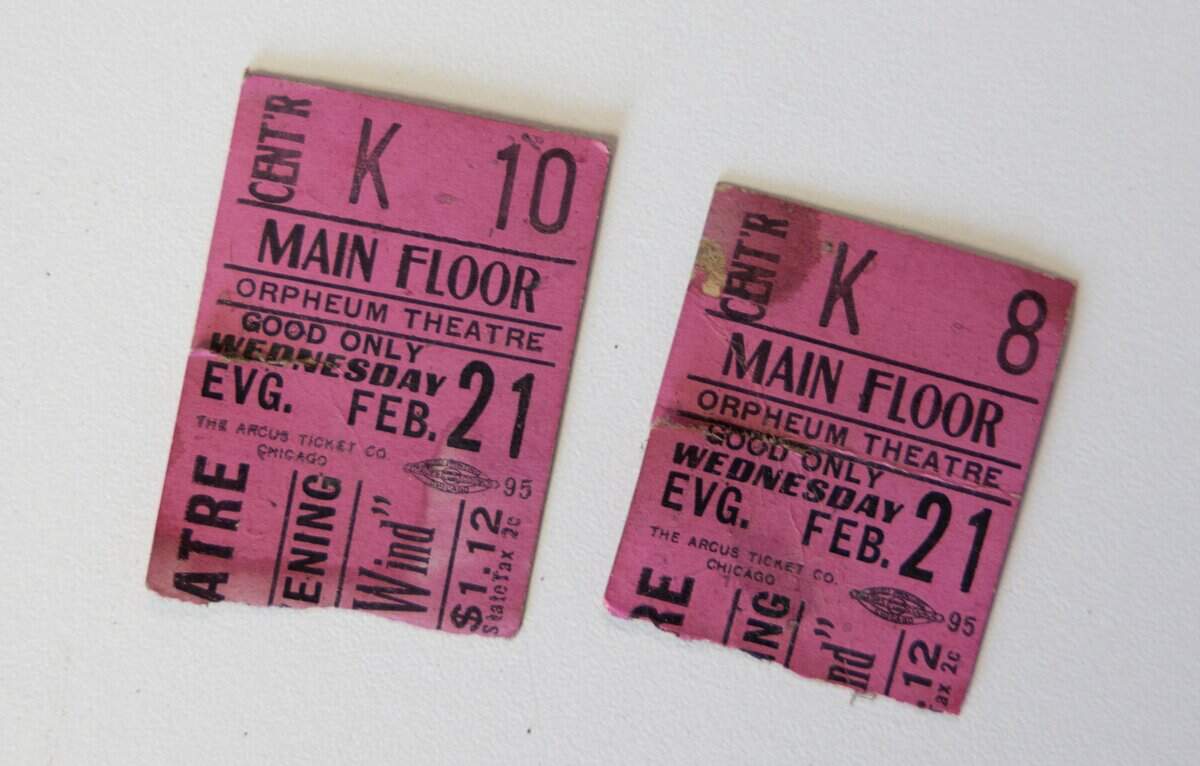
They sat in seats K-8 and K-10,
It was the evening of Wednesday, Feb. 21, 1940, and Wichita’s Orpheum Theatre at 200 N. Broadway was hosting the Kansas premiere of “Gone With the Wind,” just weeks after it had debuted in Atlanta.
The two moviegoers paid $1.12 each for their tickets, and at some point in the evening, they became separated from their bright pink ticket stubs. Somehow, those stubs were swept into a crevice, where they remained for the next 86 years.
Wichita has been eagerly awaiting the reopening of the 104-year-old Orpheum Theatre, which has been closed since May of last year so that it could be restored to its former glory. During that time, crews have put in new seats, installed new carpet and repaired and repainted the theater’s intricate plasterwork. The results will be revealed when the theater reopens sometime in September, said the theater’s executive director, Stacee Olden.
The restoration, though, has resulted in more than just shiny new finishes inside The Orpheum, the last survivor of the grand Wichita theaters built in the 1910s, 1920s and 1930s.
It’s also resulted in a fascinating collection of historic trash — or treasure, depending on who you ask.
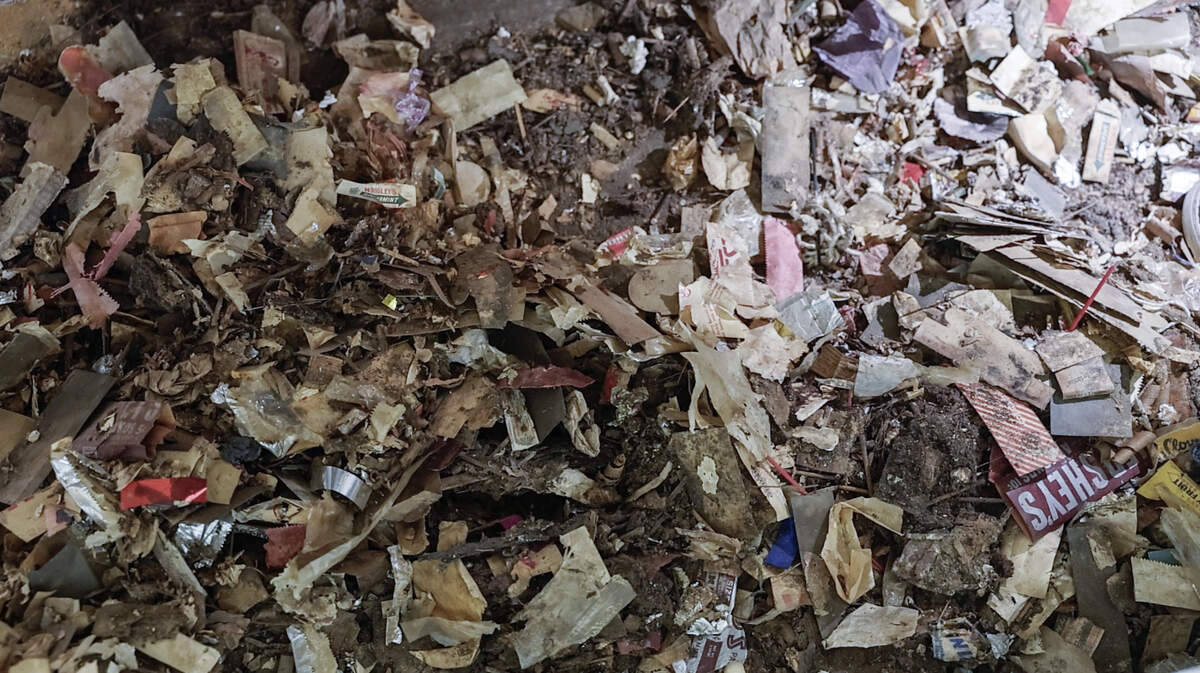
As they tore out old stairs and ripped out old flooring last summer, Eby Construction crews kept unearthing bits of detritus left behind by theatergoers past. Those two “Gone With the Wind” ticket stubs were among the big finds.
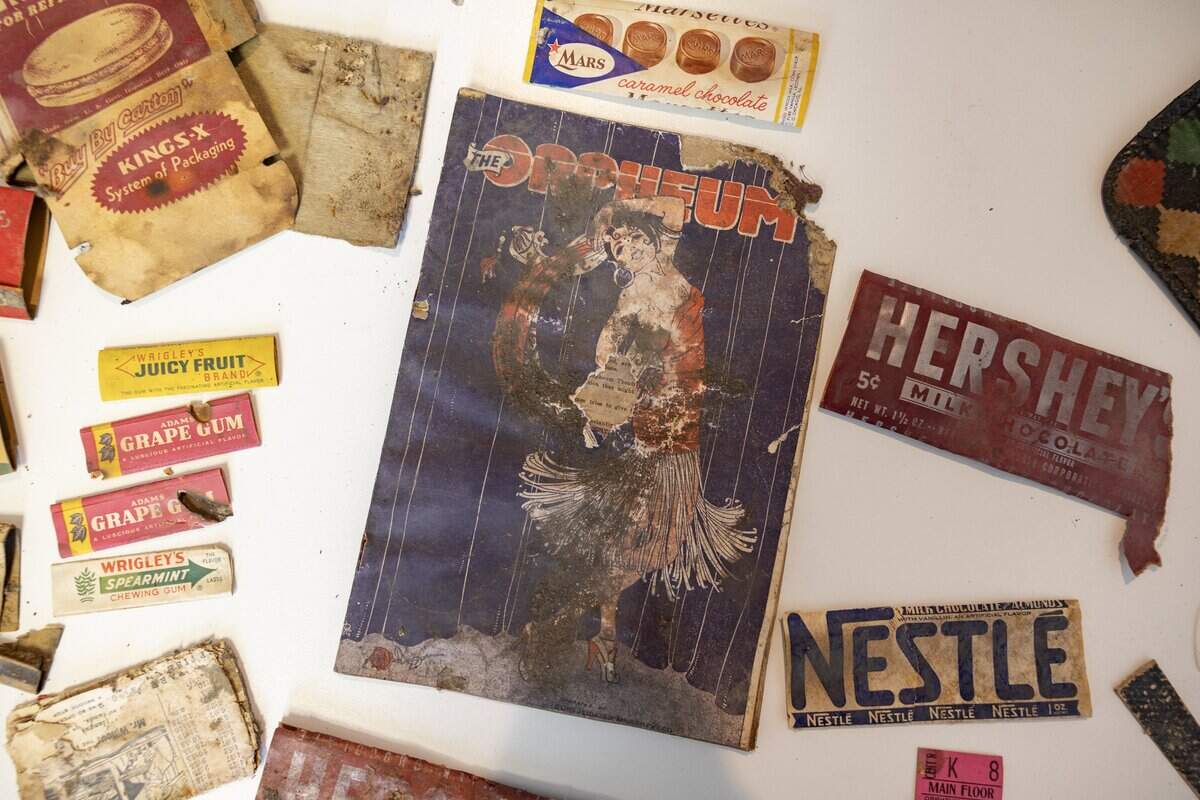
Olden now has amassed a small but fascinating collection of candy wrappers, matchbooks and other relics unwittingly left behind by theatergoers and performers dating back to the 1920s.

For now, she has the best items stored in small boxes and plastic sleeves near her office. Her goal is to eventually display some of them along with other historic items from the theater in an archival library that members of the public can visit. She plans to name the library for Delmar Klocke, a former Orpheum board member and onetime chair of the theater’s restoration committee, who died in January 2024 at age 90.
“To me, it’s fascinating when you can unearth pieces of history, things that actually were a part of the theater’s past, and just to see, ‘What did people bring in when they came to a show”’ and ‘What did they eat when they came to a show?” Olden said.
Trash tells the theater’s story
The collection of debris Olden and her staff have collected tells the story of the various lives The Orpheum has lived through the decades, from its debut as a vaudeville theater in the 1920s, to its run as a movie house in the 1950s, to its time as an X-rated theater in the 1970s to its eventual rebirth as a crumbling-but-functional performance venue in the late 1990s.
As they began tearing out parts of the theater that would need to be replaced, workers began uncovering piles of dusty straws, receipts and cigarette butts. They’d sift through it and pluck out items they thought would be interesting to Olden and her staff. Sometimes, the workers would leave the treasures in place so that the staff could take pictures of the items where they were discovered.
“It’s like you’re on a treasure hunt,” Olden said. “If someone finds a treasure, they’re pretty proud of it, and so the contractors definitely reveled in delight when they would share trash with us.”
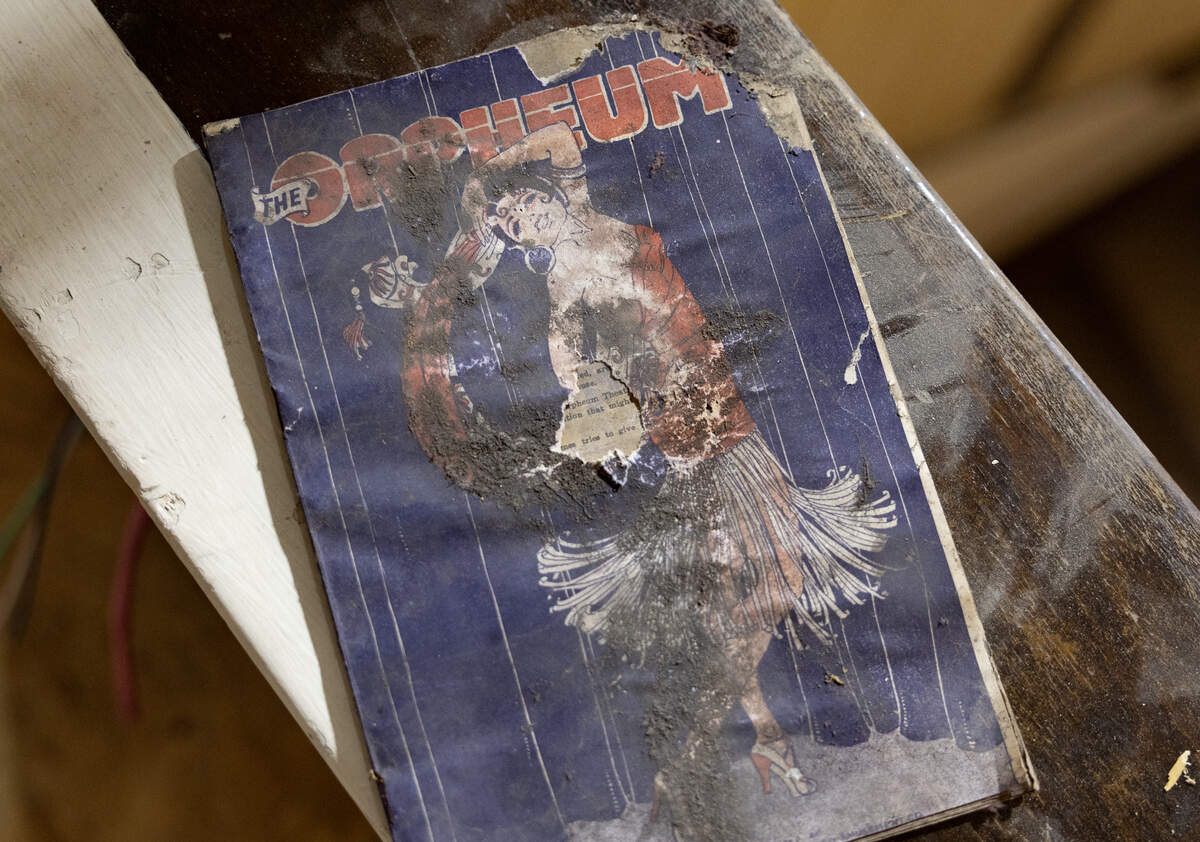
One of the oldest finds was a tattered vaudeville program, most likely from 1925: There’s an ad for a 1925 five-passenger Willys-Knight car on the program’s back page. Inside the program is a list of the Orpheum’s “house rules,” including “Expectorating is strictly prohibited in theaters and public places by law” and “Ladies are especially requested to remove hats.” The program also includes ads for nearby restaurants such as Pan-American Cafe at 150 N. Market, King Fong Cafe at 116 S. Lawrence, and Fouts Chili Parlor No. 2 at 130 N. Lawrence. (Broadway was called Lawrence until 1933.)
A restaurant relic also was discovered in the trash pile: a smashed slider box from Kings-X. The famous restaurant chain was started in 1938 by A.J “Jimmie” King, a former White Castle manager who, when the chain left Wichita for Ohio, bought several of its hamburger stands, including the one across the street from the Orpheum at First and Broadway. A moviegoer most likely brought the container into the theater, which didn’t have concession stands, during the 1940s.
Movie ticket stubs were among the most common treasures that workers discovered, and they spanned the decades. Olden has a whole box of them, printed with prices that range from 10 cents to 40 cents. Most of the ticket stubs were found on the main floor, while hundreds of cigarette butts were found in the balcony — leading Olden to wonder if the balcony once served as the smoking section.
.jpeg "2026-06-26_12-06-18_596 (1).jpeg")
The workers also found an entry ticket, likely from 1939, for a contest that would give away three Nash Sedans. And they unearthed a faded fabric glasses case printed with a colorful harlequin pattern, most likely from the 1950s or 1960s.
They also found several tattered matchbooks. One advertised Kings-X. Another, likely from the 1950s, was printed with the logo for “Heavenly” Hunts canned peaches. And another advertised Petrie’s, a clothing store that operated in Wichita for 78 years, closing in 1962.
The candy and gum wrappers discovered were from a 1950s-era Nestle milk chocolate with almonds bar, from a package of Mars Marsettes (a Rolo-like candy sold from 1958 until the mid 1960s), and from a 5-cent Hershey’s bar, which was what the candy cost through 1969. There’s also a more faded Hershey’s wrapper that is likely even older.
Another fascinating relic, discovered stashed in the old doorman’s closet just off the lobby concession area: a bottle from 1964 that once held a half pint of whiskey. It was discovered as workers were excavating to install a new storm water pipe and seemed to have been hidden in the closet by its owner.
More modern finds include half of a ticket for the Festival of Magic, which happened at the theater as part of the Wichita Riverfest in May 1999, a couple of used guitar pics, and a Select-a-Seat ticket from a Canadian Brass show on Dec. 4, 2005.
The theater staff also gathered some larger pieces of historical refuse during the tear out, including the rusty metal end of a row of the theater’s original seats and several original light fixtures. When the Orpheum’s main floor had been completely removed, revealing the original dirt underneath, Olden also dug some out and put it in a box. She’ll likely display a jar of it in the theater.
“I’m just kind of nostalgic like that, and I wanted a piece of it,” she said. “We hadn’t seen that for 103 years, and I was just like, ‘I want some.’”
Whose trash is the best trash?
People in the historic theater business know that, when a major restoration starts, remnants of history will likely be uncovered.
Workers restoring the Paramount Theatre in Austin found lipstick from the 1930s along with old soda cups. And last year, crews working on Chicago’s Auditorium Theatre uncovered an 1889 issue of the Chicago Herald newspaper and a 57-year-old ticket to the ballet.
“I think sometimes there might be this little bit of a competition of who can find better trash when we’re restoring our theaters, and there’s some pretty incredible things that are found throughout historic theaters, especially because most of them date back over 100-plus years,” Olden said. “So, most often when you see others doing theater restorations, they’re going to put their trash on display as well and gloat about what they found,”
The Orpheum staff has kept images of the restoration’s progress secret, but the theater is almost ready for its big reveal. When it reopens in September, Olden said, the community will be invited to see the results. The staff also is planning to stage a big reopening concert by a yet-to-be-named headliner.
In September 2024, Olden announced that the theater had finally raised enough money to begin the restoration. The project has been ongoing since Orpheum supporters first started raising money in 1991.
When she made the announcement, Olden said that of the 100 Orpheum Theatres that once existed in the United States on the vaudeville circuit, only 17 were remaining. All were in full operation, but only Wichita’s Orpheum was still waiting for restoration.
.jpg)