
Easter egg art inspirations
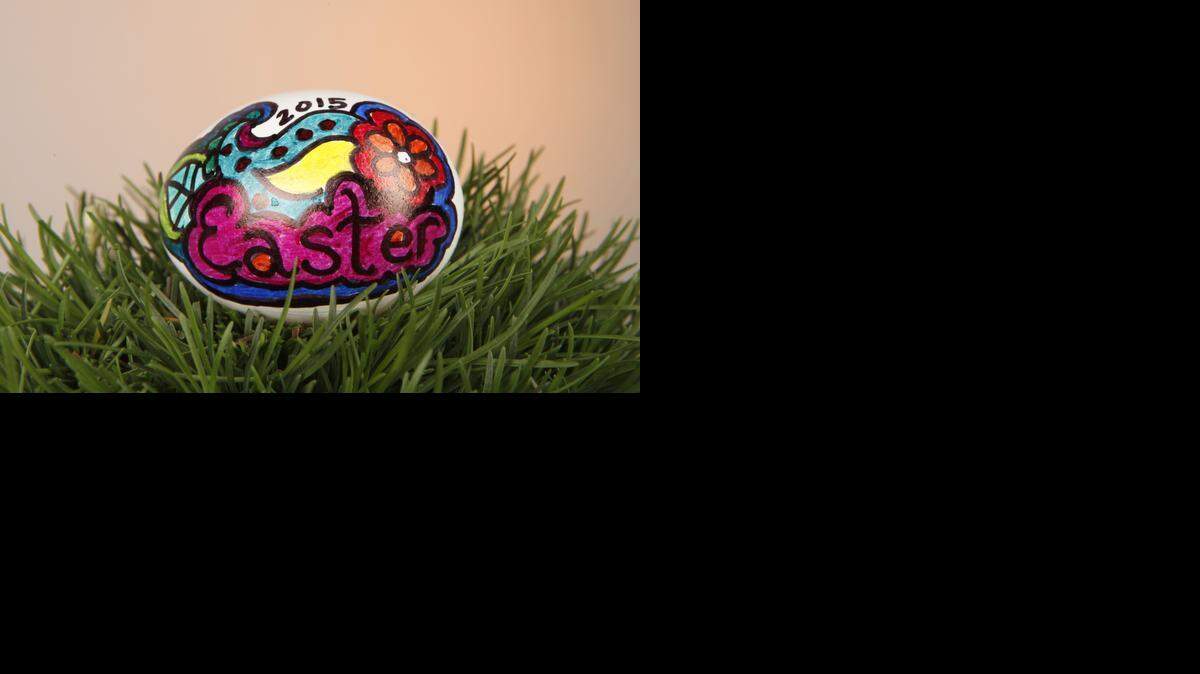
We asked several artists and egg-happy people for their take on Easter eggs decoration, and they responded with a range of methods and designs. Here are their contributions. You may even pick up some inspiration for your own decorating.
Janie Bradfield of Andover, watercolor painter, gardener and retired middle-school art teacher from Andover, dyed her eggs, then used white and red paint pens to draw designs: Zentangle (“That’s a new name for doodling”), a Japanese design of a chrysanthemum dotted with red push pins, and an organic pattern. “That one’s probably my favorite. It’s simple,” she said. When Bradfield was in college, she decorated a dozen eggs in the Ukrainian pysanky style, using a tool that applied wax designs to eggs that were then dipped in lighter to darker colors, the wax designs standing out in relief. She still has the eggs, perfectly kept in a cardboard egg crate.
Julie Price of Wichita is a former Andover schoolteacher who now teaches her two boys and offers occasional children’s classes at the Wichita Center for the Arts. She paints with acrylic on canvas and draws. For her Easter eggs, she used fine-tip Sharpies to create vibrant designs.
Jennifer Walterscheid’s main medium is cloisonne enamel; for her Easter egg she painted with acrylics. She is an art teacher at Holy Cross Lutheran School and currently has works on display in the Works of Faith exhibit at Karg Art Glass in Kechi. “Before beginning my egg, I looked at Russian cloisonne enamel eggs to see how they used pattern, color and line to create their small but gorgeous works of art. I painted on an egg given to me by my friend and co-worker Lisa Wagner, who raises her own laying hens.”
Allison Stucky used acrylic paint on her Easter egg. “This is the first time I thought this hard about an egg,” she said, laughing. She is an art and graphic-design teacher at West High and has a shoe-painting business on the side. She’ll be busy decorating eggs at home with her six children, experimenting this Easter with pairing shaving cream with dye for a marbled look.
Paula Sims and her family raise chickens at Morning Harvest Farm in Walton and color eggs using natural dyes. The eggs she started with already were naturally colored — green, brown, blue. She made dyes with red grape juice, purple grape juice, blueberry juice, elderberry juice and turmeric; there are many more options. Her recipe for dye: 2 cups of juice, 1 cup of water and 1 tablespoon of vinegar, or 1 teaspoon of spice, 2 cups of water and 1 tablespoon of vinegar, boiled, then simmered, then cooled in mason jars. She dunked the eggs for 30 to 45 minutes; the longer the eggs are in the dye, the darker they get.
Charles Baughman grabbed an egg from his family’s backyard chickens to decorate with Sharpies. The Americana chickens lay eggs that already are blue and green. An exhibit dedicated to 25 years of Baughman’s teaching, which includes his artwork and that of some of his students, is on display through April 18 at CityArts. He and his wife, Kate Pepper, also own The Art Park.
Erin Horton, an instructor at CityArts, used a felt-tip scrapbooking glue pen and super-fine-grit glitter to decorate her Easter eggs. She traced first with a mechanical pencil, then used the glue pen to fill in the area where the first color would go, then applied glitter and blew it off before applying the next bit of glue and color of glitter. She finished it off with a bit of spray acrylic. Her red and silver egg bears the Rebel symbol from “Star Wars.”
Reach Annie Calovich at 316-268-6596 or acalovich@wichitaeagle.com. Follow her on Twitter: @anniecalovich.
This story was originally published April 3, 2015 at 12:53 PM with the headline "Easter egg art inspirations."