
Kansas State basketball lifted Chris Lowery during the most trying time
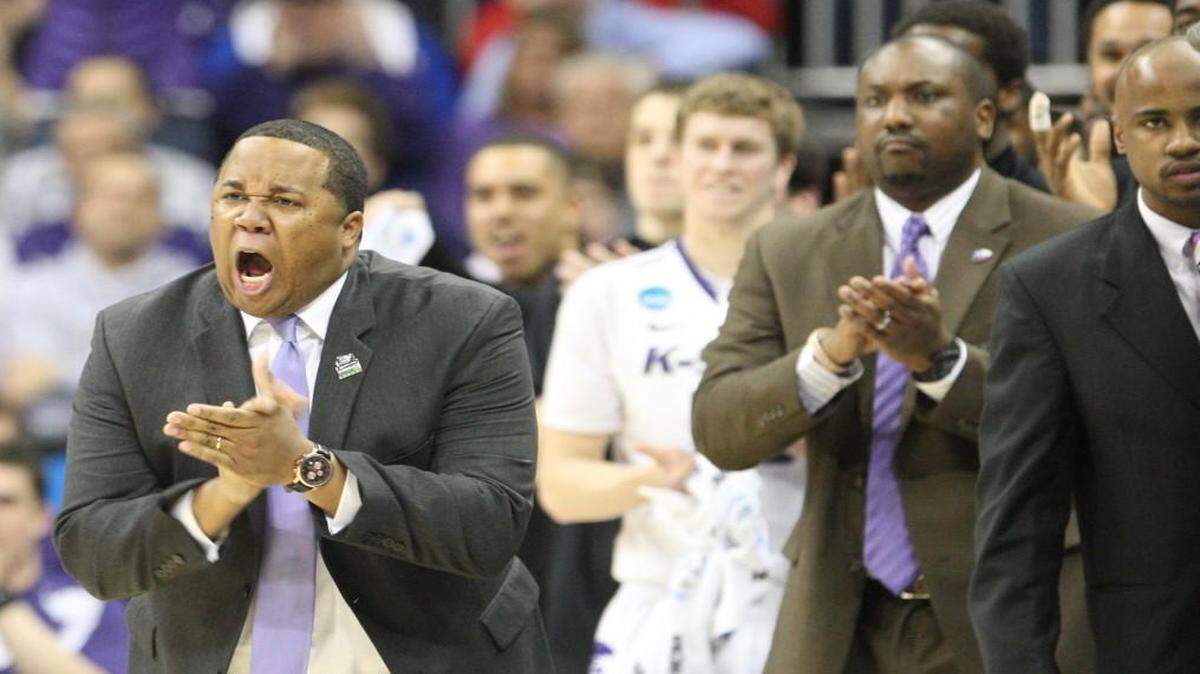
Chris Lowery doesn’t consider himself an emotional basketball coach. Yes, he will have the occasional moments of joy, frustration, disgust and rage on Kansas State’s bench, but all assistants have those. You won’t see him cry after losses or hear him scream after victories.
About the only time he has dropped his even-keel persona came earlier this season on an early-November night, when he began crying during starter introductions and couldn’t stop. It took a hug from coach Bruce Weber and the support of K-State players to help him through the following two hours at Bramlage Coliseum.
Lowery had never experienced anything like that — the loss of his son, Kahari, followed by an entire basketball team wearing warm-up shirts that honored his son, followed by the team dedicating the game to his son’s memory.
“It touched my heart,” Lowery recalled in an exclusive interview with The Eagle. “I’m not an emotional person. It was hard for me to stay focused the rest of that game.
“I didn’t think my son’s death would affect our players in the way that it did. They were great. Carlbe (Ervin) and Barry (Brown) even wrote ‘RIP Kahari’ on their shoes. It was such a kind gesture that my family holds dear. It broke me down.”
K-State’s basketball team spent the rest of the season lifting Lowery and his family up.
Nothing can prepare a father for the death of a child, but coaching helped Lowery mourn and recover. Being part of 21 victories (the most at K-State since 2013) and reaching the NCAA Tournament (K-State’s first trip since 2014) brought smiles to his face after months of despair.
Lowery didn’t know when – or if, more accurately – he would return to coaching following the unexpected loss of his son on Nov. 1. The circumstances hit him so hard that he felt guilty showing up for a home game against Omaha two weeks later. If not for his wife ordering him back to work, he’s not sure what he would have done.
“Me and my family really struggled with it,” Lowery said. “My son has been with me for all the victories I have had going back to my time as a head coach and with Coach Weber as an assistant. He has always been there and this was the first year that he wasn’t. But it’s obvious his spirit stayed with this team. That really helped.”
Million Dollar Baby
Everyone who knew Kahari remembers his smile.
No matter the day, time or circumstance, he was always showing it off. It was the type of grin that his father describes as “infectious” and capable of “adding light to rooms.”
“He was always happy,” sophomore guard Barry Brown said, “and he loved to be around the team and his family. There was never a dull moment with him. He was always smiling, just a great kid.”
Kahari became a staple at K-State games and practices after moving to Manhattan in 2012 with his family. He always seemed to be front and center, smiling ear to ear.
That’s the last vision K-State players had of him. The day before he died was Halloween, and Kahari celebrated by handing out candy at practice dressed as “Game of Thrones” character Jon Snow. He wore plastic armor, sported a wig of long, curly hair and wielded a toy sword.
“We thought the world of him,” senior guard Carlbe Ervin said. “He was fun to be around.”
News of his death the following day was devastating.
“It took a toll on everyone,” Brown said.
The Lowery family had long anticipated this day, but that did nothing to soften the blow.
Born two months early and weighing 2 pounds, 11 ounces, Kahari led a different life. He was constantly diagnosed with daunting health issues that included cerebral palsy. He spent his first four months in a hospital and made dozens of repeat visits for surgeries, including some on his brain. He couldn’t walk on his own and was always in a wheel chair. Lowery nicknamed his “Million-Dollar Baby” as the medical bills multiplied and his “little Superman” as he stayed strong.
A premature death felt inevitable, but Kahari defied expectations and lived 15 years, experiencing things some children his age only dream of.
He traveled with his family to New York and to Hawaii, he had front-row seats for basketball games at Southern Illinois — where Lowery was coach — and K-State. He loved “Spongebob Squarepants” and penguins, and he made friends across the region. Many called him Hobby, a nickname he picked up from his brother, who struggled to pronounce his name as a child.
After he died, the Lowery family held funerals for him in Evansville, Ind., and Manhattan, packing churches in both towns.
“It’s a credit to him,” Lowery said. “They didn’t come because they knew me or my wife. It was all for him. He got to know a lot of people.”
When the funerals were over, K-State honored Kahari with videos at Bramlage Coliseum and Saint Louis did the same during a road game. People lined up to help.
“K-State people have been unbelievable for them,” Weber said. “They showed up at his house with meals every night. It’s going to take a while for him to get over the loss, but they really showed their support.”
If only they could replace that smile.
“That’s what I miss most,” Lowery said. “Win or lose, I could go home and he would make me smile. His laugh, his smile, I would walk in the door and call out his name and he would get so happy recognizing his dad was home. That was priceless.”
Playing for him
K-State faced many challenges this season, including injuries and last-second losses, but none felt bigger than the loss of Kahari.
The Wildcats missed him.
“It made them put things into perspective,” Lowery said. “It made them focus on the one life you have. For a lot of the players, this was their first time being around death. Life is about more than basketball, and I think learning that helped them develop a higher level of urgency.”
It showed.
“We honored him by playing our (butts) for him,” Ervin said of Kahari. “I like to think our season helped Coach (Lowery). We never saw him break down after that first game. He never showed us weakness. He kept his spirit. That is a hard thing to after losing a child.”
Winning helped. K-State started 15-4 and struggled through a rough 2-8 stretch that almost cost the team a spot in the NCAA Tournament and raised questions about Weber’s future, but the Wildcats rallied with late wins over TCU, Texas Tech and Baylor to reach the postseason and then defeated Wake Forest in the First Four, earning a No. 11 seed on the main bracket.
Lowery has been on quite the coaching ride since guiding Southern Illinois to three consecutive NCAA Tournament appearances, capped by a Sweet 16 run in 2007. He was viewed as one of the game’s brightest young minds back then, but he was fired in 2012 following an 8-23 season. He’s been at K-State as Weber’s associate head coach since, helping the Wildcats to 100 victories, three postseason appearances and one conference championship in five seasons.
Returning to the NCAA Tournament was a reminder of the highs his job can provide, especially with a group that rallied around him during an emotional time.
“When you have a special needs child it really makes you focus on absolutely loving your child wholeheartedly with no ifs and or buts,” Lowery said. “It shows you that love is unconditional and really makes you aware of how helpful you can be. It makes you want to hold open doors and offer support when you see someone struggling. It puts you in a helpful mode of thinking. This team had that. They helped me and my family in so many ways.”
Kellis Robinett: @kellisrobinett
This story was originally published March 28, 2017 at 10:11 AM with the headline "Kansas State basketball lifted Chris Lowery during the most trying time."