
Life tested him. Resilience carried Goddard golfer to a Kansas state title
The two shots that won Cohen Museousky a state championship looked, at first, like the ones that might take it away.
One tee shot sailed right and out of bounds on No. 13. Another bounced over the back of the green and trickled out of bounds on No. 17. Either mistake could have made the Goddard sophomore the next Class 5A title contender swallowed whole by an unforgiving Tallgrass Country Club course on Wednesday.
Instead, both became the clearest proof of why Museousky won.
He did not panic. He did not sulk. He did not let one bad break become a disaster. Twice, with a boys golf title hanging in the balance, Museousky took a breath, stepped back into the shot and saved the kind of bogey that felt like something much bigger.
By the end of the afternoon, those two bogeys were not the blemishes on his scorecard.
They were the reason he became the first golfer from Goddard to win an individual state championship.
“He showed the perseverance of a champion,” Cohen’s father, Nick Museousky, said. “He won that tournament because of those two bogies.”

Museousky followed Tuesday’s even-par 71 with a 1-over 72 on Wednesday to finish the tournament at 1-over 143, two shots clear of Eisenhower senior and Drake signee Luke Springer and Blue Valley Southwest’s Beau Sheldon, who tied for second at 145.
It was a fitting victory for a golfer whose life story has been shaped by resilience.
Long before he had to survive Tallgrass, Museousky had to survive leukemia.
He was diagnosed at 20 months old, when he weighed 22 pounds and his parents began noticing strange bruises on his body. Doctors told the family he had a 50% chance to live. His mother, Jamie, remembers the fear, the long hospital visits, the seven rounds of chemotherapy.
Museousky was too young to remember the treatments himself. He was declared cancer-free at 6 years old. But he has grown up understanding what he survived and what that second chance means.
That perspective followed him around Tallgrass on Wednesday.
“I think it kind of defines who I am in some aspects,” Museousky said. “I just tried to battle back and get through whatever life threw at me. So I’m just really proud.”
The final day began with Museousky and Springer tied atop the leaderboard after both opened with even-par rounds of 71 on Tuesday. But the championship race unfolded in unusual fashion.
Museousky teed off on No. 1 at 10:20 a.m. Springer started on No. 10 about an hour later. That meant the two most consistent players in the field were not walking side by side. They were separated by the course and the clock, battling each other from opposite ends of Tallgrass.
The field behind them was loaded with talented players: Bishop Carroll’s duo of Kaden Leivian and Max Farber, St. James’ Josh Fratzel and Kapaun Mt. Carmel’s Carson Bachrodt were all part of a deep Class 5A field.
But on a course that demanded precision and recovery, Museousky and Springer separated themselves.
Tallgrass did not offer many easy chances. The rough was thick. The greens were slow. Miss a fairway, and par suddenly became a fight.
“They call it Tallgrass for a reason,” Goddard coach Jim Zimmer said.
Zimmer knew Wednesday was not going to be about overpowering the course. It was going to be about limiting mistakes. Avoiding doubles. Taking bogey when bogey was the best possible outcome. Making every player behind Museousky chase a number.
“We wanted to go out there and set a number and make everybody chase him,” Zimmer said. “To his credit, that’s exactly what Cohen did.”
It took patience early.
The front nine at Tallgrass played as the more difficult side with few scoring chances and little margin for error. Museousky hit only two greens in regulation on the front nine, but he stayed composed enough to avoid the kind of mistake that could have knocked him out of contention with a 1-over score at the turn.
He knew the back nine would give him more opportunities if he could just get there with a chance .That is exactly what happened.
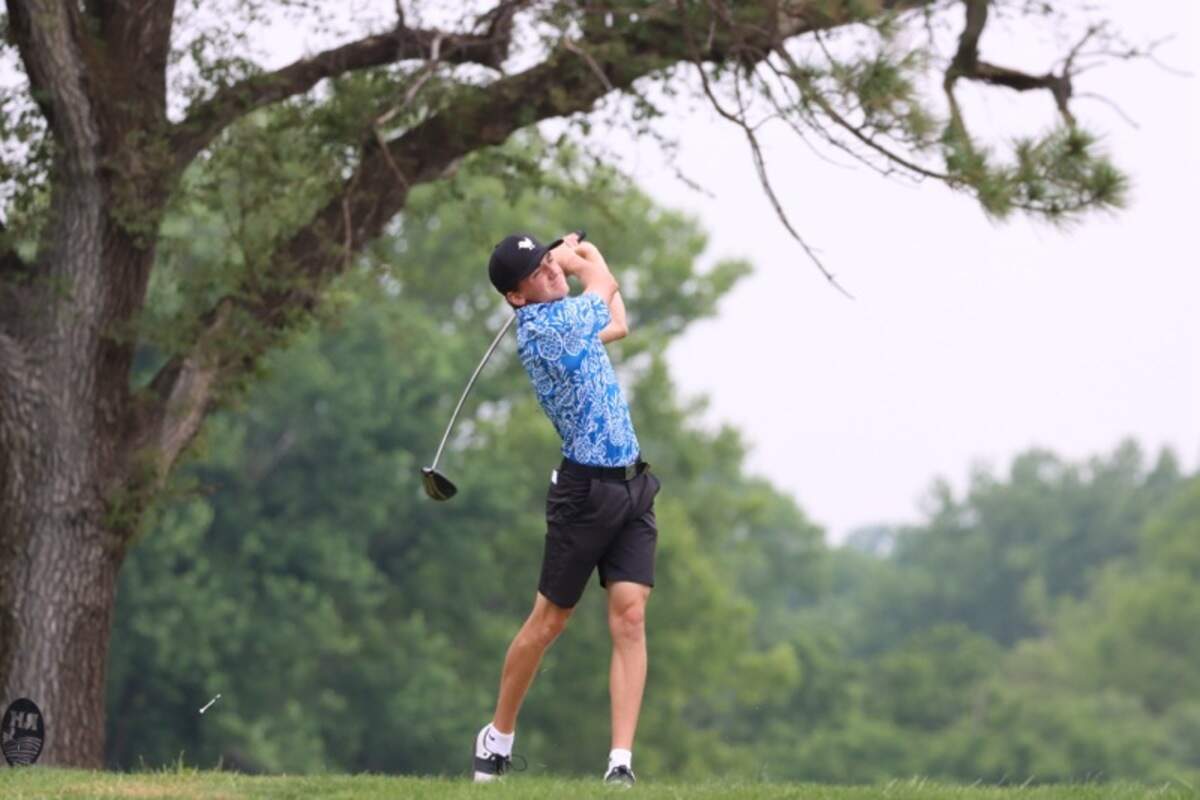
Museousky found a better rhythm after the turn, hitting seven of nine greens in regulation on the back nine. He made birdie on No. 12, a shot of momentum that pushed him into control of the tournament.
Then came the first test.
On No. 13, coming off the birdie and feeling good at the top of the leaderboard, Museousky lost his tee shot right and out of bounds. He had to make the long walk back to the tee box and hit again, the kind of walk that can make a player replay the mistake with every step.
Museousky took a breath and reminded himself there was still a lot of golf left .His focus narrowed to one thing: minimize the damage.
His second tee shot stayed in play, then from there, Museousky produced one of the best shots of the tournament, knocking his approach inside six feet and made the putt.
On the card, it was a bogey.
To Museousky, it felt like a birdie.
“Someone might look at my scoreboard and say, ‘Two bogeys, that’s not great,’” he said. “But to me, they felt like birdies. It could have easily been much worse. I’m really proud of those bogeys.”
Instead of stealing his momentum, the bogey seemed to sharpen him.
Museousky answered with a birdie on No. 14, then gave himself two more birdie chances on Nos. 15 and 16. He missed both putts, but he was still steady. Still in control. Still giving himself chances.
Then No. 17 delivered another test. That one may have been even more dangerous.
Museousky’s tee shot on the par 3 landed near the back of the green and took an unlucky bounce. The ball trickled just over the out-of-bounds line behind the green.
What Museousky did not know was that he still held a one-shot lead.
He had not been asking for leaderboard updates during the round. In his mind, there was a chance someone else had already passed him. So he did not step back to the tee thinking he had to protect a state championship lead. He thought he had to keep fighting because there might still be ground to make up.
Once again, he focused on the only thing he could control: the next shot.
Museousky teed up another ball and struck it to about 15 feet. Then he rolled in the putt.
Another bogey.
Another save that felt like something far more meaningful.
“Anybody can give up and accept a bad number,” he said. “But I felt pretty positive after that.”
But the state championship was not his yet.
Springer still had six holes remaining, and when Museousky walked off the course, the two were tied on the scoreboard. That left Museousky in the strange position of having done everything he could do, but not yet knowing whether it would be enough.
“I was a little nervous there, but then I just realized that there was nothing I can do about it,” Museousky said. “Whatever happens is going to happen. I had no control over it. I had done my part.”
So Museousky did what came naturally — he went back to work.
Instead of sitting in the clubhouse and refreshing the online scoreboard, instead of anxiously following Springer’s group, Museousky went to the driving range. Then he moved to the putting green.
Part of it was preparation. If the tournament went to a playoff, he wanted to stay warm. But part of it was simply who he is.
“There are always things you can work on, always ways that you can get better,” Museousky said. “You’re never going to be the best. So I wanted to spend that time working on my game, in case there was a playoff, but also for my future rounds to improve my game.”
That is the same mindset that has made Museousky more than just a talented golfer at Goddard.
Even though Museousky is one of the best young golfers in Kansas, Zimmer said he never acts like he is above anyone. He encourages teammates trying to break 100 the same way he would encourage another elite player. He does not brag. He does not chase attention. He treats golf as a place to improve and a place to help others improve, too.
That is what made the scene after the tournament feel so fitting.
As Springer continued his final holes, he kept fighting. He nearly chipped in for birdie late to pull even again. But when he made a late bogey, Museousky moved into the lead alone. Another bogey pushed Springer another shot back.
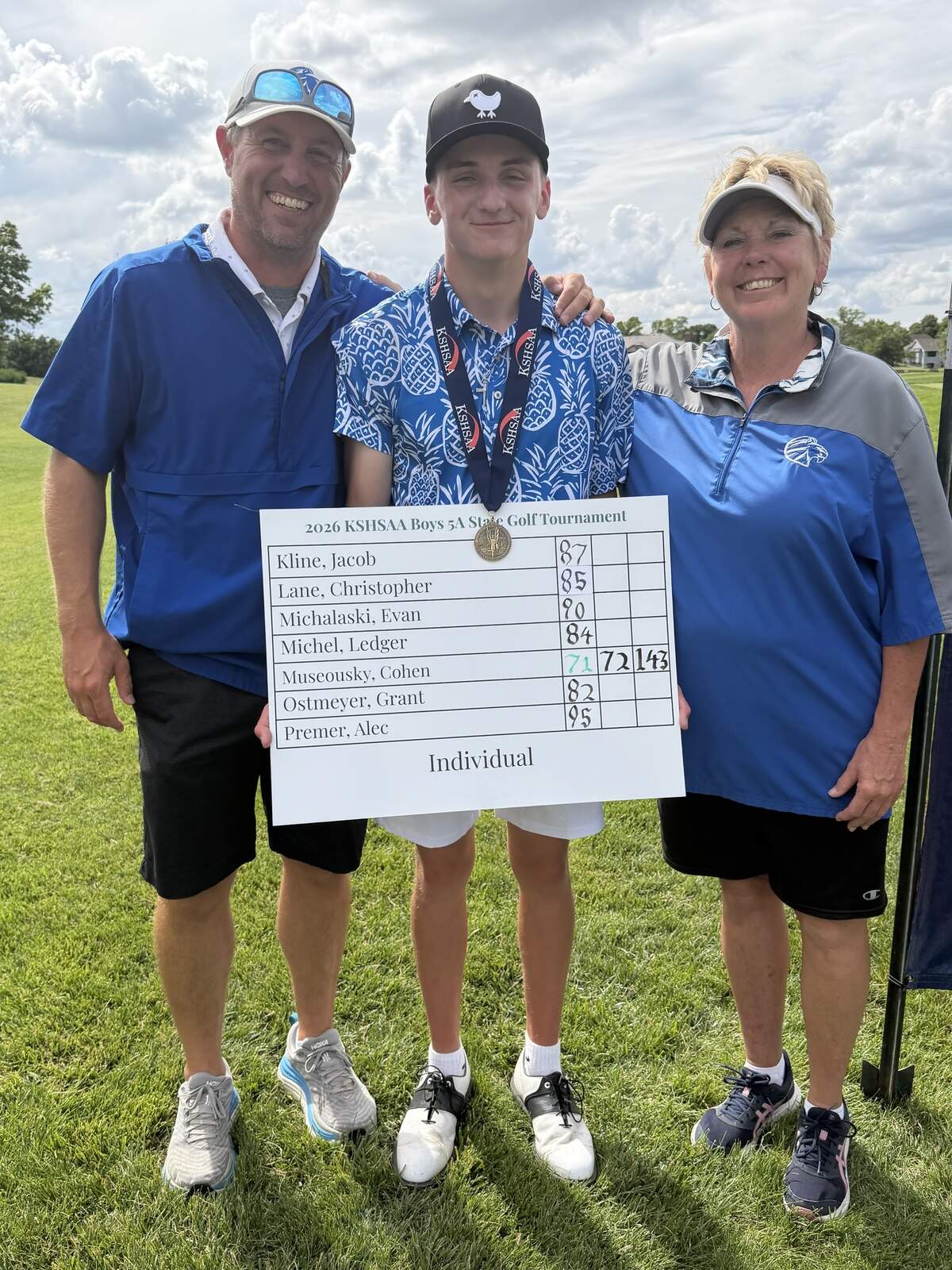
Zimmer had found him just before the crowd arrived.
“I shook his hand and told him thanks for a great season,” Zimmer said. “And enjoy all of the love you’re about to get.”
That’s when the wave came.
Golfers, parents and spectators swarmed Museousky to congratulate him. One after another, they shook his hand, hugged him, smiled at him and celebrated the player who had just made Goddard history.
From a distance, Jamie watched it unfold in tears.
Her son had once been a toddler fighting for his life. Now he was standing in the middle of a crowd as a state champion.
“It was so surreal,” Museousky said. “I couldn’t believe it in the moment. I was just really excited about the accomplishment. It’s probably the biggest win in my golf career and I’m extremely proud of that.”
Zimmer understood the meaning of the moment better than most.
He is also a leukemia survivor. Like Museousky, Zimmer was treated in Wichita by Dr. David Rosen. The two did not realize that connection until last fall, when Museousky raised money for the Leukemia & Lymphoma Society through a charity golf event. Zimmer donated, asked questions and eventually discovered that his sophomore golfer had survived a similar battle with the same doctor.
Zimmer has seen how survival shaped Museousky’s outlook. He saw it again on Wednesday when the course gave Museousky every chance to unravel and he refused.
“Cohen’s resilience was incredibly paramount today,” Zimmer said. “I don’t think you could put a higher value on a quality to have on this golf course.”
Resilience can be an easy word to throw around in sports.
But if anyone fits the bill, it’s Museousky.
Not for a golfer who won a state championship because he refused to let two out-of-bounds shots define him. Not for a sophomore whose worst moments on the scorecard became the shots his family will remember most. Not for a leukemia survivor who has spent his life turning a second chance into purpose.
Museousky did not win the Class 5A state title with a perfect round.
He won it with something better.
Twice on Wednesday, he looked like he might lose the state championship.
Both times, he showed exactly why he deserved to win it.
This story was originally published May 27, 2026 at 6:55 PM.
.jpg)