
Kansas high school sports moratorium bill ignites fight over faith and family
AI-generated summary reviewed by our newsroom.
- Kansas debate pits proposed statewide moratoriums against local control.
- Supporters cite student well-being and faith; opponents cite scheduling chaos.
- SB 515 passed the Senate; KSHSAA will discuss moratoriums April 23.
On Ash Wednesday last year, Father Daniel Duling looked at the Kansas high school basketball schedule and saw a conflict he believed had been building for years.
Cheney and Garden Plain were scheduled to meet in a sub-state boys basketball game on the first day of Lent. According to Duling, there was an effort to move the timing because of the holy day. It never happened.
For Duling, the pastor at St. Rose of Lima in Mount Vernon and St. Louis in Waterloo, that was more than an inconvenient date on a crowded calendar. It was a flashing warning light.
In his view, Kansas schools had drifted so far into an always-on activities culture that students were no longer truly free to choose faith, family time or even rest without fearing what they might lose in return. If a player skipped an “optional” workout, he argued, everyone knew it was not really optional. If a student wanted to attend a church service on a Wednesday night or a Sunday commitment with family, that choice increasingly came with pressure, guilt or consequences.
That frustration has now burst far beyond one small-town gym and one Christian observance.
A yearslong campaign by Duling to strengthen moratoriums on school sports and activities has suddenly landed in two power centers at once: the Kansas Legislature and the Kansas State High School Activities Association. What began at the Statehouse as a relatively narrow bill about expanding participation opportunities for home-schooled students has been transformed into something much broader and much more combustible — a statewide fight over whether Kansas should impose blackout periods for school contests, practices and activities on Sundays, around Easter and on Wednesday evenings during much of the school year.
Supporters say the idea is overdue. They say teenagers are over-programmed, over-pressured and too often trapped in a culture that leaves too little room for worship, family, emotional breathing room and physical recovery.
Opponents say the proposal confuses a real concern with the wrong solution. They argue a statewide mandate would create scheduling chaos, hurt school-based activities, complicate state events, squeeze already-limited facilities and invite club sports and private trainers to fill the openings left behind.
In other words, what started as a bill has become a values fight — over who gets to decide how much is too much for Kansas students, and what should matter most when school life, sports and family obligations collide.
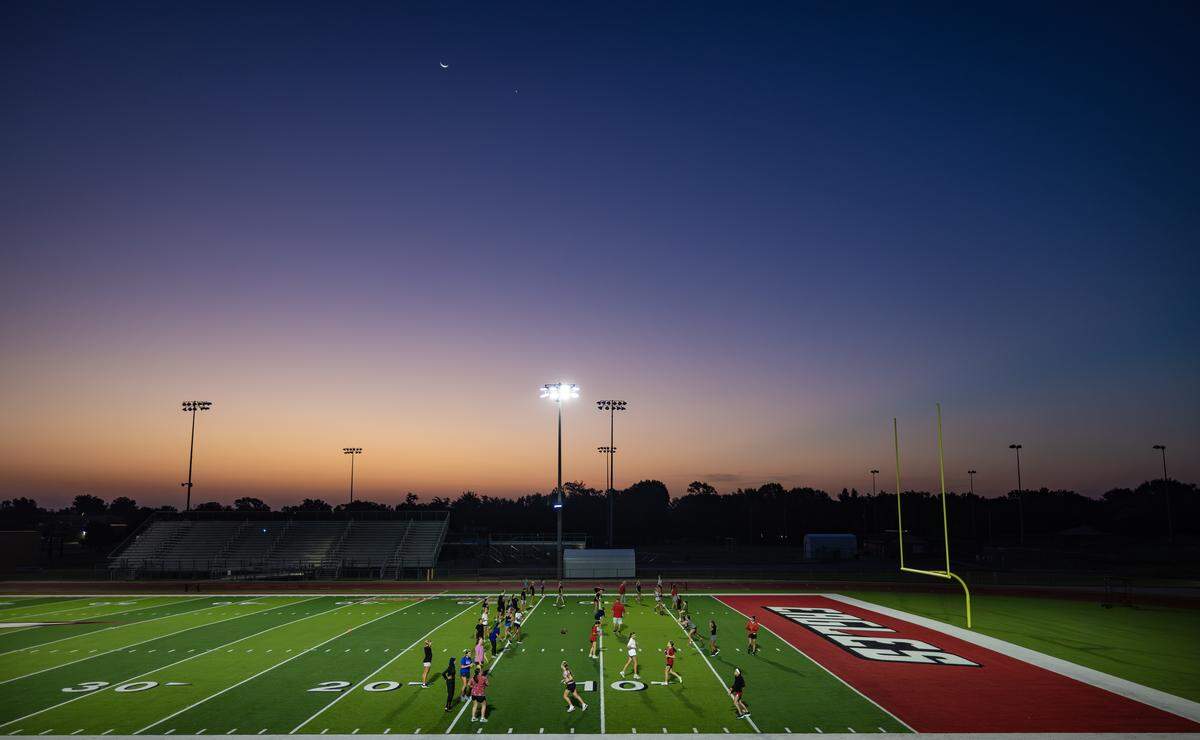
How the Wednesday-Sunday moratorium in Kansas gained momentum
Duling said the sudden legislative attention caught even him by surprise.
He has been talking with KSHSAA for years about stronger moratorium protections, but said the push did not originate in the Legislature. That changed when Senate Majority Leader Chase Blasi, a Wichita Republican, proposed a floor amendment adding the moratorium language to Senate Bill 515.
“This is going to ensure that we focus on what really keeps strong communities: that is family and faith,” Blasi said.
That move instantly raised the stakes and broadened the audience. Instead of a debate largely confined to activity administrators, school leaders and religious communities, the moratorium question was thrust into the center of a live legislative fight.
But the roots of the issue, at least for Duling, stretch back well before this session.
He points to that Ash Wednesday sub-state game in 2025 as a turning point. In a place like Cheney, where high school sports are stitched into community identity, Duling did not see the moment as a condemnation of athletics. He saw it as evidence of how difficult it had become for students to step back from them.
The way he tells it, the issue is not whether sports and activities matter. Of course they do. It is whether they have grown so large in the lives of students that families no longer feel they have real leverage to say no.
“Our kids are being put in situations and being pressured in ways that they will tell you that they don’t like,” Duling said. “If they don’t show up to this practice or show up to that, then there’s consequences. These coaches say it’s optional, but we all know what that really means.”
That word — optional — has become one of the emotional fault lines in this debate.
To Duling and many supporters, “optional” has become a polite fiction in modern school sports. Miss enough voluntary workouts, informal practices or off-day sessions, they argue, and students know exactly what can happen: a loss of playing time, diminished trust, fewer opportunities or the subtle sense that everyone else is more committed than they are.
Duling’s case is not built entirely on religion, even if faith is clearly at its center. He says that is only one part of what he believes is a broader student-wellness problem.
“It’s easy for me, as a priest, to say the faith part is an important part of this,” Duling said. “But I understand that not everybody has a faith background. I would still argue that our kids need a break from all of the pressures being put on them. Kids need to spend time with their family. So this is not just a faith issue. This is about the emotional and social well-being of the students choosing their own freedom.”
He also rejects the notion that the idea is narrowly Catholic.
“By no means is this just a Catholic thing,” Duling said. “I’ve spoken with plenty of ministers and other faith leaders, not just Catholics, who are all very supportive of this and a part of this.”
Support for the proposal has spread online. Duling created a Change.org petition that has gathered more than 3,000 signatures. In that petition, he argued that teenagers are caught in a web of broken relationships, social media pressure, over-involved adults and rising demands from coaches, administrators and club sports. Students, he wrote, need freedom to make responsible choices, time to recover physically and emotionally, and space to enrich their spiritual lives if they choose.
One supporter wrote in a petition comment that students in small communities are often expected to play every sport, join multiple extracurriculars, attend youth group on Wednesday evenings and serve at church on Sundays, creating a constant tug-of-war between faith and athletics.
Another supporter, Katy, wrote that “non-mandatory is mandatory for these kids” and said boundaries are needed to preserve time for family and worship.
Duling said he has been surprised by the online response and by how far the idea has traveled. He never expected it to gain enough momentum to appear both on a Statehouse bill and on a KSHSAA board agenda. He also said some school leaders have encouraged the idea privately, even if they have been reluctant to do so publicly.
“When I go and talk with superintendents, principals and athletic directors, when I talk with them 1-on-1, a lot of them are supportive of it,” Duling said. “But when they get out there in public, for some reason or another, they don’t want to publicly support it.”

What the proposal would change for Kansas high school sports
The original bill focused on access. It would authorize private schools to allow home-schooled students to participate in KSHSAA-regulated activities, as long as they met the required eligibility rules.
Then came the amendment.
Blasi’s floor amendment added a broad moratorium on interscholastic contests, activities and practices during several time periods: every Sunday; a consecutive five-day period that includes Christmas; a consecutive four-day period around Easter Sunday; a consecutive seven-day period including July 4; and every Wednesday from 6 p.m. to 11:59 p.m. from Sept. 1 through April 30.
The language goes further than just banning games. It says there shall be no interscholastic activities or practices and no staff members present for those activities or practices, regardless of whether they take place on or off school property.
That last part is where many school leaders and coaches see the proposal turning from aspirational to disruptive.
On paper, the moratoriums might sound limited. In practice, opponents say, they could reach into almost every corner of school life.
The Sunday moratorium might initially sound manageable because many schools do not schedule varsity competitions then. But Sunday practices are common in some sports, especially when teams preparing for a Monday game use Sunday as a final tune-up.
The Wednesday evening ban is even more sweeping. That is the provision that has generated the most backlash because Wednesday often serves as an overflow night — not necessarily for marquee varsity games, but for the less visible machinery that keeps school programs running.
Freshman games. JV doubleheaders. C-team contests. Extra practices for teams sharing one gym. Rehearsals for activities that are easy to forget in a sports-centered debate — theater, band, cheer, dance, debate, forensics and other fine arts or spirit programs that would also be affected by KSHSAA’s proposed wording.
In many smaller communities, one gym can serve junior high and high school athletes, boys and girls teams, and multiple activity groups at once. In larger districts, the issue is different but no less real: large participation numbers and crowded calendars leave schools scrambling for usable time and space.
Add in Kansas weather and the calendar gets even tighter. Rainouts, snow days and other disruptions already force schools to improvise. Opponents say pulling Wednesday evenings and Sundays off the board removes two of the pressure-release valves schools often need most.
Blasi, though, has argued that the amendment simply restores perspective.
“My community loves sports, loves activities and it holds a lot of state championships,” Blasi said. “We take a lot of pride in a lot of the hard work that our students commit to. It takes long practices, it takes sometimes weekend practices and sometimes there’s tough games on the field and they happen on the weekends. But this amendment just ensures that we focus on what’s also very important and more important than sports, which is the family and community.”
Sen. Caryn Tyson, a Parker Republican, cast the debate in similarly cultural terms.
“It’s a sad day that we have to legislate this,” Tyson said. “Years ago, it wasn’t even an issue. It was a standard and acceptable. But here we are.”

Why Kansas coaches and KSHSAA are pushing back
If supporters view the proposal as a needed reset, many coaches see it as an overly broad fix.
The social media reaction from Kansas high school coaches has been immediate and pointed and their objections have come from multiple angles.
Some have framed it as state overreach.
Gardner Edgerton football coach Jesse Owens wrote, “Placing restrictions on motivated kids and families is not the answer. Family rest, faith time, and personal schedules should be decided by families, not legislated by the state.”
That argument goes directly at the premise of the amendment. Even some people who agree with Duling’s diagnosis — that students feel pressure and are stretched too thin — may disagree with the cure. Their view is that local districts, schools and families should decide how to balance those priorities, not a sweeping state mandate.
Others worry the bill would accidentally strengthen the very forces many school leaders already see as a threat to high school athletics. Blue Valley Northwest football coach Clint Rider warned that taking time off the board for school programs would not necessarily create real rest.
“I’m not sure the legislature understands the ripple effect this will have on high schools in larger districts/populations,” Rider wrote. “The voids won’t create rest, it will create voids private trainers/club sports will fill.”
Duling’s proposal is rooted in a belief that kids need relief from mounting pressure. But some coaches argue the pressure will not vanish — it will merely migrate away from schools and toward the private ecosystem of trainers, club coaches and outside organizations less accountable to schools and communities.
Then there is the day-to-day operational argument, which may be the most persuasive to athletic directors and principals.
Mill Valley girls basketball coach Adam Runyan posted a public letter expressing “significant concern” with the bill. He wrote that modern school programs are already trying to accommodate varsity, JV, sophomore, freshman and C-team levels with limited access to gyms, fields and shared facilities. Many are already operating at or near capacity.
Eliminating Wednesday evenings and Sundays, he argued, would compress practice schedules into fewer hours, making it difficult or impossible to provide equitable access to all levels. It would also reduce flexibility when weather forces postponements and rescheduling, creating the possibility of shortened seasons or unequal opportunities.
That real-world concern stretches beyond athletics. The KSHSAA agenda item Duling is set to introduce before the Board of Directors on April 23 is, in some ways, even more explicit than the Senate amendment.
The proposed KSHSAA language for the Sunday moratorium states there shall be no athletic practices or competitions, off-season conditioning, informal basketball shooting, working out on wrestling mats, “optional” practice or anything that gives the appearance of such activity on Sundays. It also says those activities may not be held under the supervision of a school staff member, volunteer, parent or player in school-owned or non-school facilities.
The Wednesday evening proposal is broader still. It says that after 6 p.m. on Wednesdays from September until the end of April, when school is in session that day, there shall be no practices, off-season conditioning, informal practice or working out in school-owned or non-school facilities. It explicitly says gyms and fields shall not be open to students during that time for shooting baskets, lifting or similar activity outside school hours. It also states the moratorium would affect fine arts and all school activities, including spirit activities.
That level of detail cuts both ways.
For supporters, it reflects precisely the point: a moratorium only works if it closes the loopholes that allow “optional” to keep operating as mandatory.
For opponents, it confirms their fear that the proposal is far more expansive than a casual reading might suggest.
KSHSAA executive director Bill Faflick, in a statement to The Eagle, did not explicitly endorse or reject the proposed moratoriums. But he made clear the association wants the issue vetted through its own representative process.
“The KSHSAA recognizes and appreciates the passion attached to many facets of the education based activities programs at nearly 750 member schools across the state,” Faflick said. “The Association recognizes the programs offered at local schools intersect with many parts of the communities and families with students participating at their local school. With any issue of concern, we respectfully request the opportunity to work with our representative governing boards to support their efforts to make the best decisions for students, schools, and the KSHSAA.”
Faflick’s emphasis was on autonomy — the idea that member-school representatives should study the issue, debate it and weigh it based on local facilities, local needs and local realities.
That gets to the deeper struggle at the center of the story.
Duling and his supporters believe Kansas activity culture has reached a point where students need firmer guardrails. They believe adults have allowed sports and activities to crowd out healthier priorities and they see statewide boundaries as the only way to give students real freedom back.
Coaches, administrators and KSHSAA leaders pushing back do not necessarily deny that kids face pressure. But they argue that one rigid statewide answer could create a new set of problems: less flexibility, more inequity, more scheduling strain and less local control in communities that all look very different from one another.
Now the issue moves on two tracks.
SB 515 passed the Kansas Senate 23-16 on March 13 and has been referred to the House Committee on Education. The Legislature is scheduled to adjourn March 27 before returning in April for a veto session, leaving little time for the House to move the bill.
But even if the bill dies there, the fight will not.
Because Duling serves on a Diocese member school advisory committee, he has the ability to introduce agenda items before KSHSAA’s Board of Directors. The board is set to discuss Rule 9, Moratoriums, Section 1, on April 23 in Topeka.
So what began with a disputed Ash Wednesday basketball date and one priest’s concern about the quiet costs of “optional” school culture has grown into something much larger, a statewide argument over who gets to decide how much is too much for today’s student-athletes and activities participants — families, schools or the Statehouse.
This story was originally published March 25, 2026 at 6:03 AM.
.jpg)