
From torn Achilles to title hero: Hines-Turner comeback lifts Wichita Collegiate
For the first 16 minutes of its first state championship appearance in a decade, the Wichita Collegiate boys basketball team looked nothing like the offensive juggernaut that had terrorized Kansas all season.
The next 16 minutes from Sebastian Hines-Turner made sure none of that mattered.
With the Spartans’ season hanging in the balance, the 6-foot-5 senior seized the Class 3A state championship game with the force of someone who had already decided the ending. He poured in 25 of his game-high 33 points after halftime, scored 17 in a brilliant third-quarter burst and carried Collegiate to a 55-42 win over Burlington at Hutchinson Sports Arena, delivering the program’s first state championship since 2016.
To anyone watching, it looked like the signature performance of a star saving his best for last.
What nobody could fully see in that moment was everything Hines-Turner had already come back from to get there.
“The bigger the setback, the bigger the comeback,” Collegiate coach Nate Schmitt said. “That was his motivation.”
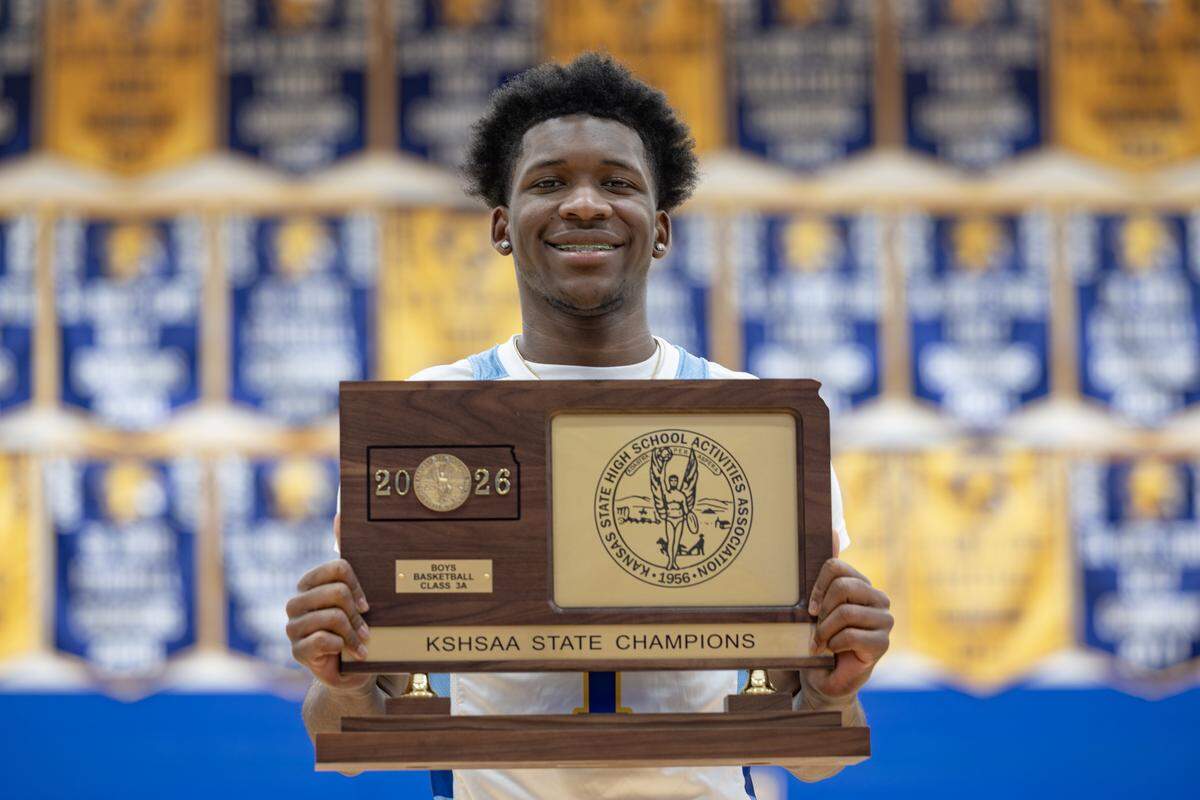
Fifteen months earlier, on Dec. 14, 2024, Hines-Turner lay on the court in pain after tearing the Achilles in his left foot in a buzzer-beating win over Wellington, an injury so devastating that he briefly wondered if it had ended the future he imagined for himself.
Hines-Turner had just helped deliver a thrilling win in the fourth game of the season, driving late and somehow finding Jack Grace wide open underneath for the game-winning basket as time expired in a 76-74 victory. Students rushed the floor. Teammates exploded in celebration. For a few seconds, the gym belonged to pure joy.
Then the mood changed.
Near the foul line, Hines-Turner was writhing in pain.
He knew almost immediately something was very wrong. He had taken a long step back with his left foot to explode and it felt like somebody kicked him from behind. It was a classic Achilles tear. What still seems hard to believe is that he managed to take two more steps after the tear, enough to continue the drive and make the pass that won the game, even as his own body was giving way.
For a star athlete entering a crucial stage of his recruitment, the timing felt brutal.
“Going into your junior year, that’s the year where you want to pop off and show people,” Hines-Turner said. “So that was a big year for me and I feel like it got taken away.”
In the quiet that followed surgery, his mind went to dark places. He wondered whether the injury was a sign, whether the dream he had been chasing was slipping out of reach.
“I started to think maybe the next level was not for me,” he said. “Maybe that wasn’t my path.”
His mother, Davia Turner, never allowed him to stay there for long.
“I remember that he felt like it might have been the end,” she said. “But in my spirit, I always knew Sebastian was destined for greatness. This wasn’t going to be the end of his story.”
Davia leaned on her Christian faith during her son’s recovery, believing prayer would help carry him through. But she also understood that faith alone would not rebuild his body or restore his confidence.
“As much as I wanted to tell him it was going to be OK, ultimately it wasn’t up to me,” Davia said. “So I just stayed in prayer and allowed God to lift him up. But prayer without deeds is dead. He had to put in the hard work.”
That support mattered because the hardest part of the comeback was not just physical.
“The toughest part was definitely the mental part,” Sebastian said. “You come into physical therapy and you do the work, but you do the same thing over and over and over again.”
Cam Clark, the athletic trainer at Collegiate who oversaw much of Hines-Turner’s rehab, said Achilles recovery can be grueling precisely because it is so repetitive. Progress can feel small. There are good days and discouraging ones. Athletes need something to chase.
That’s why Hines-Turner set an aggressive goal of returning in time for Collegiate’s first football game of the 2025 season.
“They have to be able to see that light at the end of the tunnel,” Clark said. “Because the rehab work is grueling and it’s boring. You have to have something to look forward to.”
That target sharpened everything. It gave purpose to every mundane day in rehab. Clark said there were small setbacks and days when Hines-Turner did not feel like he had made progress, but one thing never changed.
He kept showing up.
“Everything you would throw at him, he just buried it,” Clark said. “He was always asking, ‘What’s next?’”
On Sept. 5, 2025, less than nine months after surgery, Hines-Turner suited up for Collegiate’s first football game of the season, exactly as he had hoped. He came back at full force, then went on to earn first-team all-state honors from The Eagle as a standout wide receiver and defensive back.
In some ways, the injury even changed him for the better as a basketball player.
Because Hines-Turner had gone from football to basketball to track and field to summer basketball for so long, he had rarely been forced to slow down and break his game apart piece by piece. During rehab, he finally had that time. He spent endless hours reworking his shooting form and getting up shots on the shooting gun. The result was a more polished perimeter jumper and more confidence from beyond the arc.
Before, teams could sag off and dare him to settle. This season, that became dangerous .If defenders backed up, Hines-Turner made them pay with his jumper.
There was no better example than the state championship game.
Collegiate entered the final weekend as one of the most explosive teams in Kansas. The Spartans went 27-1, averaged big scoring numbers and cracked 100 points three different times. Hines-Turner averaged 19.3 points, 7.4 rebounds and 4.6 assists while serving as one pillar of a devastating three-man attack alongside fellow senior A.J. Batiste, who averaged a team-high 20.4 points, and point guard Kamari Jennings, who averaged 14.9.
That’s what made the first half against Burlington so jarring.
Collegiate scored only 17 points before halftime and trailed by one point at the break. Hines-Turner had played only eight minutes in the first half because of foul trouble. Usually, he is one of the most vocal players in the locker room, the one delivering energy and speeches. This time, he mostly kept to himself. It was less nerves than focus, almost as if he were storing something up.
Then he missed his first shot of the second half, a 16-foot pull-up jumper that came up short.
That was about the last thing that went wrong.
Soon after, Hines-Turner led a fast break and finished an up-and-under layup in transition to put Collegiate in front. With the Spartans trailing 23-19, he recognized the defense was playing too far off and stepped back into a long jumper that splashed through. Right after that, he attacked in transition again and curled in a side-step jumper. The next time down, he saw his defender retreating and drilled a step-back 3-pointer from the top of the key.
Now he was in rhythm and everyone in the building could feel it.
A little later, he got Burlington backpedaling again and hit another step-back 3. On the next possession, he got downhill and finished through contact. Then came the dagger to end the quarter: Hines-Turner dribbled out front, sized up his defender and buried another side-step 3 in the closing seconds to put Collegiate up 36-29 entering the fourth and cap a 17-point explosion.
There was no complicated playbook behind it. Collegiate was essentially giving him the ball and trusting him to carry the team.
He did.
“I just got that look in my eye and I knew I was going to take over the game,” Sebastian said. “I just knew that I’ve been through too much to let this moment slip away.”
That line may explain the performance better than any box score could.
This was not just a hot shooting stretch from a talented senior. It was the release of everything he had carried since that December night in 2024 — the fear that maybe basketball had been taken from him, the endless rehab sessions, the doubt, the rebuilding, the stubborn refusal to let the injury define him.
“It’s something out of a fairy tale,” Clark said. “It was just mind-boggling to see him say, ‘You know what, this one’s mine.’ He just completely took over. We’ve seen him do it before, but this was something special.”
By the end, Hines-Turner had scored 33 points on 11-of-20 shooting. He had delivered 25 in the second half. Collegiate had outscored Burlington 38-24 after halftime and won 55-42 for the school’s seventh state championship, as the program has now won a state title in four different decades.
The championship run was impressive enough on its own. It became even more meaningful considering the short runway that Schmitt had in his first season. Legendary coach Mitch Fiegel retired in the offseason and Schmitt was not hired until the summer. That meant no normal offseason transition and no full summer to build chemistry with a new coach.
Schmitt tweaked things, but he also recognized what Fiegel had built and kept much of the foundation intact, allowing the Spartans to stay true to their fast-paced offensive identity. The players took it from there.
“It just now started to sink in that it wasn’t just a dream,” Schmitt said. “It really happened. And it happened because of the boys on the team. I was just along for the ride. They were the ones who put in the work. They wanted this and they went out and did an amazing job.”
For Schmitt, Hines-Turner’s return itself remained remarkable.
“We still kind of joke that we don’t know if he’s even 100% yet,” Schmitt said. “For him to be back this soon from an Achilles tear is pretty remarkable.”
His mother saw something even deeper in it.
“I feel like everything he has gone through has prepared him to be who he is at this point,” Davia said. “Everything had its purpose. And this ain’t the end. This is just another level and he’s still going up.”
Even Hines-Turner gained perspective from it. Achilles injuries, he said, are often freak accidents. They can happen to anyone, even athletes who do everything right. Once he accepted that, he stopped seeing the injury only as something taken from him and started viewing it as something he had to move through.
That became the heart of his comeback. In his darkest moments, he thought maybe the original path he had imagined was gone. Eventually, he came to believe a different path was still there — but only if he was willing to work for it. He remains uncommitted but eager to help some college basketball team next season.
That is what made the state championship performance feel so powerful. Hines-Turner had not merely returned. He had returned sharper, more skilled and more complete. The player who once overwhelmed opponents mostly with size, strength and athleticism had become someone who could score from all three levels and take over the game with his mind as much as his body.
And when the biggest moment arrived, he looked like someone who understood exactly what it meant to still have the ball in his hands.
“We said all along that this was the year we were going to get it done and no one was going to get in our way,” Hines-Turner said. “We always told ourselves not to be denied. And we weren’t denied.”
In the end, the image that will last is not the one from the torn Achilles, even if that scene changed everything.
It is the one from Hutchinson.
Hines-Turner in full command. Jumpers falling. Confidence swelling. A state championship within reach.
A year earlier, he had wondered whether his story was ending.
Instead, under the brightest lights of the season, he authored the best chapter yet.
.jpg)