
Bob Lutz: Shockers’ search for offense now has heft
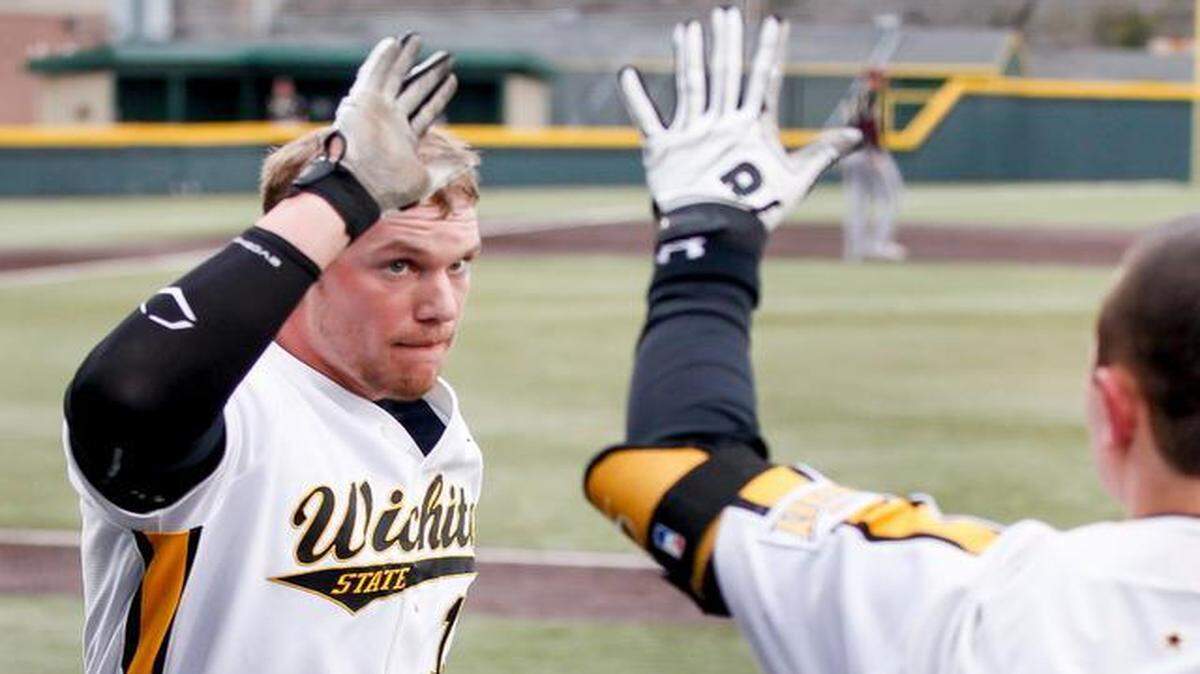
Todd Butler’s first baseball season as Wichita State was, as expected, an adventure. It started with the apparel scandal – he wasn’t involved – that became news again this week when WSU president John Bardo opted not to appeal NCAA sanctions that could take as many as 74 victories from 2012 and 2013 away.
It’s hard enough replacing a coach like Gene Stephenson, who was fired after the 2013 season, let alone being hit immediately with NCAA violations.
Then, WSU endured an up-and-down 31-28 season with the least-effective offense in Shocker history.
Wichita State’s .270 average was its lowest. So were its 294 runs, 101 doubles and 63 stolen bases.
Butler obviously wasn’t going to stand for that. So he went about a restructuring project – 28 of the 37 players on the roster had not appeared in a Wichita State game until this season.
There are a bunch of reinforcements from the junior-college ranks. Six Shockers who were in the lineup for one or both of Friday’s home-opening doubleheader wins over Texas State are transfers from jucos.
And there are some big guys.
It’s too soon to know how much the Shockers’ offense has improved, but they have brought in a bunch of guys who fill out their uniforms.
There’s second baseman Jordan Farris, a Jeff Kent-looking 6-foot-3 and 215 pounds.
New third baseman Chase Rader, who played last season at Coffeyville Community College, packs 215 pounds on his 6-foot frame.
Ryan Tinkman, who caught both ends of Friday’s doubleheader, is 6-5, 205. First baseman Sam Hilliard goes 6-5, 225. Willie Schwanke, a DH/pitcher, is 6-1, 190. And Zach Reding, the DH for the second game, is 6-2, 220.
The Shockers hope they’re beefing up their offense with beef.
It was on display in Friday’s Game 1, when WSU broke loose for a seven-run third inning on the way to a 14-1 rout behind a 17-hit attack.
Game 2 was different as the Shockers went the small-ball route to win 6-1, despite being out-hit 13-6 by the Bobcats. Wichita State was able to wiggle out of several jams while capitalizing on opportunities to score runners from third base with less than two outs.
It’s going to be interesting to see how much Wichita State’s offense improves this season because the NCAA has made it a priority to get more runs and hits into the college game.
Baseballs with lower seams are being used at all levels of the NCAA for the first time this season. Those balls are somewhat harder to grasp for pitchers and travel farther when hit squarely. According to test results that included mathematical formulas well above my pay grade, a ball which used to travel 375 feet with the previous baseball will go 395 feet now.
This ball is more like the one used at professional levels.
College baseball has been struggling to find just the right stove setting for offense vs. pitching for some time now. Remember 1998, when the offense in the game was a runaway train? That’s the year in which the College World Series, then played at Omaha’s Rosenblatt Stadium, produced a staggering 62 home runs. USC defeated Arizona State 21-14 in the championship game.
Too much offense threatened to permanently damage the integrity of the game. And in 2011, as offense continued to boil over, a huge change was made with new standards for bats. Aluminum was ditched in favor of BBCOR (Batted Ball Coefficient of Restitution, whatever that is), which deadens the trampoline effect the barrel of a bat has on a baseball and produces more of a wooden-bat feel.
But the swing to a less-offensive game has been too drastic. Only three home runs were hit during both the 2013 and 2014 College World Series, which now is played at the spacious TD Ameritrade Park in Omaha. The most prestigious tournament in college baseball was becoming a snoozefest.
Too much offense. Not enough offense. College baseball is trying to find a middle ground.
The new baseball, with lower seams, is viewed by many as a compromise.
The Shockers aren’t waiting around for a new baseball to spruce up their offense. Butler went out and got a bunch of big guys with nice credentials in an effort to score more runs and produce more hits.
Wichita State had three .300 hitters last season and, outside of first baseman Casey Gillaspie, lacked hitters that opposing pitchers feared.
But with the strapping new guys joining returning players Daniel Kihle, Mikel Mucha, Tanner Dearman and Tanner Kirk, there is reason to think the Shockers are prepared to do more damage.
There’s bulk in the middle of the lineup. These guys look dangerous, which is a step in the right direction.
Reach Bob Lutz at 316-268-6597 or blutz@wichitaeagle.com. Follow him on Twitter: @boblutz.
This story was originally published February 20, 2015 at 5:54 PM with the headline "Bob Lutz: Shockers’ search for offense now has heft."