
‘We knew that we really had a world-class buck.’ KS hunter kills local legend ‘Grandpa’
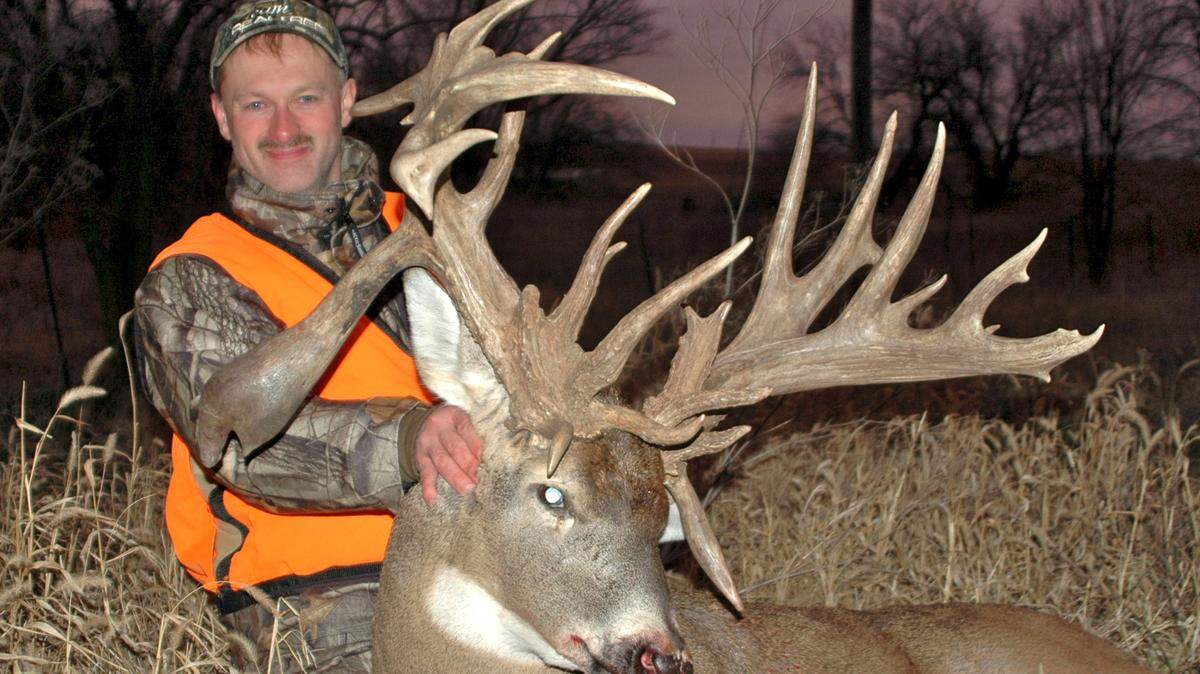
(Editor’s note: Stories about some of the biggest whitetail bucks killed in Kansas are being published now as the annual mating season hits full gear and hunters take vacation (or sick days) and weekends and evenings to take part in the action.)
Gerald Rightmyer is a lifelong hunter who says he has been blessed on a working man’s budget to experience hunts in Africa, Alaska, Canada and South America.
Included in those experiences was shooting a buck locals called “Grandpa” on his first hunting trip in Kansas. Flint Hills locals had told him the buck had enough long tines in all directions to make a moose proud, The Eagle reported in 2006.
“Obviously, Kansas holds a very special place in my heart, just because of what happened,” the trophy hunter said in a recent interview.
It’s currently the sixth-largest non-typical whitetail buck killed in Kansas; it’s around the 30th-largest non-typical buck killed and found by a hunter in the U.S., according to the Kansas Department of Wildlife and Parks and the Boone and Crockett Club, which verifies and keeps records on record racks.
Buck racks, or antlers, can be considered either typical or non-typical. There are records for each category. Typical antlers are mostly symmetric on both sides with tines growing upward off the main beam. Non-typical racks, which are less common, often have points that come off the main vertical beams in all directions and have more antler points. Genetics and injuries factor into antler growth and types.
The western New York native shot a 272 2/8 inch deer in Morris County during a swap hunt for a Rocky Mountain mule deer his friend Scott Fratter made with some local hunters. Fratter originally asked another friend first, but after that didn’t work out he invited Rightmyer to tag along.
Three tines had broken off before Rightmyer killed it.
“I have no doubt he was a legitimate 300-inch deer before those were broken,” he told The Eagle in a previous interview, “but I’m not complaining.”
Fratter and Rightmyer got a good dose of what Kansas weather is like.
It was in the 70s the day before rifle season opened when he hung a stand near a creek bottom. He expected it would be a good crossing for deer.
His friend made a comment about one of them shooting a legendary buck that locals called “Grandpa.”
“That’s a nice story I said but I doubt that happens to me,” he remembered saying.
The weather the next day dropped 50 degrees; it was around zero degrees with the wind chill, he said.
He stayed in his stand through the morning. Around 12:30 p.m., he turned around in his stand and saw a huge buck crossing the creek.
He made a second doe bleat louder than the first to try and stop the deer. The buck stopped this time.
Rightmyer made a roughly 65-yard broadside shot on the buck, who ran about 75 yards before piling up.
The then 39-year-old Rightmyer, who had become a certified Boone and Crockett measurer after taking a week-long course that summer, saw the buck go down.
“I didn’t realize how big he was until I walked up to him. ... It was then that we knew that we really had a world-class buck,” said Rightmyer, who shot the deer with a Remington model 700 that was gifted from his father. “Word traveled like wildfire.”
Someone finally got the legendary Grandpa. He was 6.5 years old.
He had three drop tines, the biggest being nearly 14 inches, The Eagle previously reported. It had an inside spread of 23 2/8 inches.
At the time, the buck was the No. 20 all-time non-typical deer shot in North America, he said.
Rightmyer was scheduled to fly home, but, rather than risk someone damaging the antlers by throwing them in with the cargo, he rented a car and drove the roughly 17 hours with his precious rack.
Score: 272 2/8 inches
Weapon: .270 caliber Remington model 700
Date: Nov. 29, 2006
Approx. time: 12:30 p.m.
Location: Private in Morris County, Kansas
More hunting stories from The Eagle
Kansas is known for its big deer. Here are the Top 10 non-typicals in the Sunflower State
We’re still looking for the top hunting dogs in Kansas; enter yours in our contest
This story was originally published November 22, 2024 at 1:31 PM.