
Surprise measurement results in his first deer being Kansas’ fourth-largest non-typical
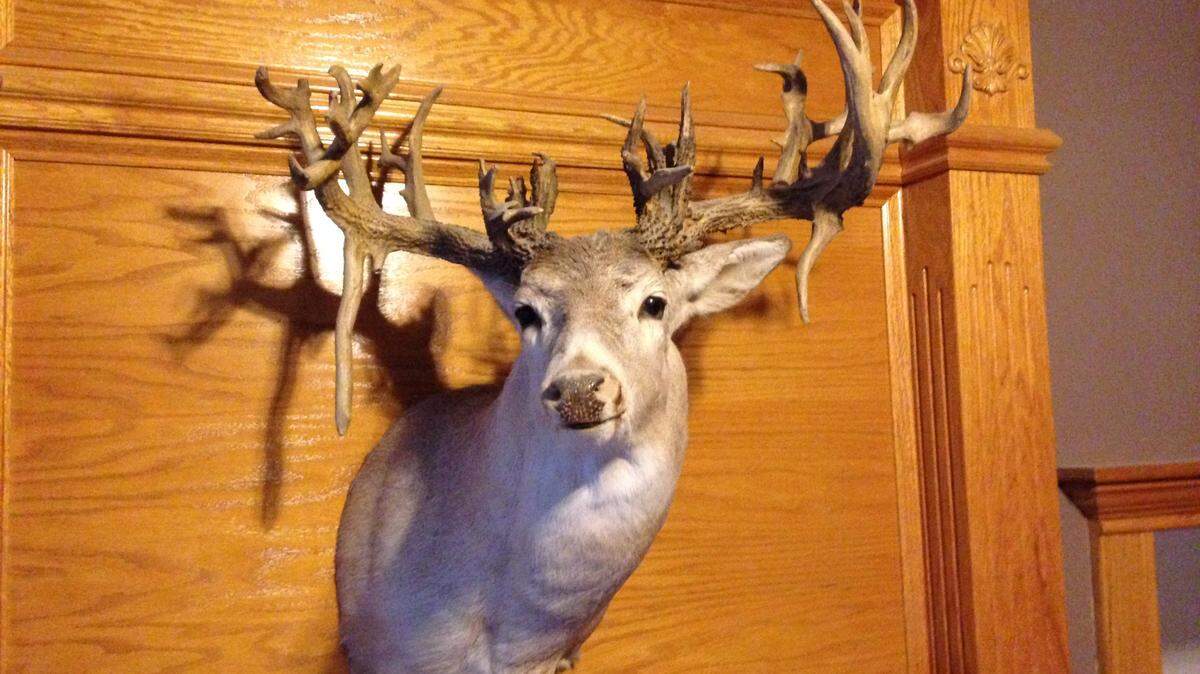
(Editor’s note: Stories about some of the biggest whitetail bucks killed in Kansas are being published now as the annual mating season hits full gear and hunters take vacation (or sick days) and weekends and evenings to take part in the action.)
Chris Theis grew up hunting quail and other birds before roping his father into deer hunting. He didn’t get anything his first year, or his second, or his third.
He finally got his first deer in his fifth year of hunting, on Dec. 12, 1992. It is Kansas’ fourth-largest non-typical buck killed and found by a hunter, according to the Kansas Department of Wildlife and Parks and the Boone and Crockett Club.
The buck is around No. 19 nationwide for largest, non-typical whitetail killed and found by a hunter in the U.S., according to the 2023 Boone and Crockett Club edition.
Buck racks, or antlers, can be considered either typical or non-typical. There are records for each category. Typical antlers are mostly symmetric on both sides with tines growing upward off the main beam. Non-typical racks, which are less common, often have points that come off the main vertical beams in all directions and have more antler points. Genetics and injuries factor into antler growth and types.
Theis’ deer ended up being one for the record book, but only after someone he met at a Christmas party persuaded him to get it measured.
It was between 45-50 degrees.
At the time he was 20 and living in Shawnee and hunting on his grandmother’s farm in Leavenworth County.
Theis was hunting off the ground and using a brush pile for cover. He saw a four-pointer that morning, but it never came in range.
He and his father, David Theis, usually didn’t stay out more than an hour after sunrise, but decided to that day.
Around 10:30 a.m., Chris Theis heard a gunshot. It was his father shooting at a buck, The Eagle reported in 1993. But he missed.
The buck was trailing a doe. The two then crossed the creek Chris Theis was at.
It was about 30 yards away, The Eagle reported in 1993. They were moving at a good clip after being shot at.
Within a few seconds of seeing the buck, Theis fired. He hit the hind quarter, causing it to turn. He fired again but missed.
He saw him lay down about 100 yards away. He went to get his father, telling him he shot a 10- or 12-pointer. The other tines he had thought were brush that tangled in the antlers.
As they walked up, they thought the buck was still alive because his head was up. The deer had expired but couldn’t put his head down because of the drop tine.
“Honestly, what I thought was this is the weirdest deer I have seen in my life,” he said.
The deer was still in velvet, which is usually rubbed off in late summer, and had no genitals, The Eagle reported in 1993. The lack of genitals could explain its velvet and unusual antlers. Bucks with year-around velvet are called “cactus bucks,” which is believed to be caused by disease or testicular trauma, which causes multiple misshapen points and globs of velvet that often look like cactus.
.jpeg "Captur_fitted (2).jpeg")
They didn’t take any field photos, but brought it to the butcher where staff and other hunters took photos. It started making him think maybe the deer was something special.
He went to a Christmas party a couple weeks later. He was telling a guy about the deer he shot.
The man told him to get the deer measured. “I didn’t even know what that was,” Theis said.
He added: “If that hadn’t happened, it [the antlers] would have just sat in my closet for years.”
He only turned it into a skull cap originally, but later got a store-bought cape and mounted it.
Today, the 52-year-old lives in Lee Summit, Missouri, and now exclusively hunts deer with a compound bow.
Score: 279 ⅛ inch
Weapon: Marlin 30-30 lever action
Date: Dec. 12, 1992
Approx. time: 10:30 a.m.
Location: Private land in Leavenworth County, Kansas
More hunting stories from The Eagle
Kansas is known for its big deer. Here are the Top 10 non-typicals in the Sunflower State
We’re still looking for the top hunting dogs in Kansas; enter yours in our contest
This story was originally published November 22, 2024 at 1:30 PM.