
Why Wichita State’s rim-finishing woes loom large vs. North Texas
For Wichita State, the most troubling numbers this season sit right at the rim.
The Shockers are elite at getting to the basket. According to CBB Analytics, the team ranks 18th nationally in the percentage of field-goal attempts taken within 4.5 feet of the rim. They consistently pressure defenses with downhill drives, cuts and offensive rebounds, exactly the type of shots most offenses are built to prioritize.
Instead, those attempts have exposed a glaring flaw. WSU is converting just 52.7% of its shots at the rim, ranking No. 351 nationally and finishing roughly 10% below the Division I average. Even more concerning is when those misses occur.
In the first 10 seconds of the shot clock, typically the most advantageous window for rim attempts, the Shockers are still one of the worst finishing teams in the country.
“It creates a lot of other opportunities by playing with force,” coach Paul Mills said. “So we’re doing it, we’re just not finishing.”
That tension — generating quality looks but failing to convert them — has become the defining issue of the Shockers’ offense.
It’s an issue that looms large as WSU (9-7) prepares to host North Texas (10-6) in a 2 p.m. game Sunday at Koch Arena with the game airing on ESPNU. Both teams enter 1-2 in American Conference play, but the matchup doubles as a stress test for WSU’s finishing woes against one of the nation’s stingiest defenses.
North Texas cuts off access to the rim better than almost anyone. The Mean Green rank in the top 50 nationally at preventing shots at the basket and over the past five games, that number has climbed to No. 6. That is by design. Their “no-middle” defense is built to angle ball-handlers away from the center of the floor, sit on driving lanes and force attacks toward help defenders along the baseline — all with the singular goal of eliminating clean looks at the rim before they ever materialize.
However, when opponents do break through, they have converted at a 58.3% clip at the rim, offering WSU a glimpse of hope if it can be more efficient.
What makes the problem especially frustrating for WSU is that it often does the hardest part. The Shockers rebound 46% of their missed shots at the rim, an elite rate nationally. So they retrieve missed opportunities and generate second chances, but they just do not consistently convert them.
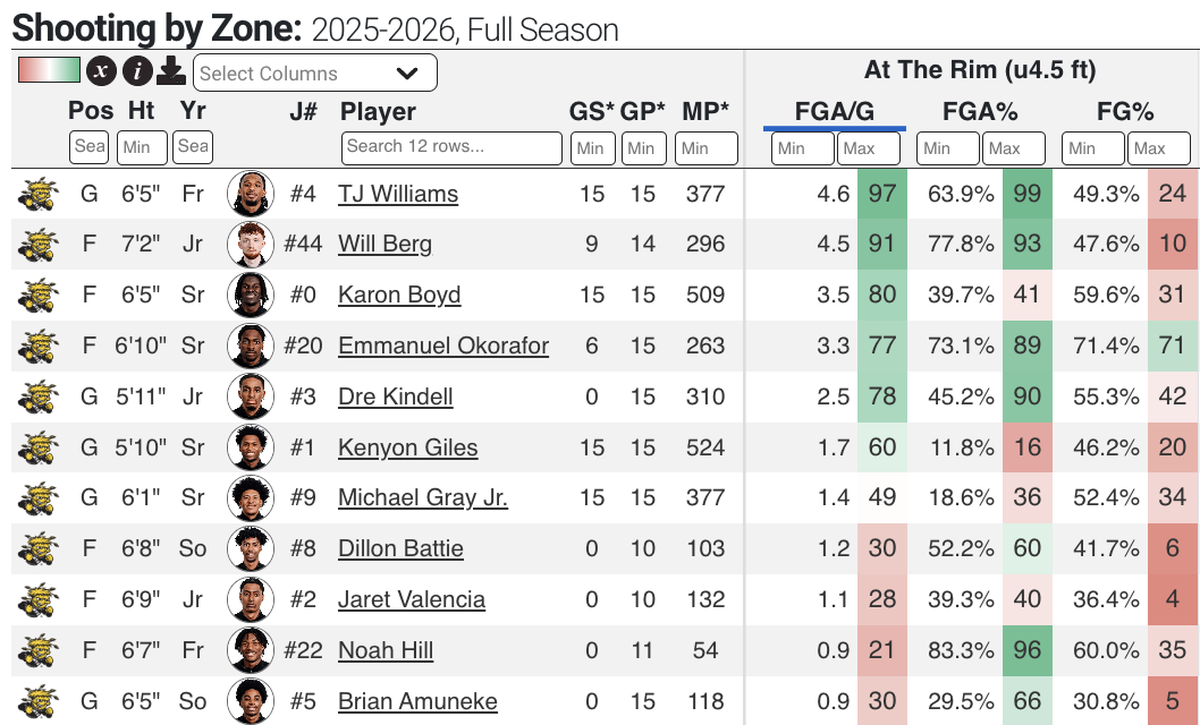
Individually, the disparity is stark. Center Emmanuel Okorafor has been excellent, finishing 71% of his shots at the rim. Karon Boyd is next at 60%. After that, the numbers fall sharply.
Freshman wing T.J. Williams is converting just 49% on 4.6 rim attempts per game, while 7-foot-2 center Will Berg is at 48% on 4.5 attempts, a figure that ranks in the 10th percentile nationally. Kenyon Giles, WSU’s undersized scoring dynamo, is at 46% on limited volume.
Mills does not believe the answer is to attack less.
“I think every coach who would ever sit here would tell you, ‘How do we become number one at that?’” Mills said of WSU’s top billing in generating shots at the rim.
That aggression is a foundational principle of the program. It draws fouls, collapses defenses and creates opportunities for others when executed with discipline.
That’s why Mills believes the solution is simply more practice at it.
“You just practice,” Mills said. “It’s just like free-throw shooting. We’ve seen improved free-throw shooting since the DePaul game. That’s simply guys putting in the time.
“There’s a commitment to being able to convert opportunities around the rim. But the truth is, it just comes down to work.”
The refinement Mills is chasing is less about toughness and more about control. Guards and wings are being asked to attack with a plan in mind — jump off one foot if the lane is open, two feet if it is not — and to lean into the program’s “P Squared” principle of paint and pass. Generate the paint touch first, then make the basketball play that follows.
Williams is emblematic of that learning curve. As scouting reports have evolved on the freshman, defenders are backing off him on the perimeter, daring him to shoot. Against Rice, that space led to some out-of-control drives where Williams appeared to be more focused on drawing a whistle than making a play.
With his passing ability, Williams is a prime candidate to improve under a renewed “P Squared” mindset.
“He’s not trying to go in there and make a basketball play,” Mills said. “He’s just sticking his head down and hoping that he gets bailed out by a whistle. He needs to go in and play under control and make basketball plays.”
Sunday is unlikely to offer easy answers.
Mills predicted a rock fight, as North Texas has won all three battles against the Shockers since joining the conference. The Mean Green enter with an elite defense and star power in Je’Shawn Stevenson, a 6-foot-2 guard averaging 16.9 points.
For WSU, the urgency should be unmistakable.
After back-to-back losses by a combined six points to teams projected to finish in the bottom half of the league, the Shockers need to stop the bleeding at home. Doing so will almost certainly require solving their most persistent problem, finishing at the rim, against one of the nation’s elite defenses.
This story was originally published January 10, 2026 at 6:02 AM.
.jpg)