
Here’s what Gregg Marshall thinks is the secret to his coaching tree success at WSU
Since arriving at Wichita State in 2007, the branches on the Gregg Marshall coaching tree have become more impressive with each passing year.
Entering his 14th season with the Shockers, Marshall has had a total of 13 assistant coaches, and five of the 10 who’ve left are currently employed as Division I head coaches. Since leaving WSU, Earl Grant (College of Charleston), Dana Ford (Missouri State), Chris Jans (New Mexico State), Steve Forbes (Wake Forest) and Donnie Jones (Stetson) each occupy top hoops jobs at their respective schools.
“Now it takes me a little more time to read the sports section because I have to follow a lot of teams,” Marshall said in a recent webinar hosted by the National Association of Basketball Coaches.
Counting his time at Winthrop, where he tutored Barclay Radebaugh (Charleston Southern) and Zach Spiker (Drexel) before they became head coaches, Marshall’s coaching tree has produced eight current Division I head coaches — a “big source of pride,” he said.
So what does Marshall look for in an assistant coach?
“I like to have people on my staff that I like to hang out with,” Marshall said. “That I like to not just work with in the office and coach with on the floor and in games, but come over to the house in the evening and kick it by the pool and have a cold beer with. We spend so much time together that I want people that I have something in common with, that I like talking to, and I enjoy being around.”
But a compatible personality isn’t the only trait that Marshall wants. He also requires loyalty.
“There’s so many times in this business where guys have not been successful because they can’t keep a staff,” Marshall said. “Guys come and go and it’s like a revolving door. It’s a double-edged sword because you want your guys to be able to move on and be successful in coaching.
“What I’ve asked my guys to do when I hire them is a two-year commitment. Don’t come in and leave in one year, unless it’s a head coaching job. Don’t jump for another assistant coaching job that pays $12,000 more and never even finish one recruiting cycle.”
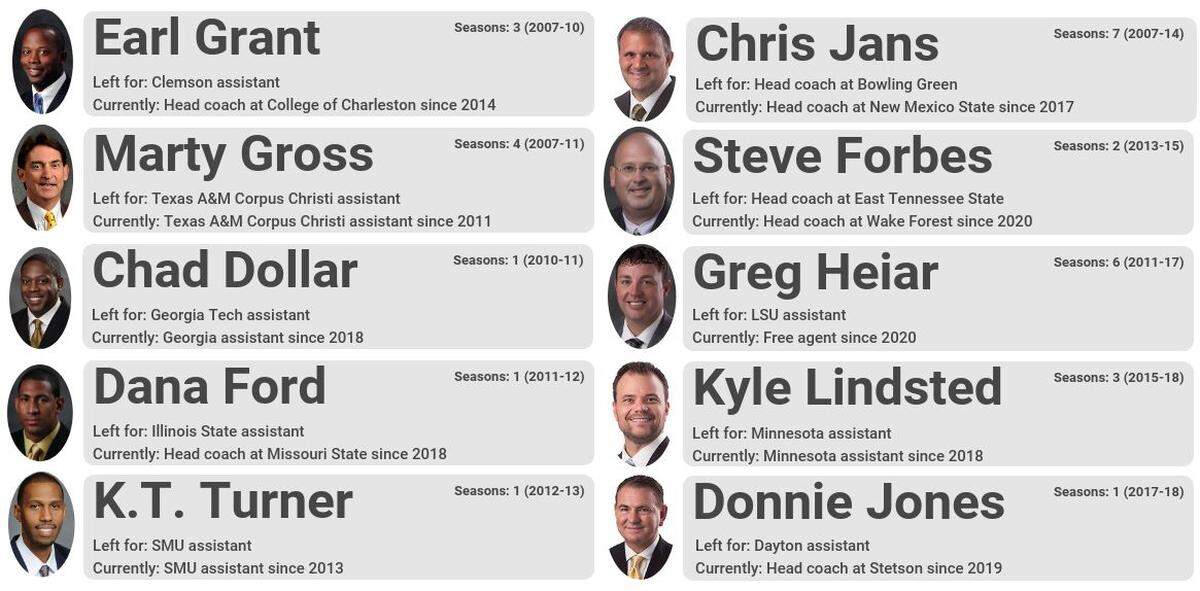
The majority of his assistants have adhered to Marshall’s request, as nine of the 13 assistant coaches to work under him at WSU have stayed at least two seasons. Their average stay has lasted a little more than three seasons. Marshall has had the same director of operations, Dominic Okon, for all 14 of his years in Wichita.
His current trio of assistants — Isaac Brown, Lou Gudino, and Tyson Waterman — are entering their third straight season together, only the second time that has happened under Marshall at WSU. Brown, who has been with Marshall since 2014, is entering his seventh season as an assistant at WSU, tied with Chris Jans (2007-14) for the longest-tenured assistant under Marshall.
In his webinar with NABC, Marshall shed some light on the motivation he gives his coaching staff.
“First of all, I tell them treat this job at Wichita State like it’s the Los Angeles Lakers or the Boston Celtics or the Toronto Raptors,” Marshall said. “Treat it like it’s the best job in the world. Care for it, give it your undivided attention, really pour yourself into this job. If you do that, then the job will repay you.”
Here is a roundup of other highlights from Marshall’s hour-long chat with the NABC:
On the new season: “We’ve got seven new guys coming in. We’ve had Zoom meetings. We’ve had many, many phone calls and FaceTimes and things like that. We’ve sent them some of our playbook and hopefully they’ve been looking at that and learning. The plan for them is to come back in late June and early July and we can have some sit-downs in the office with the dry erase board and go over what we’re doing. We’re going to be able to start working on them on July 20 and have eight weeks from that point to get in our summer work. I’m really, really excited about this new group of young men and our returners. I don’t think there will be much expected of us with the turnover that we had, but I’m very, very optimistic and excited about building this team this coming year.”
On what he looks for in recruiting: “At all of my early (coaching) jobs, I was a grinder. There was no silver spoon. My dad wasn’t a coach. I didn’t play in the NBA. There’s no name recognition. You have to grind your way to where you want to be. We try to do the same thing with our team. We want guys that are self-starters that are going to put in some time on their own. We only get ‘X’ amount of time. We’ve developed well over 30 pros at Wichita State and six NBA guys, but we don’t get top-100 guys. So they have to come in and be pretty special to go from a two-star or a three-star or a zero-star and make themselves pros. We want guys that have some type of ability to affect winning, whether it be great on-the-ball defending, a great passer, a good screener, a big-time rebounder. I love ball-getters, guys that give tremendous effort. We teach toughness where effort is vital. We try to play as hard or harder than our opposition every single night.”
On how WSU decides the team captain: “I don’t choose the team captain, I let the players choose the team captain. I don’t want to appoint someone in a position of leadership. I think leadership should come naturally. I don’t want to appoint someone maybe the guys don’t respect or like or don’t think is a very good leader. I’m not in that locker room, I’m not in the apartments, I don’t see the things like they do. I think the natural evolution of a leader is way more valuable and important. We always tell them our offices are open all the time. If you have something you need to talk about or get off your chest that’s bothering you, you have to come talk to us.
“We can’t read your mind. I have the players over individually and in small groups and the whole team over to my house several times a month. We try to encourage and build relationships with these guys. But your captain needs to be that guy that can whisper in your ear, ‘Hey coach, I think we may need to think about this.’ You rely on that and I’ve got to do a better job of that, especially in these times that we’re in now. We’ve all got to be better listeners. We genuinely have to listen and I especially want to be a better listener and give not only the captain, but any leader in your program that really cares about the program, give them a sense of ownership so they feel like they can come to you and bring important issues to your attention.”
On how WSU has become a great rebounding program: “Rebounding is a big part of what we do and you have to teach and drill rebounding in everything that you do. That means 1-on-1, 2-on-2, all the way up to 5-on-5. The possession is not over until the rebound is secured and the whistle is blown. So every possession, every drill, every day you’re getting those guys to compete offensively to go get the basketball, which in turn makes your defense have to check out and block out and finish the possession with two hands. It’s an every-day, every-drill thing. It doesn’t matter what drill you’re doing, make or miss, there still has to be a rebound. Even if it goes through the net, we still have to secure it. It’s an emphasis more than a specific drill.”
On his defensive philosophy: “Our biggest thing is make sure you are giving great effort, sprinting back in transition, getting your butt to the baseline, communicating, getting in a stance and helping your team. Defense is not just an individual thing, it’s a team thing. Helping the team force the opposition into a tough, contested jump shot or a turnover. That takes 30 seconds of great effort, great communication, great teamwork and great toughness and then finishing the possession by securing the ball. You just have to demand it every day.
“We try to recruit guys that fit in with that. Not guys that you see in AAU that never pass the ball and it’s all about them. Malcontents when they’re not scoring, even if the team is winning. We don’t recruit those guys. We recruit guys that we think care more about winning and understanding what it takes to win. Sometimes you’ve got to go set a good screen.
“I try to value guys like that who set a good screen or throw a good pass just as much or more as guys putting the ball in the basket to finish the possession. You have to praise those guys all the time and never miss an opportunity to praise what I call guys making winning plays.”
This story was originally published June 23, 2020 at 6:05 AM.
.jpg)