Family of LaVannes Squires to be recognized at KU-K-State game in Allen Fieldhouse
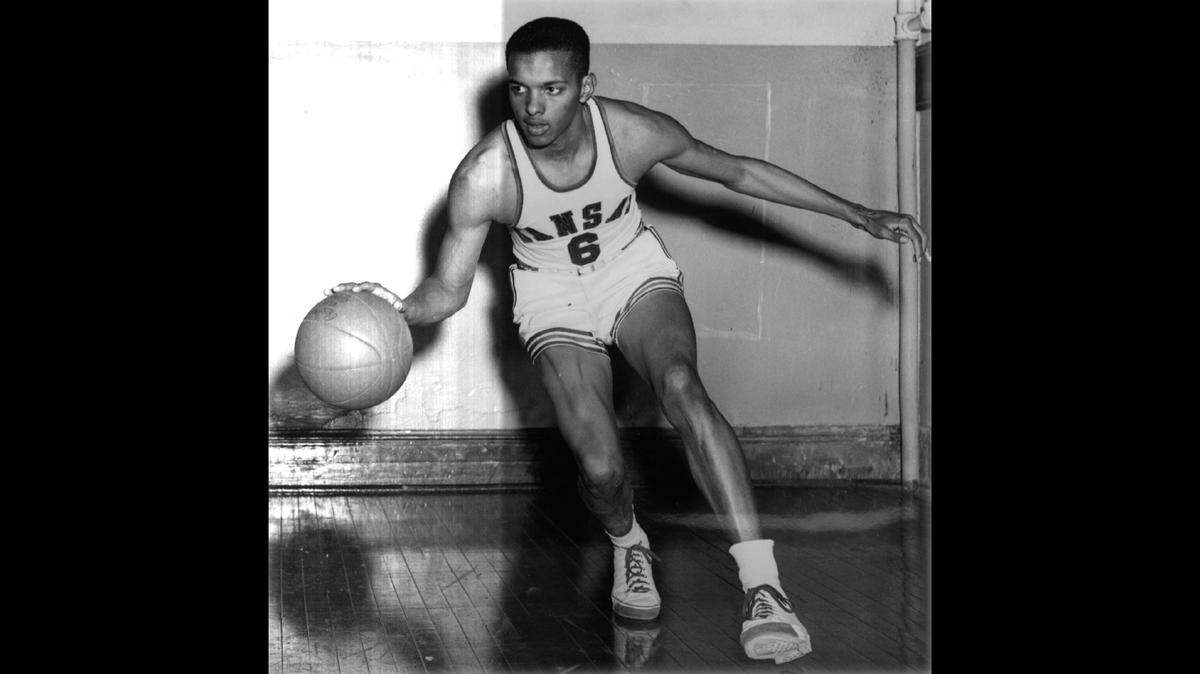
Several members of the family of LaVannes Squires, the first Black men’s basketball player at the University of Kansas, who died Feb. 19, 2021 at the age of 90, met with the Jayhawks players after practice on Monday afternoon, attended coach Bill Self’s weekly Hawk Talk radio show Monday night and will be recognized at Tuesday night’s Kansas-Kansas State game at Allen Fieldhouse.
Tuesday’s on-court recognition of Squires, a member of KU’s 1952 NCAA title team, will include La Tanya Squires (LaVannes’ daughter), Gwen Squires (LaVannes’ niece), Goulade Farrah (LaVannes’ mentee) and Joshua Smiley (LaVannes’ great nephew).
Both KU and K-State, who will meet in an 8 p.m. tipoff Tuesday, this season are honoring KU’s Squires and K-State’s Gene Wilson, who broke the color barrier in basketball at both schools during the 1951-52 season.
Both schools, as they did during the first Sunflower Showdown of the season on Jan. 22 at Bramlage Coliseum, will wear special shirts before the game and KU’s coaches will wear a patch honoring the individuals. The Jayhawks will wear special uniforms during the game honoring Black Excellence and Squires.
Squires lettered three seasons at KU from 1952-54 on teams coached by Phog Allen. In 1950-51 Squires earned KU’s freshman basketball award. With Squires on the team, Kansas won the 1952 NCAA championship, three Big Seven regular-season titles and two Big Seven holiday tournaments.
He went on to become a successful banker.
“LaVannes Squires is important to the history of this program. Primarily he paved the way. He opened the doors for many to follow,” KU coach Self said at KUathletics.com. “In large part, if you look big picture, he’s important to the history of college basketball because if he hadn’t come here I doubt that Wilt (Chamberlain) would have ever come here. That helped shape the landscape of the history of our game.
“It would never get as good as it is now without somebody like LaVannes Squires,” Self added. “I’m sure his talents were probably squashed a little bit because of the pressures others (in society) felt to maybe squash them. That would be so frustrating and hard for anybody. He took that and I’m sure he was an unbelievable teammate loved by his peers. Then he goes off in the business world and kills it.” Self added.
On his Hawk Talk radio show, Self said: “There has to be a first and being the first in 1951 and ‘52 and ‘53 … it was totally new and probably not very well accepted. Having the courage, and not only an individual having the courage but a family to stick in there and know that your son would be going through some of these things and saying, ‘Hey, this is not only great for you but you’re setting the tone for so many others and you’re setting the tone for the future,’ is special.
“There’s so many people across America but certainly within our program whose life is better because of LaVannes and the courage that he showed,” continued Self. “We’re very proud to have LaVannes’ family here because it the sacrifices that people make for the good of others should always be noted and respected,” Self stated.
KU senior power forward David McCormack said at kuathletics.com: “I think it’s very important to recognize LaVannes Squires — one for being the first African-American basketball player here. He definitely set the tone for athletes to come after him. Because of him we were able to cross boundaries that were never set before and able to follow in his footsteps and continue to break barriers. He definitely was a man of dedication and discipline in order to receive the treatment he did and still go on to become a successful banker — to continue to play, show his strength and composure and how he held himself to a higher standard.”
Born in Hartsdale, Missouri, Squires, who was the eighth of 12 children, was raised in Wichita, where he played basketball for Hall of Fame coach Ralph Miller at Wichita East High School.
At East, Squires served as a team captain and earned All-City and All-State honors his senior year. Academically he graduated in the top 10 percent of his class.
After graduating from KU, Squires worked in the accounting office for Look Magazine in Des Moines, Iowa. He worked at Douglass State Bank in Kansas City, Kansas, then Swope Parkway National Bank in Kansas City, Missouri.
In 1964, Squires started as chief executive officer at Bank of Finance and later became president of the bank.
Squires started L.C. Squires Real Estate Company, Inc., in Los Angeles. He later created a postal center in his Los Angeles community and following retirement Squires worked in real estate and trading until his death.
Former KU basketball player Nolen Ellison said this about Squires in a 2016 article on the KU Athletics’ website: “The influence of early Black KU athletes like LaVannes Squires, Wilt Chamberlain, Maurice King and Bill Bridges had addressed the several issues of race that confronted American sports in the late 40s and 50s.”
K-State’s Wilson died on May 30, 2020 at the age of 89.
Wilson according to kstatesports.com “was one of the rare athletes to be mentored by two Naismith Hall of Fame head coaches in Jack Gardner and Tex Winter, helping the Wildcats win 47 games in his two stints, including a Big Seven Championship and an NCAA West Regional Semifinal appearance as a senior in 1955-56. He also ran track for legendary Wildcat track coach Ward Haylett, who was later inducted into the National Track and Field Hall of Fame.”
Wilson was drafted into the Army in 1952, where he served 13 months in the Korean War before returning to campus in 1954.
Wilson became the first Black director of the State of Kansas Youth Center in Topeka and the second director of the Equal Employment Opportunity Commission (EEOC). He was also the first Black umpire for the American Legion in Topeka, where he participated in 12 regional games, four World Series Tournaments and two international series tournaments.
Born in Anderson, Indiana, Wilson was inducted into the inaugural class of the Shawnee County Baseball Hall of Fame in 2013 due his outstanding umpiring services to the youth of Topeka for over 50 years.
This story was originally published February 22, 2022 at 1:21 PM with the headline "Family of LaVannes Squires to be recognized at KU-K-State game in Allen Fieldhouse."