Why did KU Jayhawks’ win over West Virginia bring baseball thoughts? Glad you asked
Before we dig deeper into Kansas’ 79-65 victory over West Virginia — and why it made me think a lot about baseball — let’s start with a thought exercise.
Here’s a photo of two Jalen Wilson three-point tries, one from last week’s game against Texas Tech and the other from Tuesday.
Take a few seconds here and go through the details: the score, the separation from the closest defender, the distance of the shot.
Which attempt would you rather have? Or, another way of looking at it ... would you consider these good shot attempts, or bad ones?
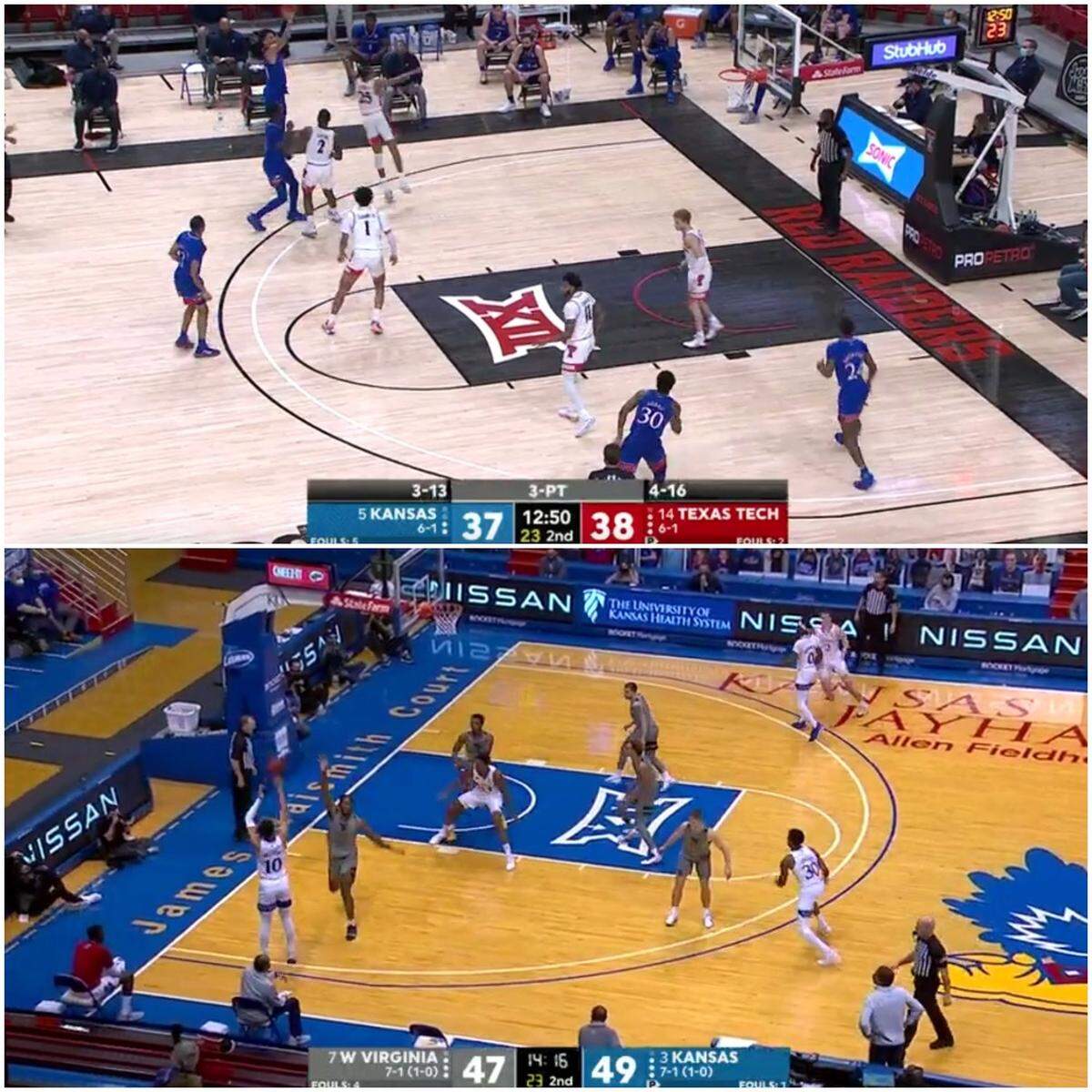
OK, now that you’ve committed to an answer, we can point out the similarities. Both feature a close score early in the second half, with Wilson appearing semi-guarded and 23 seconds left on the shot clock.
Those watching Tuesday’s game probably know how the bottom picture turned out. Wilson — following two KU passes — made one of his four three-pointers, firing away confidently in front of KU’s bench.
The top photo had a much different outcome. Not only did Wilson’s three miss off the front rim, but the decision also resulted in him getting benched, with KU coach Bill Self delivering this basic message in front of ESPN’s cameras: What are you doing? That was the first pass of the possession.
These two shots — and the completely different reactions they received — are why my mind started wandering to baseball in the second half.
Former Red Sox and Cubs executive Theo Epstein started a conversation this month that is relatable across sports. He admitted he was part of the problem when it came to baseball becoming less entertaining in the last few years, simply because his teams were trying to utilize every analytics edge.
Power mostly wins in baseball, for example, not speed. And studies have shown that it doesn’t matter all that much if your hitters strike out; as long as they can walk and mash, swinging through strike three sometimes isn’t all that harmful.
It made sense for Epstein to take advantage of this knowledge. He was given the rules to a game, figured out how to play it optimally, then worked to implement his pieces in the most ideal ways.
And yet ... I think this is why analytics often gets a bad rap from fans and reporters alike. Epstein wasn’t building rosters to create beautiful music; he was churning to make the most efficient factory in town.
It can all seem so unromantic — while also going against so much of what we as humans value in every other walk of life.
A sacrifice bunt isn’t just about moving a runner ... it’s about showing a willingness to be a team player. Going the other way for a single might not have gotten you the same reward as a home run ... but it shows you are fine giving up on some power to put the group’s goals ahead of your own.
It’s a long way of looping back to KU, but also reflects the same type of dilemma that Self faces with the screenshot above.
Does the KU coach want his team to make beautiful music? Or does he want it to churn to become the most efficient machine around?
The emotional Self would have reason to get mad at both shots. KU didn’t move the defense side to side, as he has preached for decades. The Jayhawks didn’t push the ball inside and out, and also didn’t give the defense much of an opportunity to break down.
But I’m here to tell you: From a strict numbers standpoint, that all might not matter too much, especially with this particular team.
A semi-guarded three-pointer is a win offensively for KU. Synergy Sports’ charting numbers reflect this, as the Jayhawks have averaged 1.083 points per possession on “guarded” spot-up attempts this season; that’s in the 79th percentile nationally, and also nearly identical to the team’s output in transition situations (1.09 PPP).
Thinking even more logically, putting up these tough-ish perimeter attempts have three clear positive outcomes:
1. KU has the potential of three points;
2. It ensures the team does not turn it over later in the possession;
3. It gives KU an opportunity for an offensive rebound.
Self reflected on that third aspect when talking to reporters after Tuesday’s game.
“We did a great job of running down a ton of long misses. If we missed 21 threes, which is a ton, I wouldn’t be surprised we got 10 of them back,” said Self, whose team did get the offensive rebound on exactly 10 of its 21 errant three-pointers. “ ... That’s also something to think about from a strategy standpoint: Do we need to shoot more threes just so we can become a better rebounding team offensively?”
Self has recently proven himself to be one of college basketball’s most adaptable coaches. He’s shifted from two-big to four-guard to five-out offenses at a rapid pace, and also has quickly left behind outdated thoughts about three-pointers that he firmly believed just a few years ago.
He’s not the same coach defensively either. Self, in the not-so-distant past, didn’t allow his teams to switch any screens in non-conference play, believing that was both soft and the easy way out; now, a huge part of the Jayhawks’ success is that their guards trade off on everything while making it difficult for opponents to get into the plays they want to run.
This is the gray area that Self must navigate when it comes to three-point shot selection moving forward.
There are valid reasons to want a team that plays unselfishly. There is strong rationale for wanting to make defenders move, along with getting players to search for opportunities to pass up good shots in order to get teammates better ones.
Then again ... the numbers are screaming for KU to “settle” for more of those good three-point attempts. Tuesday’s barrage gives a best-case scenario, but considering the Jayhawks have made 39% of their threes compared to 47% of their twos ... it’s clear that they would stand to benefit from hunting more outside shots than they have so far.
All coaches have an ideal way to play. Every team would love to win with a beautiful offense that played an entertaining style in transition while sharing the ball effectively in the half-court.
The reality is a bit different. Teams have flaws, and passionless statistics often point to a more efficient path, even if it flies in the face of long-held beliefs or feel-good vibes.
Self finds himself at that crossroads now, with the Wilson photo above serving as a litmus test.
Are those good shots or bad?
The math would tell us there’s a clear answer ... as unromantic as it might be.
This story was originally published December 23, 2020 at 3:58 AM with the headline "Why did KU Jayhawks’ win over West Virginia bring baseball thoughts? Glad you asked."