
What’s the end game for Big 12 after taking aim at ESPN in conference realignment?
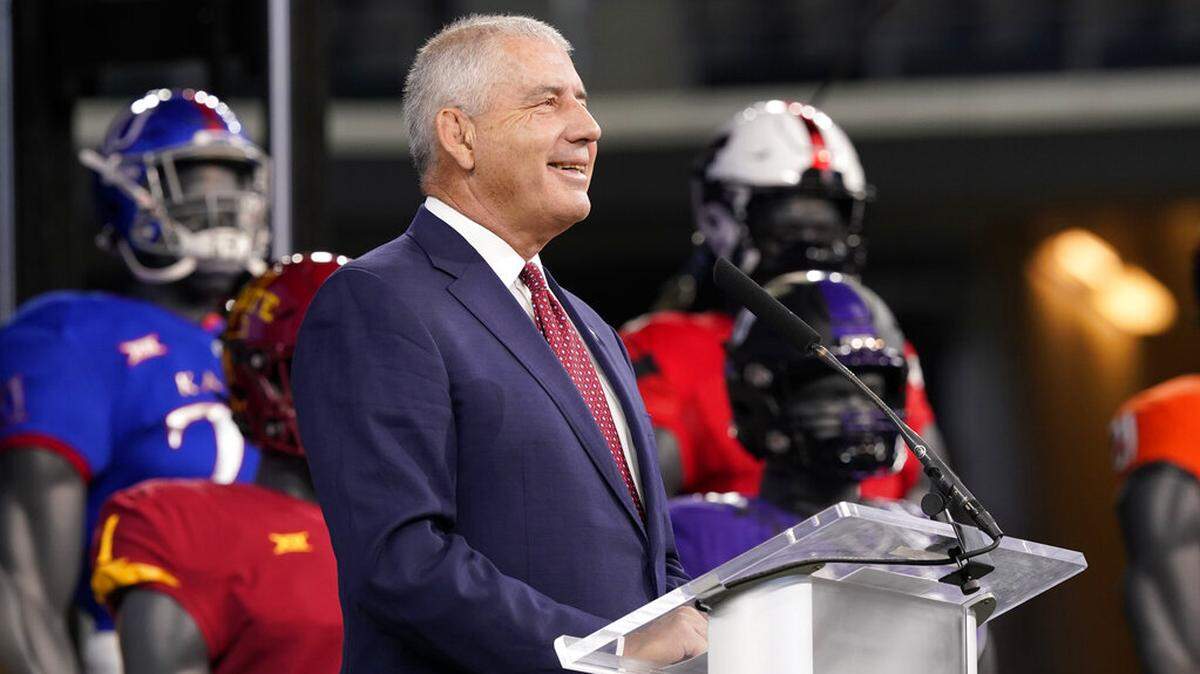
It’s impossible to know what the future holds for the Big 12 without Oklahoma and Texas, but one thing does appear clear following the conference’s nuclear accusations against ESPN.
The Big 12’s eight remaining members will likely stay united for at least a little while longer.
Teams across the league were furious when the American Athletic Conference approached three to five schools in the Big 12 and tried to poach them earlier this week, according to a pair of sources who are administrators in the conference. Big 12 commissioner Bob Bowlsby claimed that ESPN conspired with the AAC beforehand and he has told media outlets that he has irrefutable proof.
“This whole thing has been a complete articulation of deception,” Bowlsby told The Associated Press on Wednesday.
The eight remaining schools in the Big 12 seem to agree. The two administrators said the eight were unanimously in favor of Bowlsby sending a cease-and-desist letter to ESPN on Wednesday to prevent the network from having future conversations with Big 12 schools or other conferences pertaining to future realignment that involve the Big 12.
CBS Sports has reported that Big 12 leaders think the AAC will ultimately try to poach all eight remaining Big 12 teams, though it’s unclear why the American thinks it has a realistic shot of pulling off such a move.
On Thursday, ESPN responded to the letter, saying Bowlsby’s accusations are without merit.
“ESPN has engaged in no wrongful conduct and, thus, there is nothing to ‘cease and desist.’ We trust this will put the matter to rest,” wrote Burke Mangus, ESPN president for programming and original content, in part.
ESPN may still be the Big 12’s primary TV provider, but they aren’t on speaking terms at the moment.
People like to say the enemy of my enemy is my friend, and that famous move line applies here. Yes, teams across the Big 12 are likely working behind closed doors to make contingency plans with other conferences as the college sports landscape continues to change, but they also appear willing to work together in the short term if for no other reason to collect as much money as possible from the Sooners, the Longhorns and possibly ESPN, potentially through litigation.
This was the Big 12’s first bold move as a conference since news broke last week about Oklahoma and Texas plotting a course to the SEC.
What’s next?
The most pressing issue seems to revolve around the Big 12’s departing members. Oklahoma and Texas are contractually bound to the Big 12 through 2024-25. Awkward as it may be to keep them in the conference for four more years, that would make financial sense for the other eight members. The longer they can make power-conference TV money, the better.
Or the conference could work to negotiate an early exit penalty with the Sooners and Longhorns. It has been reported that those penalties could go as high as $80 million per departing school, which would be worth around $20 million for each remaining member. But at least one source has suggested the Big 12 could possibly push for even more cash than what has been reported.
In any case, that is far too much money for the remaining Big 12 schools to simply walk away from.
Oklahoma, Texas and ESPN would all save money if Big 12 teams joined other leagues and the conference dissolved, but that seems unlikely to happen now. The Big 12’s accusations against ESPN and the AAC could significantly slow the pace of further realignment, and its cease-and-desist letter seems like a good way to signal that it is ready for a legal battle.
It would be foolish for any remaining school to walk away from the conference until it milks every cent possible out of its departing cash cows.
Bowlsby told media outlets that the Big 12’s remaining schools have promising realignment options if they stick together.
It will be interesting to see if they can remain united in the long term. If the Big 12 can’t repair its relationship with ESPN, that means the conference will need to look elsewhere for future TV packages. Would CBS or Fox make better partners? Could a streamer like Amazon or Hulu enter the picture? Eliminating one bidder from the process could have a negative impact.
For now, though, the Big 12 is united against a common enemy.
Drew Davison of the Fort Worth Star-Telegram contributed reporting
This story was originally published July 29, 2021 at 12:44 PM.