A bumblebee lookalike could be gnawing through your Kansas deck this spring
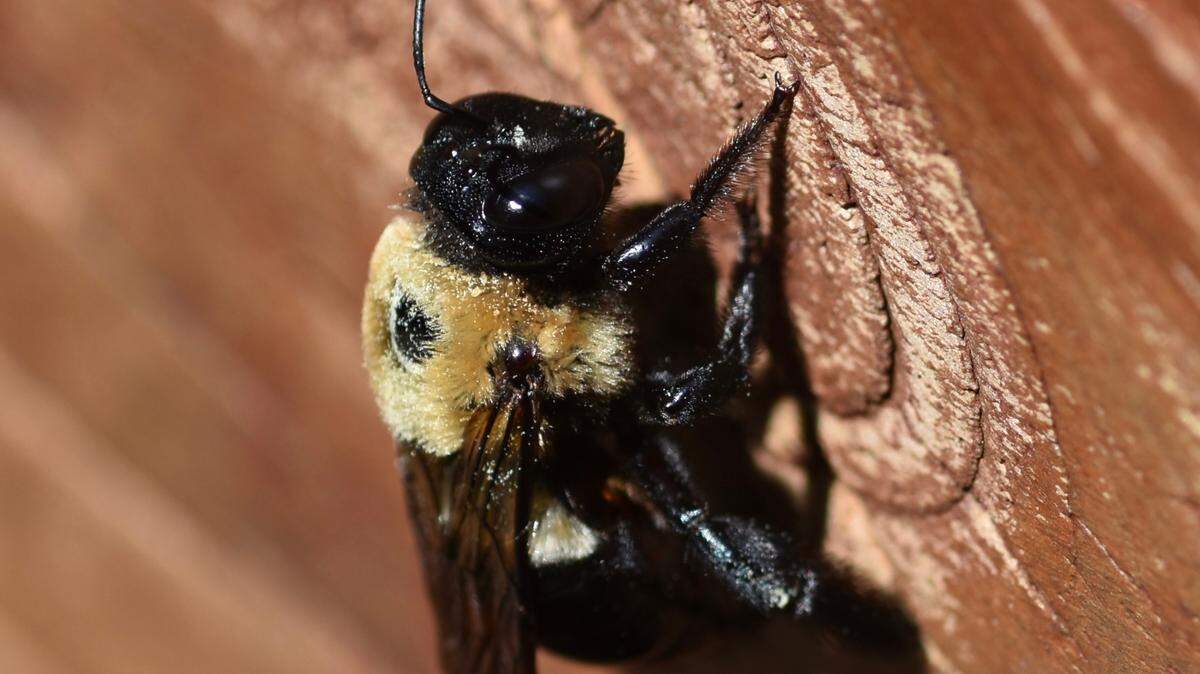
As the afternoons get warmer leading up to the first day of summer, insects are becoming more and more active.
But that doesn’t just mean you see more insects out and about on your morning walk — it could also mean visible damage to your property.
One of these nuisances is the carpenter bee, a species oftentimes confused with the bumblebee, which can burrow into your wooden decks and structures, leading to costly repairs on your Kansas property.
The carpenter bee is native to the United States, said Raymond Cloyd, Ph.D. and an entomology professor at Kansas State University, and the adults usually come out in the months of April and May.
“They’ll mate, and then the female will find a location, wood, to develop a nest, and then she’ll provision it with some pollen [and] nectar,” he said. “That’s naturally where they become a problem is, when they’re on a deck or wood structure, they create their round holes, they go in a little bit, and then they make a right angle, and that’s where the larva develop.”
From there, the larva will emerge and feed on the nectar and pollen, and then develop into adults. There’s only one generation of carpenter bees each year, Cloyd said.
Like all insects, for carpenter bees, the warmer the temperature the better. They’re usually most active outdoors when temperature reaches the 70s and 80s.
So how might you protect your wooden deck, patios and play structures from a nuisance carpenter bee?
“If you have like a deck or area that hasn’t been varnished or stained, those are areas that are really attractive to carpenter bees,” Cloyd said. “They tend to infest wood that hasn’t been varnished or stained ... that doesn’t mean they won’t, but if they had a preference, they would prefer that type of wood.”
If you already have carpenter bees nesting on your property, Cloyd said you can apply an insecticide to the holes. He said to be sure to use one that is registered as effective for carpenter bees.
What’s the difference between carpenter bees and bumblebees?
Unlike bumblebees, carpenter bees are usually mainly black and not banded. Bumblebees also tend to have a lot more hair than carpenter bees.
“[Carpenter bees] do feed on nectar and pollen, but probably not the extent of bumblebees and the honeybees will,” Cloyd said.
Carpenter bees are usually 0.75 to 1 inch long. Females have a black head, while the males have a yellow spot on their forehead. They don’t have yellow markings on their abdomen.
Bumblebees are hairy and usually 0.6 to an inch long. They are black with yellow bands, which is the biggest physical difference between them and carpenter bees.
Cloyd said more often than not, if you’re noticing small round holes in your deck, you’re dealing with carpenter bees. But if you are unsure, he said you can capture one and bring it to the extension office for identification.
Be sure not to grab it with your bare hands, because the females can sting. Instead, if possible, get close and capture it in a jar.