Top Kansas election official must persuade Republicans their votes are safe. Can he do it?
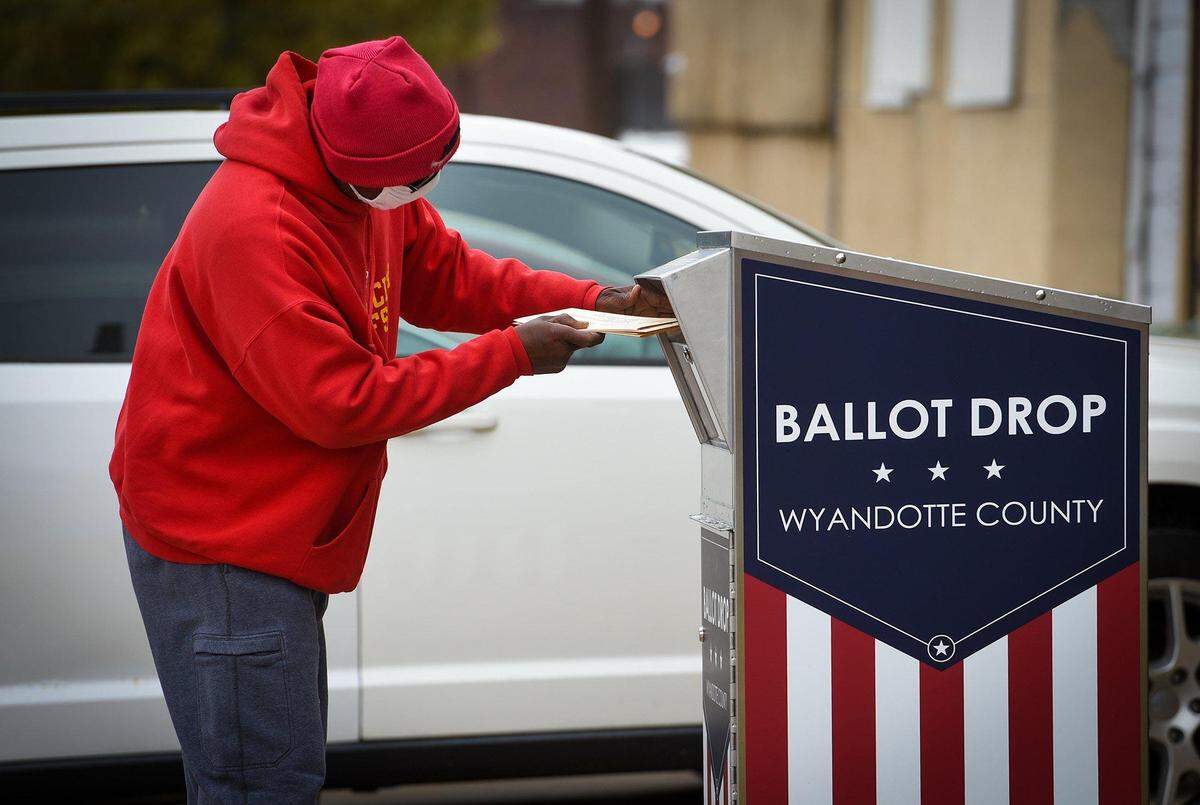
Ballot drop boxes are a source of suspicion for some Republicans, who believe, despite a lack of evidence, that they create opportunities for fraud and mischief.
Kansas Secretary of State Scott Schwab is not one of those Republicans.
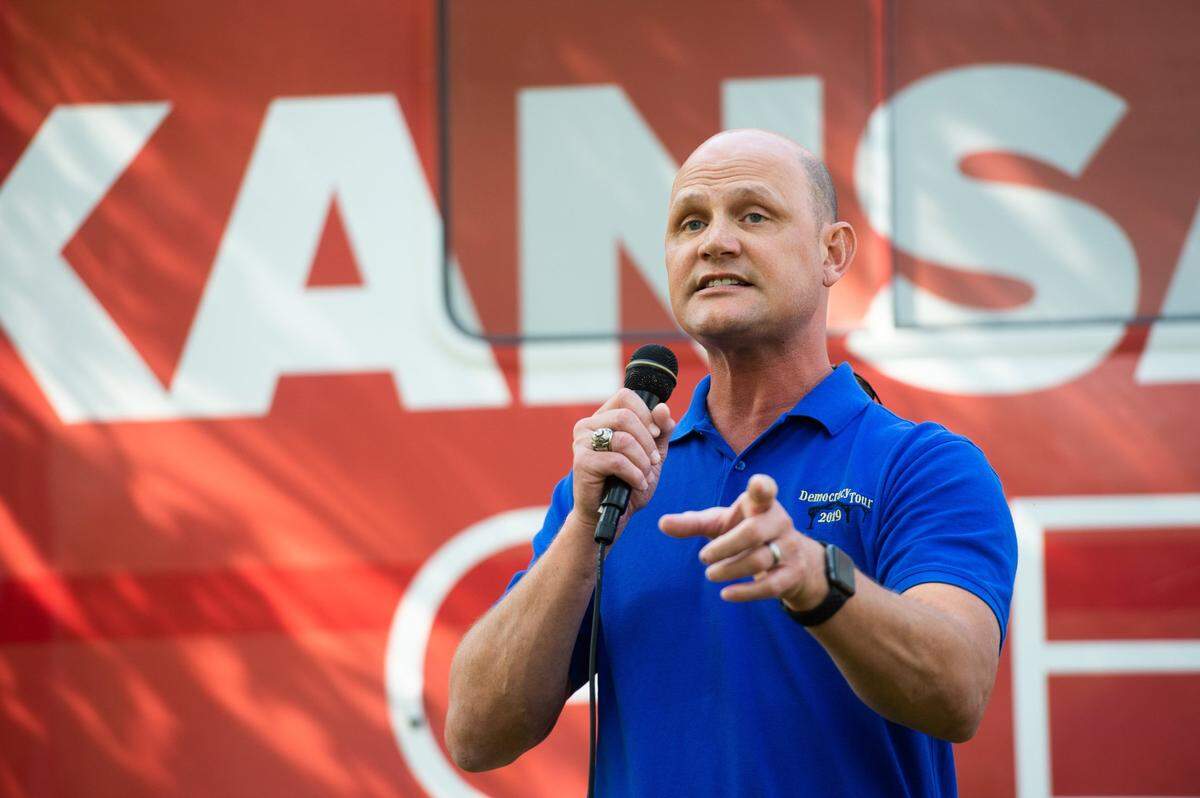
Schwab, stumping for votes ahead of the Aug. 2 primary election, was telling a group of Johnson County conservatives last month why he supports ballot drop boxes – and why they’re secure – when the interruptions started.
“That’s not true,” someone at the gathering of the group Faithful Patriot called out. “That’s garbage,” another said.
The group was formed in the summer of 2020 with a focus on “faith, family and freedom.” Schwab, who needs the support of conservatives as he faces a hard-right primary challenger, showed up at its regular meeting to campaign.
“Let me just finish my piece,” Schwab shot back as tempers flared.
Schwab is Kansas’ top election official, overseeing an elections system largely administered by local officials across the state’s 105 counties. After Kris Kobach’s tumultuous tenure, which saw the office mired in lawsuits and controversies as Kobach championed aggressive voting restrictions, Schwab has largely drained the Kansas Secretary of State’s Office of public drama over the past four years
Schwab, a 50-year-old Overland Park resident and former state lawmaker, has repeatedly vouched for the security and integrity of elections in Kansas —a state former President Donald Trump won by double digits in 2020— as false allegations of fraud and conspiracy theories nevertheless take root.
But he is still a Republican in a Republican-dominated state.
As Schwab runs for re-election, the first-term secretary of state is navigating treacherous political terrain. He’s among a host of Republican secretaries of state —and other GOP statewide officials— under pressure from Trump supporters who have embraced false conspiracy theories about the 2020 election.
His primary opponent, former Johnson County Commissioner Mike Brown, is provoking baseless suspicions about Kansas elections and attacking Schwab as soft on election security.
The hard-right Republicans Brown is most likely to attract may hold false or distorted views about election integrity. But they are also the kind of voters who tend to show up to vote in primary elections, their election-related misgivings notwithstanding.
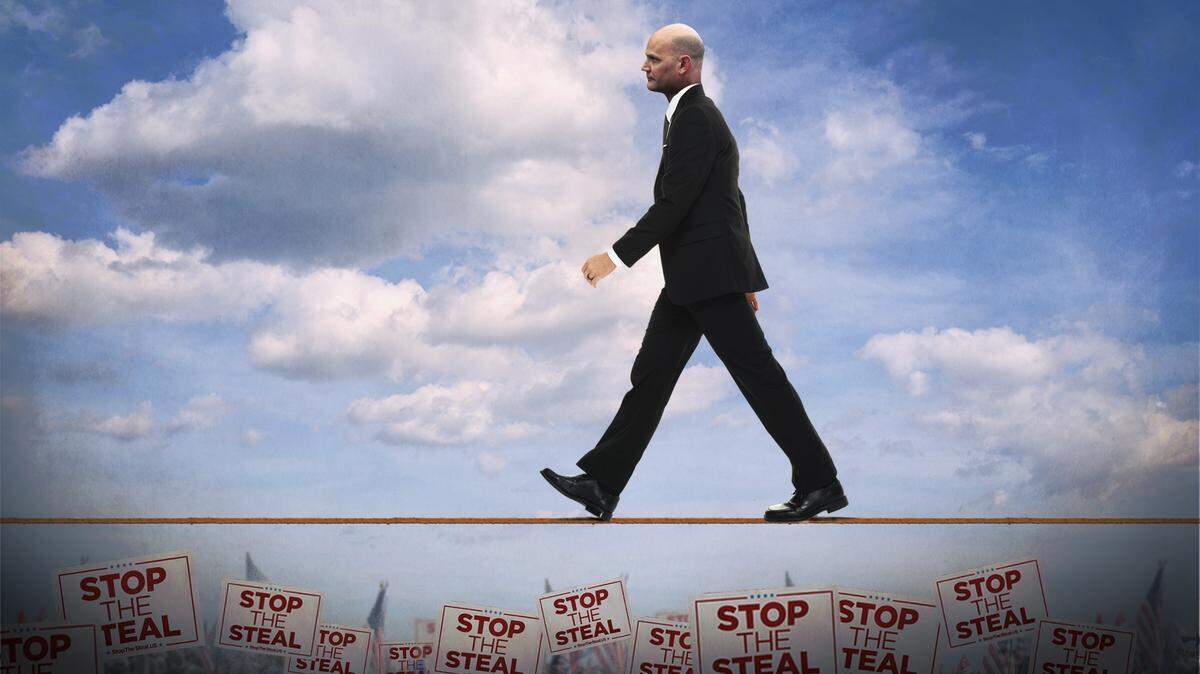
Schwab is responding by delicately walking a tightrope as the primary approaches. He has stood by the security of Kansas elections, but is also trying to reach skeptical Republicans in a language they’ll understand.
The stakes extend well beyond his own race. Ultimately, how he handles this balancing act will affect how much confidence Kansas Republicans place in elections locally— and may influence whether any Republicans stay away from the polls on Aug. 2.
If even a small fraction of the party’s base sits out the election over fears about its legitimacy, it could harm efforts to pass an amendment stripping the right to an abortion from the state constitution, a key GOP goal.
Schwab has framed his support of drop boxes as a way to keep ballots out of the mail – and by extension a sprawling federal bureaucracy, echoing fears Trump fomented about mail voting in the lead-up to the 2020 election.
He argued it’s better to place ballots in a locked box in your community than send them through the mail, where they may travel across state lines before getting to their destination.
That message of local control feeds into conservatives’ natural skepticism of the federal government.
“You put your ballot in there, Kansans no longer control it,” Schwab said of the mail.
The Secretary of State’s Office in December also launched an online tool to report voter fraud.
He has tried to redirect concerns about election tampering against Brown by pointing out that as a county commissioner, Brown voted to accept more than $850,000 to help administer Johnson County elections from the Center for Tech and Civic Life, a nonprofit funded by Facebook founder Mark Zuckerburg. Republicans call this type of funding “Zuckerbucks” and allege it opens the door for private entities to influence elections. Zuckerberg has already said he doesn’t plan a similar effort for future elections.
When asked about the pro-Trump documentary “2000 Mules,” which features debunked allegations of fraud, Schwab’s response is that Kansas implemented many of the election security recommendations made by the film years ago.
The film, which spreads false claims about Pennsylvania and other key swing states, was made by Dinesh D’Souza, a conspiracy theorist convicted in 2014 of making illegal campaign contributions who was pardoned by Trump four years later.
Schwab largely avoids speaking about elections in other states, including those at the center of conspiracy theories about the 2020 election.
At Faithful Patriot, the heckling of Schwab began when he outlined how Kansas makes drop boxes secure, like requiring that both parties are involved in handling ballots.
“But he’s not telling the truth,” one audience member said after a group leader pleaded for quiet.
“Well, if I can finish you will hear it,” an angry-sounding Schwab replied.
The “2000 Mules” documentary never said get rid of drop boxes, Schwab told the crowd of a few dozen. It outlined recommended policies, which Schwab said Kansas has had in place for years.
Schwab declined The Star’s request for an interview. But his comments to Faithful Patriot give insight into how he perceives the current political landscape.
He has described himself as both a conservative Republican and a Republican in the mold of former President Ronald Reagan. At the same time, he criticizes populism and unlike some Republicans, doesn’t offer extensive praise of Trump.
“Conservative Republicanism is a positive thing. It’s a message of hope. It’s a good thing,” Schwab said at the June talk. “And then we have this populism thing and when they see things that don’t look right and they stir it into fear and sell it in town squares for money or political power.”
Schwab has taken his message directly to Republican voters with conspiratorial views, even when the reception has been hostile. That kind of direct engagement, which has involved talking about debunked claims, may persuade but also risks elevating fringe beliefs.
“The bully pulpit is one of his roles. Whenever you’re lifting up misinformation or validating or legitimizing misinformation, you’re not fulfilling that part of your role,” said Corey Dukes, a policy advocate at Protect Democracy, a nonpartisan nonprofit that works to prevent American government from becoming more authoritarian.
Michael Smith, a political science professor at Emporia State University who has studied voting laws, said Schwab may alienate conservative base voters if he says flatly that there was no widespread voter fraud in the 2020 election at all. So instead, Smith said, Schwab is clear that there was no widespread fraud in Kansas while remaining non-committal about other states.
“Schwab is doing this dance that many Republicans have to do today,” Smith said.
Schwab faces hard-right opponent
The Kansas race is one in a series of state-level primary contests this year where Republicans are grappling with the continued fallout from Trump’s 2020 loss and the profoundly destabilizing effect Trump’s false allegations of fraud and manipulation had on confidence in American elections among conservative voters. Only 21% of Republicans say Biden’s 2020 victory was legitimate, compared to 58% of all respondents, according to a national December poll conducted by the University of Massachusetts at Amherst.
These races will help determine whether future officials operate broadly within the bounds of fact-based reality or give themselves over to a more conspiratorial, paranoid style.
The record is mixed so far.
In Pennsylvania, the Republican nominee for governor, Doug Mastriano, is an election denialist. Nevada Republican Secretary of State nominee Jim Marchant opposed certifying President Joe Biden’s win in the state.
But in Georgia, Republican Secretary of State Brad Raffensperger, who was pressured by Trump to find enough votes to overturn Biden’s victory there, defeated a primary challenger.
“Each of these races has a very unique dynamic … it depends on the candidates and the campaigns and the state dynamics,” said David Becker, the director of the nonpartisan Center for Election Innovation & Research who previously worked as an attorney focused on voting rights enforcement in the U.S. Department of Justice . “But what we’re seeing are all symptoms of the ongoing damage being done by the election lies.”
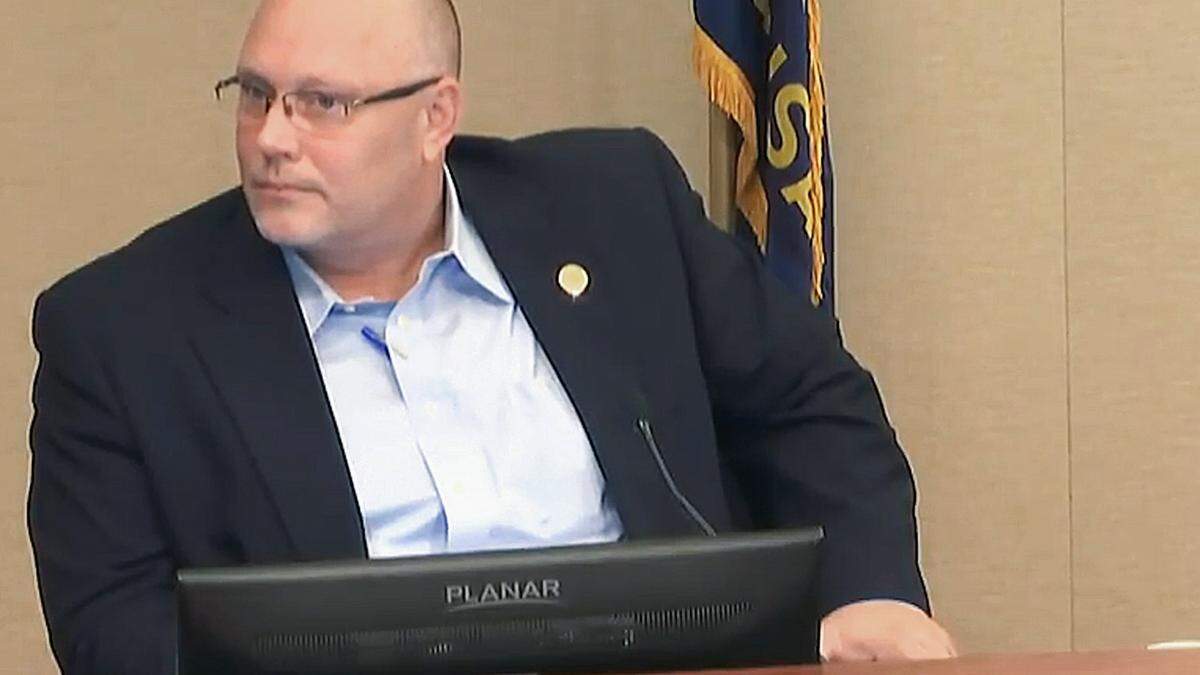
Brown entered the Republican race for Kansas secretary of state in December 2021, a little more than a year after he lost his re-election bid to remain on the Johnson County Commission. On the commission, Brown became a pariah, opposing mask mandates and urging people to buy guns in anticipation of a coming war.
An Overland Park general contractor, his campaign for statewide office is oriented around election fraud.
The America First Secretary of State Coalition lists Brown on its slate of candidates. The group, led by Marchant, wants to constrain voting to a single day and eliminate mail-in voting outside of traditional absentee ballots.
Democrats and critics say these policies amount to voter suppression designed to make it more difficult to cast a ballot.
In his campaign, Brown has echoed unfounded claims of voter fraud made by Trump after the 2020 election. He has attacked Schwab for saying Kansas’ elections have been free of issues with voter fraud and that mail voting is safe.
“What you know about what has happened in our elections is far from being out in the light of day,” Brown told the Wichita Pachyderm Club in May. “There’s much more coming. Stay tuned. It’s going to be a wild ride.”
Brown didn’t respond to an interview request.
Brown is promising to remove drop boxes and ensure the election is “over at 7 p.m. on Election Day.” Kansas law currently allows ballots postmarked by Election Day to count if they are received by the Friday after the election. Additionally, local boards of canvassers don’t decide what provisional ballots to count until several days after Election Day.
Brown also says he will revive the practice of using the Kansas Secretary of State’s Office to prosecute voter fraud. Kobach convinced legislators in 2015 to give the office prosecutorial power and he pursued a handful of cases, most involving individuals who double voted. In one of his first decisions in office, Schwab discontinued prosecutions, instead deferring to the Kansas Attorney General’s Office on these cases.
The conservative Election Transparency Initiative, which is led by the American Principles Project and Susan B. Anthony Pro-Life America, on Monday posted a questionnaire completed by Brown in which he marked that he wants to push back Kansas’ deadline to register to vote to 30 days before elections (the current deadline is 21 days).
He also indicated he supports a notarization requirement for absentee ballots and supports ending no-excuse absentee voting. Kansas doesn’t have a notarization requirement, but Missouri had one when it temporarily expanded mail-in voting in 2020 in response to the pandemic.
“Who knows who wins,” Davis Hammet, director of the Kansas-focused civic engagement organization Loud Light, said of the secretary of state primary.
But Brown, he said, “certainly changed the conversation and started to legitimize what are debunked, fringe theories.”
At the Wichita Pachyderm Club, Brown said he had watched “2000 Mules” with Johnson County Sheriff Calvin Hayden, who months ago launched a criminal investigation related to the county’s elections. Hayden, a Republican who embraces right-wing causes, frequently promotes the investigation in front of conservative audiences – stoking suspicions of fraud without making specific, detailed allegations.
Home to both Schwab and Brown, Johnson County is at the center of Kansas’ nascent election conspiracy movement – and at the heart of Schwab’s struggle with Republican denialists. The state’s most populous county has a huge concentration of voters who are key to winning primary and general elections.
The alleged problems often center on the idea that ballot paperwork was mishandled, that the drop boxes used were illegal and that election canvassers didn’t perform their jobs properly. These claims have been debunked by election officials, shown to be based on partial or out-of-context information.
For instance, one claim is that ballot transfer documents in Johnson County have spaces for four signatures but none were fully completed. The reality is that while the documents are used internally to help election authorities keep track of ballot movements, there is no legal requirement they be signed or used at all.
Another claim is that ballot drop boxes are illegal because the Kansas Legislature never approved their use. The reality is that while drop boxes have drawn significant attention recently, they have been used for a number of years and are legal.
Kansas law says completed advance ballots shall be mailed “or otherwise transmitted to the county election officer.” That language gives wide latitude to voters and election officials in how ballots are returned.
These and other false and misleading claims about Johnson County elections have nevertheless persisted and spread, in part because state legislators have given oxygen to the allegations by holding hearings that air them at length.
Other concerns are more nebulous, based more on feelings that something must be off after Johnson County – long a base of Republican support – voted against Trump in 2020. But the county has been electing more Democrats in recent years at both the state and federal level, part of a long-term trend away from Republicans.
Trump won Johnson County in 2016 by less than 3 percentage points. In 2020, he lost the county by 8.2 percentage points.
“Democrats win Johnson County for the first time in 100 years. My question is: Does it make sense?” state Rep. Randy Garber, a Sabetha Republican, said during a February hearing of the Kansas Senate Federal and State Affairs Committee.
In June, Schwab noted that Garber didn’t contest his own election even though he was elected in 2020.
Garber didn’t respond to a call seeking comment.
Pushing back on election fraud fears
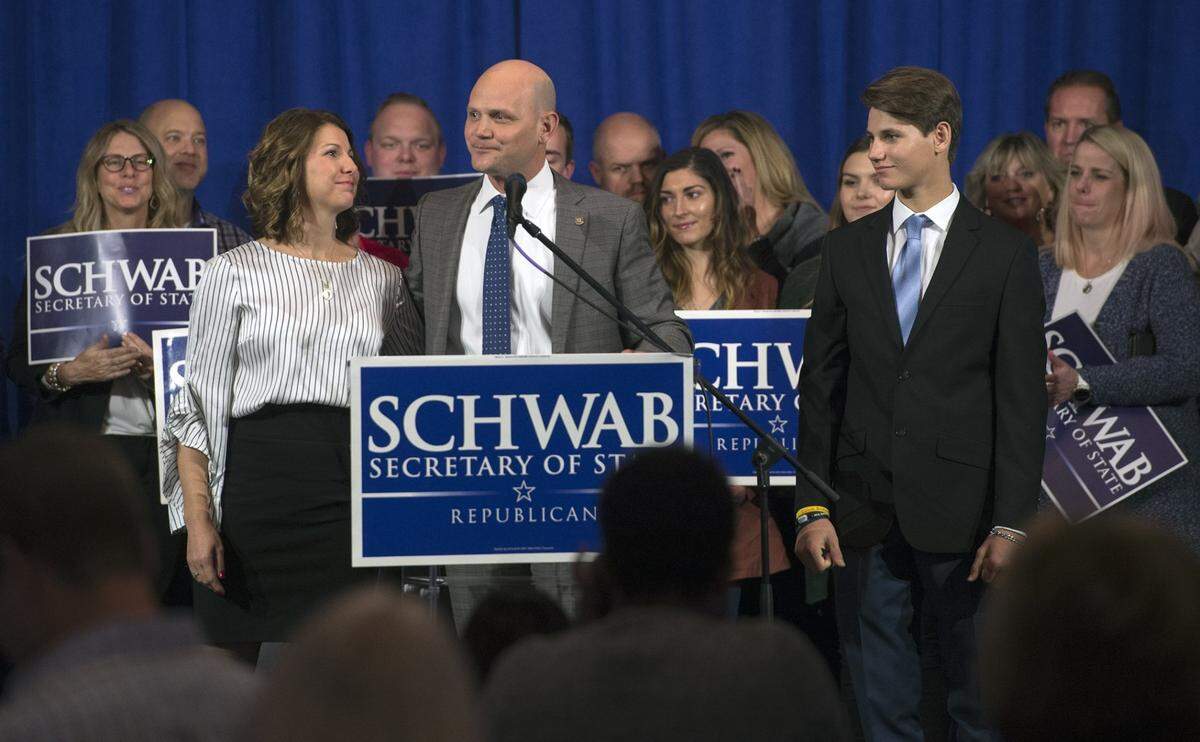
With a background in sales, Schwab served in the Kansas House almost continuously between 2002 and 2017.
An accident on a Schlitterbahn water slide in 2016 killed his 10-year-old son, Caleb. After Caleb’s death, Schwab spent his final term in the Kansas House as speaker pro tem, the No. 2 leadership position in the chamber.
He won the secretary of state’s race in 2018, campaigning as a Republican who would run the office in a business-like way after Kobach’s chaotic tenure. He promoted his role, as House Elections Committee chairman, in championing a 2011 Kansas law that required voters to show a photo ID and prove their citizenship; the law was struck down by the federal courts.
But Schwab’s appearance at Faithful Patriot last month illustrates how fraught the issue of elections has become for Republicans unwilling to toe the Trump line that the election was stolen, even those with well-established conservative credentials.
Early in his stump speech during the group’s meeting at Tomahawk Ridge Community Center in Overland Park, Schwab said flatly that he supports drop boxes – a controversial position among Republicans.
The Kansas Senate narrowly passed legislation to require dropboxes to be monitored by both a camera and an election worker when they are accessible to the public. The bill, which also limited the number of drop boxes that could be used, failed in the House in part because Schwab publicly opposed the limits.
“I think the Legislature, not the secretary of state, has done a good job implementing election policy,” state Sen. Richard Hilderbrand, a Baxter Springs Republican who championed the anti-drop box bill, told The Star.
In his speech, Schwab outlined how difficult it would be for fake ballots to be submitted through drop boxes.
For a fake ballot to make it through the security process, Schwab said, it would have to be in the correct envelope with the right color for the election. Obtaining an envelope would require stealing one from an election office without any officials noticing, he said. The envelope would need to be signed by a registered voter, the signature would need to match the signature in the voter roll, and it would have to have the correct driver’s license number.
“If you could pull that all off, you’ve changed one vote in Kansas,” Schwab said. “This is the problem when we take issues with Georgia and Pennsylvania and say, ‘well, Kansas has the same problem.’”
An Associated Press survey of state election officials found no cases of fraud, vandalism or theft that could have affected the results of elections stemming from the expanded use of drop boxes for mailed ballots during the 2020 election.
In a statement, Schwab campaign spokeswoman Lydia Meiss said the secretary’s “highest priority” is to secure Kansas elections and protect the constitutional right of legally-qualified voters to cast a ballot.
“As a Reagan conservative, Secretary Schwab is committed to running on facts, not fear. His message is one of hope and positivity; on the fact that Kansas is a leader in election security; and that election laws protect the integrity of your vote,” Meiss said.
Even though he has vouched for Kansas elections, Schwab is far from a liberal on election policy. He has not embraced same-day voter registration, for instance. Some Democrats say he slow-walked implementation of a state law to allow Sedgwick County residents to vote at any polling place within the county.
On Friday, the Kansas Court of Appeals ruled that Schwab’s office had violated the state’s open records law — denying “reasonable public access” to a public record — by not releasing a report containing data on who has cast a provisional ballot in Kansas to Hammet, the Loud Light director.
Whoever wins the Republican primary will face Democrat Jeanna Repass in November. The Overland Park resident is a former director of urban mission outreach for the United Methodist Church of the Resurrection. If elected, she would be the first Black woman to hold statewide elected office in Kansas.
Repass said voter security and voter suppression are not the same. It’s the secretary of state’s responsibility to include every eligible Kansan in the electoral process and allow them to cast a legal ballot.
“Any discussion of shrinking the voter population is a violation of what this job is supposed to be, and that is the biggest difference between myself and either of the other two” candidates, Repass said.
“One of those people is being very open about wanting to do that. The other person has just been complicit by not doing much,” Repass said, though she emphasized that Schwab is a “decent human being.”
‘Stop scaremongering’
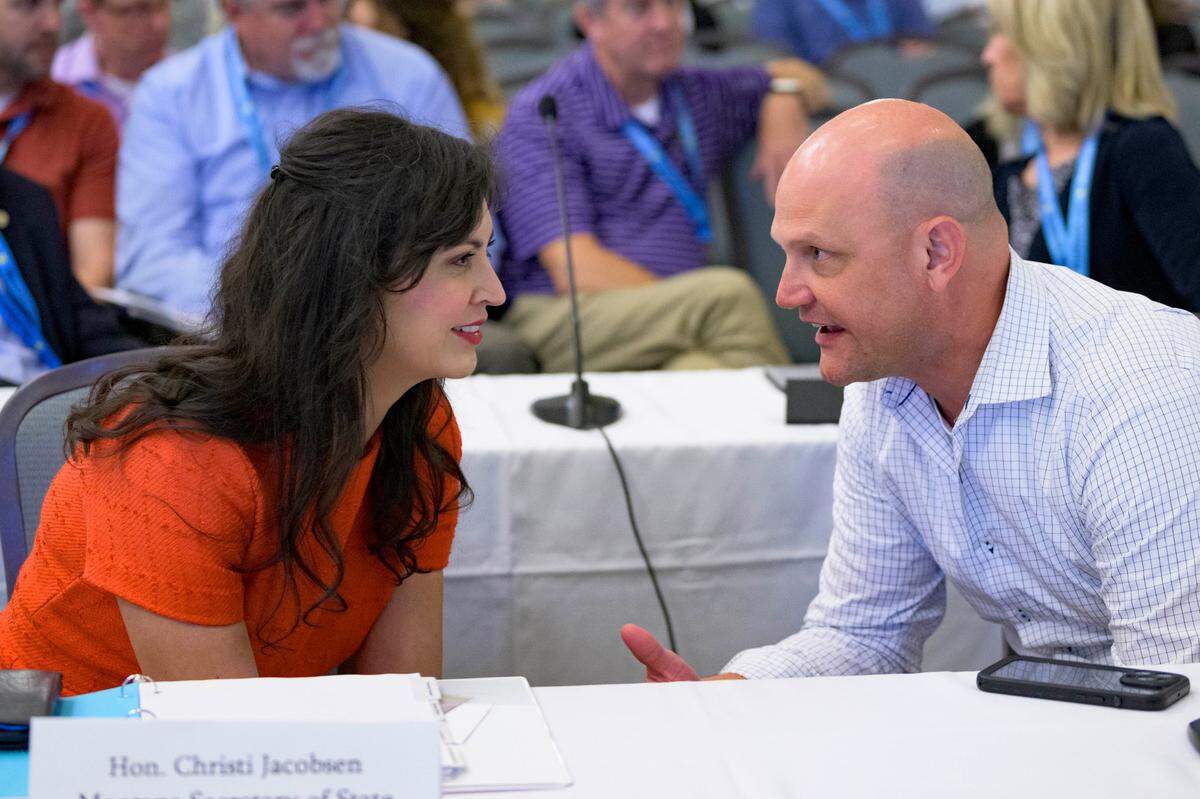
Much of the Republican establishment is backing Schwab. Sam Brownback has endorsed him, a rare public nod of support from the former governor, whose reputation took a beating because of a severe state budget crisis. Kansans for Life, an anti-abortion group that is influential with Republicans, has also endorsed Schwab.
Among some top Republicans, there is a recognition that loose talk about election fraud and manipulation risks keeping their voters at home at the exact moment they need them the most, to pass the Value Them Both amendment to the constitution. The amendment would clear the way for the Republican-controlled Legislature to severely restrict or ban abortion.
Mike Kuckelman, chairman of the Kansas Republican Party, said Republicans should continue to seek opportunities to improve election integrity, but he said that suggesting Kansas is not a safe and secure state to vote is factually inaccurate.
“We need to talk factually about election integrity and stop scaremongering because it scares voters away,” Kuckelman said.
Brown’s fears about Kansas elections – and Johnson County elections in particular – have already found a much wider audience over the past few months. The ongoing investigation by Hayden, the Johnson County sheriff, is also fueling baseless suspicions.
What that means for confidence in Kansas elections over the long term is yet to be seen.
Schwab, speaking to reporters in June, said Kansas’ election system is “pretty tight.” More than 300 post-election audits have been conducted since 2019 and no county has ever failed, he said.
“There will be some people who want to believe in anything,” Schwab said. “Some people think the world is flat, too. It doesn’t matter how hard you try to convince them.”
The Wichita Eagle’s Matthew Kelly contributed reporting.
This story was originally published July 24, 2022 at 5:00 AM with the headline "Top Kansas election official must persuade Republicans their votes are safe. Can he do it?."