A 2019 law to make voting easier in Kansas likely to be delayed by red tape till 2023
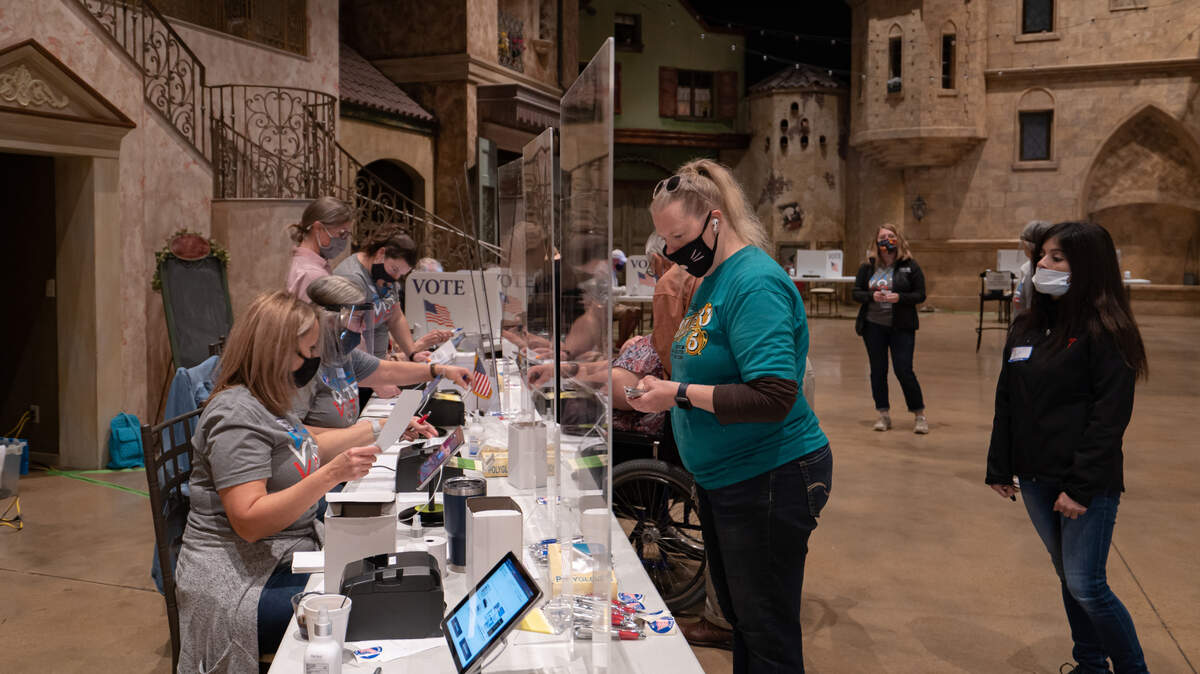
A 2019 law to make it easier to vote on election day likely won’t be implemented until the 2023 elections — more than 4 1/2 years after it passed — under rules being finalized now by Kansas Secretary of State Scott Schwab.
The law, proposed and shepherded through the Legislature by Sedgwick County government, is designed to allow residents to vote at any polling place in their county, instead of just at their assigned voting precinct.
Sedgwick County already has the capability to do that and routinely does it with advance voting sites. But the county is still barred by state law from doing it on election day until Schwab finishes the rule-making process, which has already gone on for 20 months.
State Sen. Oletha Faust-Goudeau, who sponsored the bill that changed the law, said she’s not happy that voters will have to wait another two years and eight months to actually be able vote anywhere in the county.
“That’s not good,” she said. “That kind of defeats the whole purpose.”
Faust-Goudeau, D-Wichita, said every election she hears from constituents complaining that they weren’t able to vote on election day because they work at aircraft plants south of the city and couldn’t make it back to northeast Wichita before the polls close.
Under the 2019 law, traditional neighborhood polling places would become “vote centers” where any county voter could cast their ballot regardless of where in the county they live.
The intent of the legislation was “being able to exercise your vote and moving into the 21st Century,” Faust-Goudeau said.
The 2019 law directed Schwab to write the rules and regulations to implement it, but with no deadlines on when he had to act.
County officials had hoped to have the new rules in place for the 2020 election cycle, but they’re only now coming up for approval by the Legislature’s Joint Committee on Rules and Regulations.
The proposed regulations contain two provisions that will almost certainly push implementation of the law to the August 2023 election at the earliest.
Those provisions are:
▪ A prohibition on implementing vote centers during an election in an even-numbered year, when presidential or statewide offices are on the ballot. Counties could only start doing that in an odd-numbered year when only local offices are on the ballot and turnout is generally lighter.
▪ Election officials would have to present a detailed plan to the secretary of state six months in advance of the election in which they want to start using vote centers. The plan would include the locations of all vote centers, the number and type of voting machines to be used at each site, the furniture to be provided for workers and the number of parking spaces available.
The proposed regulations are currently in a 60-day public comment period, which will be followed by a public hearing before they can be finalized.
The earliest the new rules could be approved is Feb. 16, two weeks after the deadline would pass to file a plan for vote centers six months in advance of this year’s Aug. 3 primary.
“That kind of means we won’t be doing it this year,” said Sedgwick County Election Commissioner Tabitha Lehman.
She said it would be “not a good idea” to use the current voting system for the August primary and try to rework it and introduce vote centers for the general election in November.
If the vote centers aren’t up and running this year, and can’t be started for an even-year election, the next opportunity will come in August 2023, four years and nine months after the legislation was signed into law.
In a meeting of the legislative committee Friday, a lawyer for the secretary of state faced pointed questions from Sen. Mary Ware and Rep. John Carmichael of Wichita.
“I’m wondering how often it takes two years to write rules and regs and then the rules and regs tell us we have to wait another two years to actually enjoy the benefits (of a new law),” Ware said. “ A four-year time span from passage to essentially implementation seems like an awfully long time.”
Garrett Rowe, the lawyer representing Schwab, said the delays in getting the regulations written were a combination of factors, including the need for meetings with local election officials, research on what other states have done, a lawsuit that halted work until it was dismissed in June and revisions recommended by the attorney general’s office.
He said Lehman or other election officials could “theoretically” implement vote centers this year, “assuming they can meet the timelines.”
He did not explain how a local official could meet the timelines in the regulations. He did say a county election official could ask Schwab for a waiver, or go it alone and make a plan before the regulations are finished.
Lehman has said she won’t implement voting centers until the rules are finalized.
The committee decided to ask Schwab for more information on how to get vote centers off the ground this year.
Later, Carmichael had a harsh assessment of Schwab’s performance on the matter.
“The secretary of state has deliberately delayed this statute as long as he possibly can and it’s unconscionable,” Carmichael said.
Faust-Goudeau said she’d spoken with Schwab about the vote center regulations several times in the run-up to last year’s elections and was surprised it’s taking so long.
“If I’m not mistaken, I thought he talked about implementing it in 2021,” she said.
County Commissioner Jim Howell, a former state lawmaker who pushed for the change, called the proposed regulations “needlessly complex” and said he may testify at the Feb. 16 hearing.
“He (Schwab) is asking us to indicate how many chairs will be in a vote center over six months in advance,” he said. “He’s asking a lot of questions . . . about a lot of things that frankly don’t matter.”
Also, he said the regulations appear to be geared more toward creating large, centralized vote centers than Sedgwick County’s proposal to have its usual number of polling places and equip them all with the capability to serve any eligible voter at any site.
“We’re simply saying allow us to do on election day what we do in early voting,” he said.
Between now and 2023, voters will still have the option to vote in advance, in person or by mail. And those who don’t, and can’t make it to their home precincts on election day, will still have the option to cast a provisional ballot in another precinct, Lehman said.
The problem with doing that is they probably won’t get the right ballot and the election offices will only count the races they’re eligible to vote in, she said.
For example, in the recent November election, a person who lives in north Wichita but voted in a south Wichita precinct would have had their provisional votes counted for presidential and congressional races. But their votes for state Legislature and County Commission would probably have been tossed out because they didn’t have the right candidates on the ballot.
Howell said it’s an issue of disenfranchisement, because county officials have to disallow thousands of votes on hundreds of ballots when they canvass results each cycle.
Last year, Sedgwick County considered asking the Legislature for a bill to force Schwab to hurry up and write the regulations. Rep. Blake Carpenter, R-Derby, agreed to introduce it.
But that effort was dropped amid the brewing COVID-19 pandemic and the Legislature went home halfway through its scheduled 90-day session.
This story was originally published January 8, 2021 at 5:01 AM.