
Delays ahead? How closure of a Wichita bridge could slow traffic for more than a year
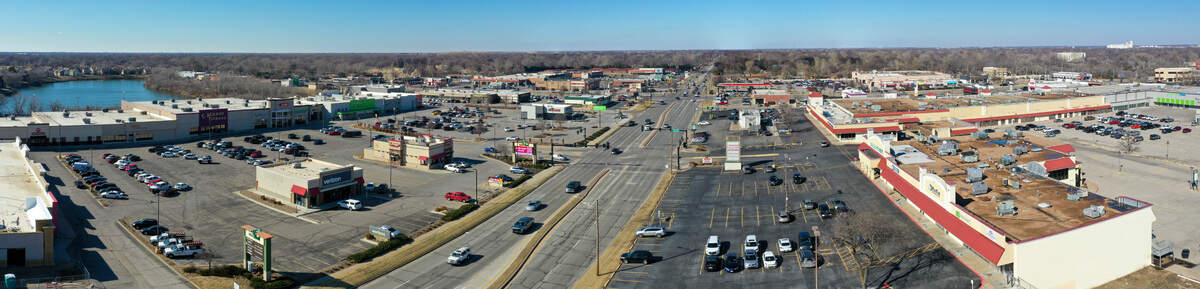
It takes less than 2 minutes to drive from 13th Street to 21st Street on Amidon in normal traffic. Less than 2 minutes to get to a north Wichita intersection with five grocery stores, four pharmacies, a DMV office, a fire station, a workforce center, two health care facilities and more than a dozen restaurants.
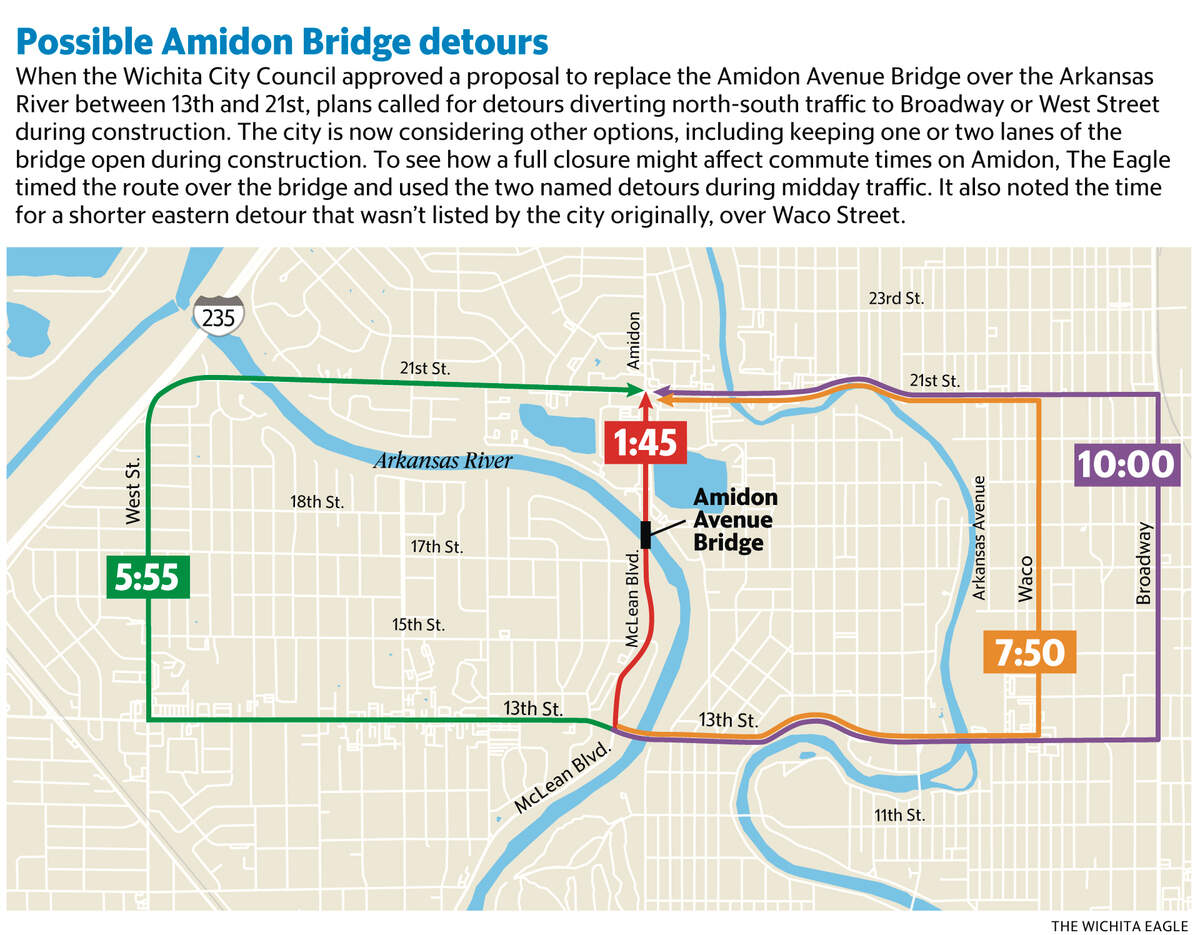
But if you can’t drive up Amidon, it takes far longer to reach the major commerce and service hub — nearly 6 minutes traveling west from 13th to West Street before cutting back to 21st. It takes even longer if you go east — nearly 8 minutes via Waco or 10 minutes using Broadway.
Those are the options Wichita commuters will be left with for at least 14 months if the city follows through on plans to fully close the Amidon Avenue Bridge, which has spanned the Big Arkansas riverbend at 18th Street North for nearly 60 years.
The aging four-lane bridge, which city data shows is traversed by more than 16,500 vehicles a day, is slated for replacement.
Disruptive bridge closures are nothing new for Wichita drivers. But the combination of a winding river and large neighborhoods with few through streets makes navigating around the Amidon bridge particularly inconvenient.
Construction was supposed to start in August or September. Now, city engineers are reevaluating plans to fully close the bridge amid lingering questions about the economic and public safety implications of the disruption.
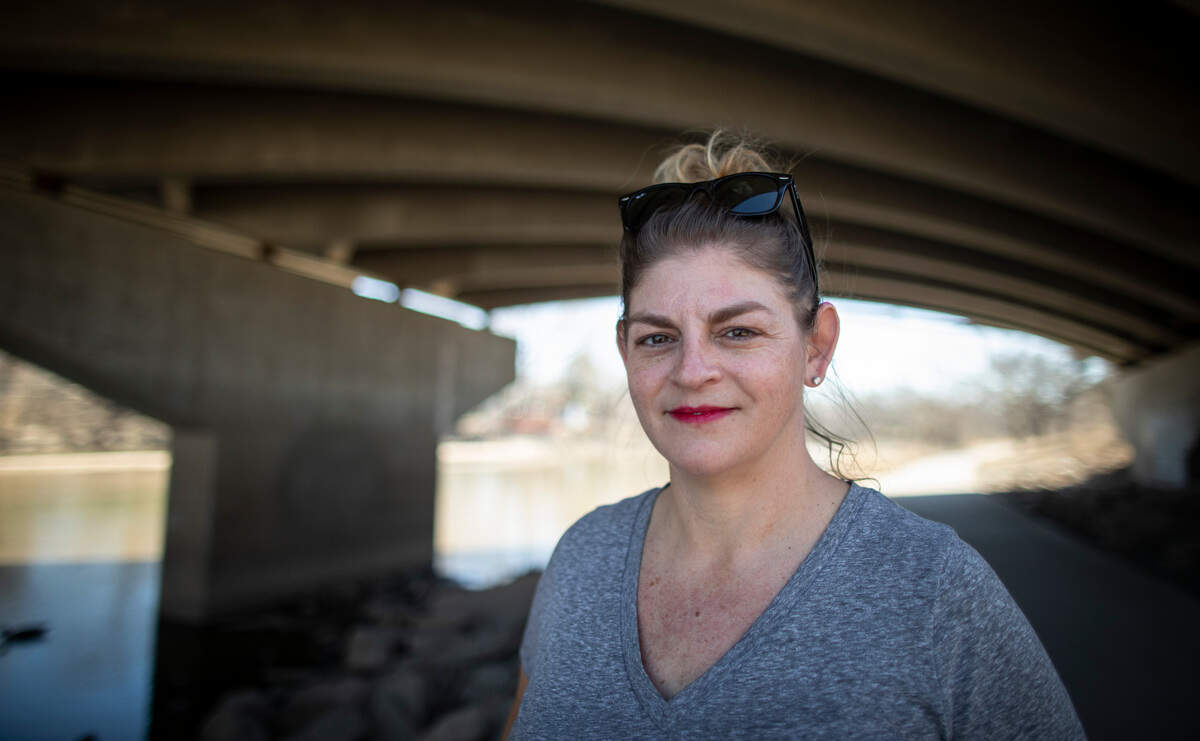
“I know what it’s like to be a small business, and closing that off completely could be devastating to some of these businesses that are barely coming out of the pandemic,” said District 6 City Council member Maggie Ballard, who took office a month after the council approved construction plans in December.
The closure also could affect emergency response times, access to key services and the safety of quiet neighborhood streets.
At Ballard’s prompting, the city is hosting a community meeting later this month to lay out options, including alternate plans that would preserve up to two lanes of bridge traffic throughout construction.
“If they are able to do it with keeping two lanes or even one lane open, that would be much easier for the neighborhood and for the people trying to cross town,” North Riverside resident Johanna Hutmacher said.
Engineers say that would prolong construction and add to the project’s $7.5 million price tag. But they want to give members of the public another chance to weigh in before finalizing plans.
“Looking at this a little bit closer with council member Ballard, we’re taking a step back,” said Gary Janzen, assistant director of public works and utilities.
“Our next step is to make sure everyone in the area understands what’s coming, what needs to be done with the bridge, talk through the options and see what kind of feedback we get at that point.”
City spokesperson Megan Lovely said no binding decisions will be made at the March 24 meeting, which is scheduled for 6 p.m. inside the Wichita Workforce Center, 2021 N. Amidon, Suite 1100.
Emergency response times
If the city opts for full closure of the bridge, Wichita Firehouse 7, which sits just northeast of 21st and Amidon on Coolidge, would be cut off from residents south of the bridge.
“We’d like some clarity on how emergency vehicles will respond to calls in our neighborhood,” said Denise O’Leary-Siemer, a community organizer in the Indian Hills/Riverbend neighborhood, situated directly southwest of the bridge.
Emergency vehicles use the bridge daily, she said, especially en route to the Meridian Rehabilitation and Health Care Center at 15th and Meridian.
Ballard said she isn’t particularly worried about Sedgwick County EMS, whose vehicles are relatively mobile and can be deployed from different directions. But the alternate routes proposed by the Wichita Fire Department so far don’t pass muster, she said.
“[In January], they said it could potentially triple response time for fire,” Ballard said. “Well, that’s unacceptable to me.”
The department showed Ballard an alternate route they said would add just 11 seconds to response times, but she said that plan seemed risky, too.
“When I looked at the route, I’m like, that is so dangerous,” Ballard said. “They’re wanting them to turn right where the Wendy’s is, the car wash and all that stuff, and go cut all the way through the neighborhood [at 13th and Perry].”
WFD Battalion Chief Jose Ocadiz said the department is considering a number of alternate routes to serve the area, but he declined to give specifics. He called the routes Ballard evaluated “preliminary.”
“Nothing has been finalized from engineering on exactly what is going to occur with the bridge, so we’re not going to decide on what routes or what the time frames are,” Ocadiz said.
“From just the early stages of planning on the possibility of the bridge being completely inaccessible, we have other crews, other fire stations that would be able to cover that area.”
The two firehouses he mentioned, stations 1 and 8, are more than three miles away from the nursing home.
Goods and services
South of the bridge, residents and apartment dwellers who don’t own their own vehicles will likely have to get creative to reach the services they rely on to the north.
“I see many people who walk to buy groceries and go to the pharmacies,” said Lea McCloud, president of the Benjamin Hills/Pleasant Valley Neighborhood Association.
Among those services is the joint GraceMed ComCare Clinic, which provides medical care, mental health treatment and a pharmacy.
GraceMed CEO Venus Lee said access to transportation is a barrier to care that many patients face.
“I really wasn’t aware that anything was happening with [the bridge],” Lee said.
“We’d have to work with the patients to find another way to get them here so they can get the critical care that they need. It’s going to be, at minimum, an inconvenience.”
McCloud said she suggested to city staff that they offer additional bus services or alternate stops for people who routinely ride the bus up and down Amidon.
Another critical service at the busy intersection is the DMV office in the Twin Lakes Shopping Center, which serves between 850 and 1200 customers a week. The only other DMV location in town sits at the northeast corner of Tyler Road and Kellogg.
Dr. Kumar Vellaichamy, owner of the Twin Lakes Huddle House diner, said some of the retailers at the busy intersection may not be able to survive if north-south traffic on the bridge isn’t preserved during replacement.
“That’s what they need to do in order to keep the businesses. After 14 months, some of the businesses won’t even exist,” he said.
Ballard said the city hasn’t done enough to warn residents and businesses of what’s to come.
“It’s a big deal, and I just feel like when I talk to people about it, they’re like, ‘We don’t know what you’re talking about,’” Ballard said. “I don’t think we can talk about it too much or soon enough.”
She expressed particular concern for a new business currently under construction at 21st and Amidon, the Freddy’s Frozen Custard & Steakburgers that’s expected to open in late March or early April.
A Freddy’s spokesperson, Kim Huynh, called the bridge replacement “a positive impact well into the future” and said the restaurant is in contact with Ballard about alternate routes.
Weighing the options
Janzen said any option to preserve through traffic on the Amidon bridge would stretch the project to at least two years from the initial estimate of 14 months.
“We can build a bridge half at a time,” Janzen said. “It’s a challenge. There’s a considerable extra cost that comes with it. There’s considerable extra time. But it can be done.”
“It’s not done often because it presents some risk, even for the traveling public and for the contractors building the bridge, but either way, it is an option so we’re looking at that.”
Keeping just one lane open would cost the city an additional $3 million, he estimated.
“We would probably want to leave the bridge open southbound for emergency response, but that doesn’t help the businesses because anybody south of the bridge still can’t go north to get to all the commercial retail,” Janzen said.
A prolonged construction timeline would also be complicated by a Kansas Department of Wildlife and Parks requirement that crews work in the river only between September and March.
“There’d be probably a period of time when there’s not much work going on because of that whole issue of not being able to work in the river,” Janzen said.
Not everyone affected by the potential closure wants to see the city go out of its way to keep cars on the bridge.
O’Leary-Siemer, the Indian Hills Riverbend community organizer, said she’d like to see the bridge get completed as quickly and as safely as possible.
“Yes, initially it will be an inconvenience because there’s a lot of services north of the bridge that this neighborhood depends on, but the people will be able to take 13th to West Street and just go around to 21st Street, so we have that option,” O’Leary-Siemer said.
“I’d rather just let the engineers and the construction workers not have to deal with traffic, setting up another lane. Let’s get this bridge done and get on our way.”
McCloud, the Benjamin Hills/Pleasant Valley Neighborhood Association president, said she hopes conversations around the bridge construction don’t get too divisive.
“The issue is not that the city does not want to allow partial traffic on the bridge, but that the type of construction would take much extra labor/time to make it safe to drive on at all,” McCloud said.
Hutmacher, t
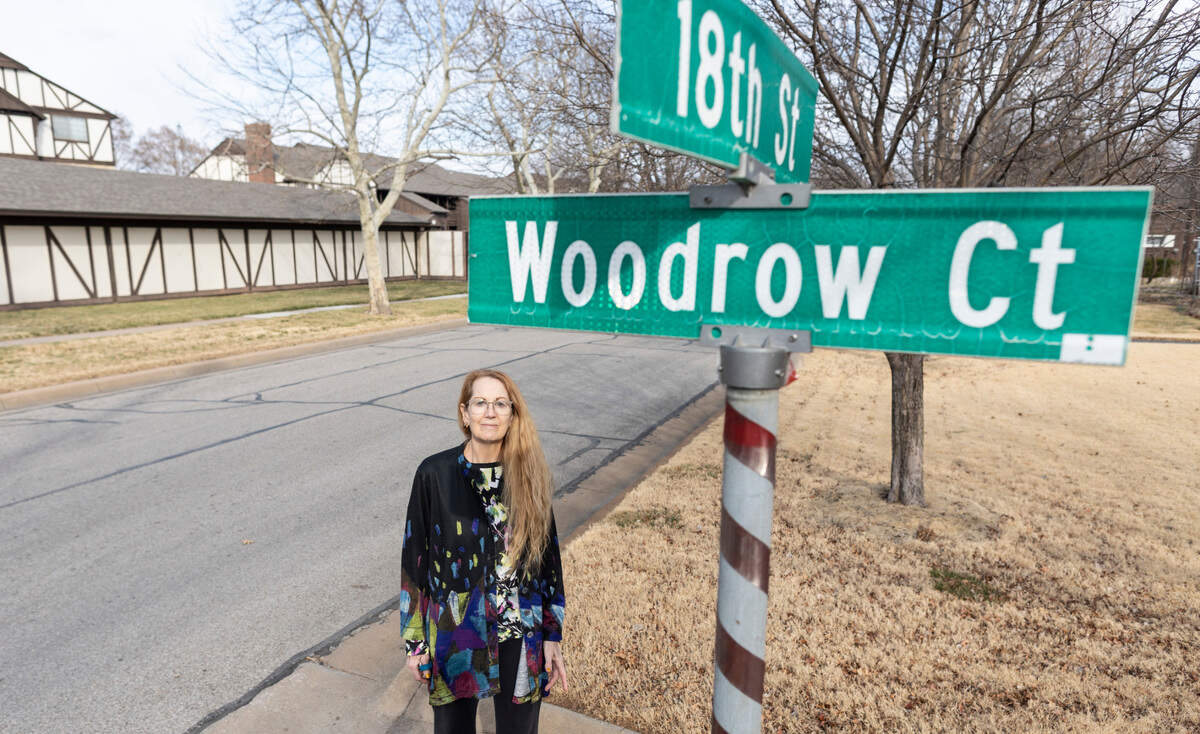
“The [North Riverside] streets aren’t laid out north-to-south. They’re very winding, and so anyone who tries to go through there is going to be very surprised and probably not very happy,” she said.
McCloud also thinks neighborhood streets to the east of the river could see a disproportionate amount of potentially hazardous cut-through traffic.
“This could become a safety issue for families with children who ride bikes in the streets, and when snow is on the roads,” McCloud said.
Ballard said she hopes the March 24 meeting and additional city engagement efforts will keep residents from feeling blindsided by whatever construction option is ultimately settled on.
“I don’t know that there’s a perfect plan, but it is unfortunate.”
This story was originally published March 12, 2022 at 11:15 PM.