State said Wichita earthquakes were likely natural. New evidence suggests otherwise
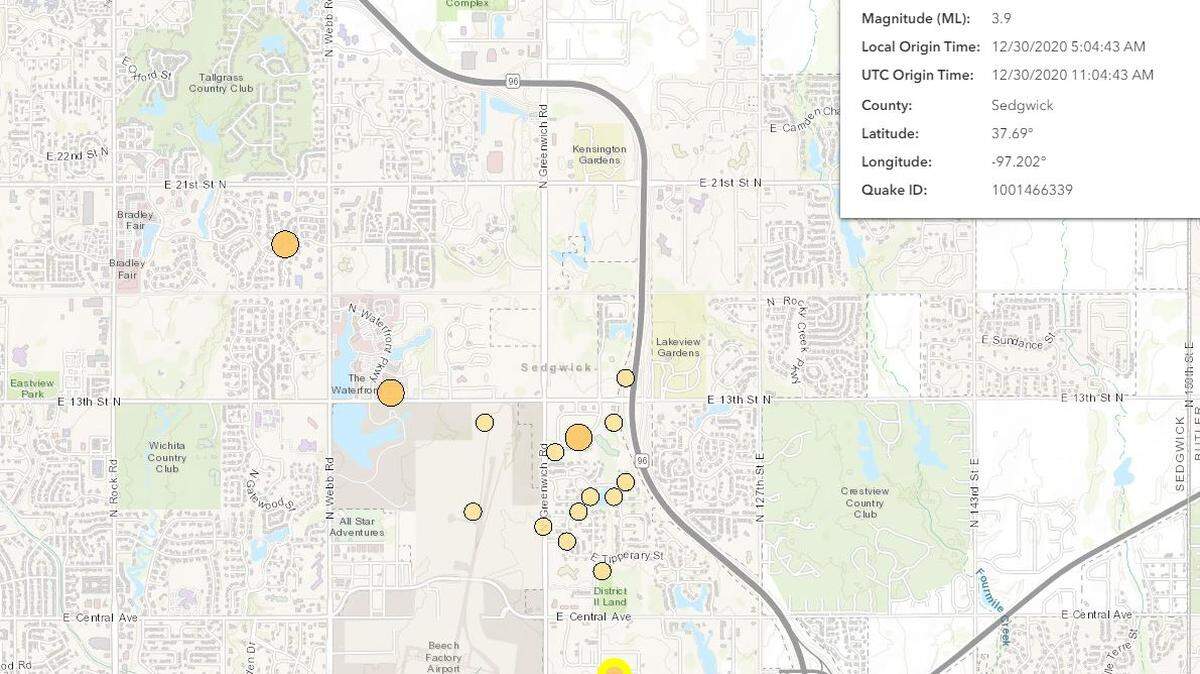
After a series of earthquakes rocked Wichita in November and December, state regulators said the oil and gas industry was not to blame, giving the impression that the earthquakes were natural.
Now, the state’s senior seismologist says he’s 99% sure that’s not the case.
More recently available data led Rick Miller, the senior scientist and seismologist at Kansas Geological Survey, to believe the earthquakes were caused by wastewater sent deep into the earth.
His investigation is still ongoing, as he looks into all wastewater injection and disposal sites in the area. The oil and gas industry accounts for a majority of the wastewater wells, but other industries, such as chemical, petrochemical and food processing, also dispose of wastewater.
Which industry is likely responsible for the wells that induced the earthquakes last December is still unknown.
A lag in information and inconsistent reporting requirements, Miller said, makes it difficult to have the answers people are searching for immediately after an earthquake hits. This is also true for the earthquakes triggered earlier this month, and Miller says they’re still investigating the cause.
Potential Damage
While wastewater injection could stress the fault and trigger more earthquakes, it won’t increase the magnitude of the earthquakes.
“We’re basically changing the pressure scenarios,” Miller said. “The stress field doesn’t change, but we’ve changed the pressures, and the stress field is what puts the pressure on faults to get them to move.”
Miller said he wouldn’t expect earthquakes near 13th and Greenwich to exceed magnitude 4.5, based on his analysis of recent earthquakes sizes, locations and recurrence.
“Now statistics are statistics, (and) it’s only as good as the data you have,” Miller said.
Elsewhere in the state, Miller says he doesn’t expect to see earthquakes of greater than magnitude 5.5. The Humboldt fault, which runs along the Flint Hills, is the reason for most earthquakes in Kansas. The majority of the Humboldt fault is not properly aligned to generate the stress it would need to cause a quake greater than a 5.5 magnitude.
“We simply do not have the fault structures to support it,” Miller said. “We just simply don’t have what it takes to be able to produce those large earthquakes.”
The largest known earthquake in Kansas was a 5.2 in 1867 by Wamego, and the second-largest earthquake in Kansas was a 5.0 in 2014 in Sumner county, near Milan.
But even smaller earthquakes could cause damage if they are frequent enough.
“You take a piece of wire and you flex it back and forth enough time, pretty soon it breaks,” Miller said. “There is a fatigue that does play into this.”
However, for the most part, well-maintained houses and buildings won’t be damaged by an earthquake less than a 5.0 magnitude, he said.
“Basically if you have a delicate or historical structure, you get into the 4.0 magnitudes, you can start seeing some damage to those delicate or historical or under-maintained facilities,” Miller said.
How wastewater causes earthquakes
In 2020, there were 75 earthquakes in Kansas of a magnitude 2.5 or greater, 17 of which occurred in December, according to Kansas Geological Survey data. There have been 17 earthquakes of that size so far in 2021.
This compares to 28 total earthquakes in Kansas above a 2.5 magnitude from 1980-2010, according to the U.S. Geological Survey.
It is the goal of the Kansas Geological Survey scientists to provide an opinion of whether the earthquakes are caused by the natural shifting of the earth or are manmade by wastewater injection sites. They work with the Kansas Corporation Commission and the Kansas Department of Health and Environment, who regulate underground wastewater disposal and would be responsible for proposing remedies.
The wastewater has been injected on top of these faults, which adds pressure underground, Miller said. The Kansas Geological Survey found that the fluid and pressure caused by wastewater injection could migrate underground and trigger earthquakes up to 55 miles away.
Once the pressure is at a certain level, what Miller calls the “triggering threshold,” even little things like turning a wastewater pump on and off, can pulse the system and cause an earthquake.
“It was sitting there by itself, quietly dormant, waiting for its energy to build, which may have taken a million years, but what we’ve done is, we’ve poured a bunch of water on top and we’ve changed the pressure in that fault area,” Miller said. “Therefore we have actually accelerated time if you will, and we’ve triggered it to go off.”
Because of the COVID-19 pandemic and a decreased demand for oil, the amount of wastewater injected into the earth has been reduced by the oil and gas industry, but this could increase again.
Volumes of wastewater produced by other industries have slightly declined over the past 20 years, according to Carrie Ridley, the KDHE’s chief of Geology and Well Technology.
“Over time, we’ve instituted policies trying to reduce the volume injected,” said Tom Stiles, director of KDHE Bureau of Water, adding that the agency was working to make sure that all the wastewater was entirely unusable.
“We are trying to make sure that what we send down is the bad stuff that really has no purpose on the surface.”
Lag time and lack of methodology
Industries that use wastewater disposal wells are separated into two groups. Class II, the larger class, is the oil and gas industry, which has more than 16,000 wells in Kansas and they are regulated by the Kansas Corporation Commission. Of those, about 2,500 inject directly into the Arbuckle, according to a KCC spokesperson. Class II wells range from about 700 feet to 8,000 feet deep.
The Arbuckle is a large, deep underground layer of rock that contains saline water and is present in most of the state, excluding the northeast and northwest portions.
Some of the largest wells dispose of 10,000 barrels, or 420,000 gallons, of water a day, but 98% of the disposal wells get rid of 5,000 barrels or fewer a day, according to a KCC spokesperson.
The second group, Class I wells, are regulated by the KDHE and are used by chemical, food and other industries. There are about 50 of those wells in the state. One of the largest in the state is located in Sedgwick County — Occidental Petroleum, formally Occidental Chemical, which uses the wastewater wells to get rid of solvents and hazardous waste. CHS Refinery in McPherson and the City of Hutchinson also have some of the state’s largest Class I wells, according to Stiles.
The non-oil and gas companies must report how much wastewater they’re sending into the earth. The numbers are recorded daily and are sent each month to the KGS.
The oil and gas industry only reports once a year by month and has no regulated methodology for reporting how much water it puts down.
Federal law dictates the reporting requirements for each type of disposal well.
But this difference in requirements is key for seismologists who are trying to understand when and how earthquakes are induced in Kansas.
“When we have earthquake swarms, we can go to the Class I and we got that data right now because it’s right there. It’s daily, (and) we have everything we need,” Miller said. “Now we go to the Class II data, we have to ask for it because it wasn’t available yet. Then what we do get, it’s really tough to use because it’s very coarse and it has no methodology.”
These extreme differences between the reporting requirements for the oil and gas industry and the other industries, make it difficult to compare the data sets, he said.
“There’s no consistent methodology for how those numbers are generated,” Miller said. “One is outstanding, very scientific, and very easy to use. The other one is bordering on not particularly useful.”
Not natural occurring
After the earthquakes late last year, Miller said he looked at historical data and found the previous precedent of earthquakes of similar size in east Wichita were naturally occurring, leading him to believe this was the case again.
But when the second set of earthquakes occurred last winter, the Kansas Seismic Action Plan, kicked in, which meant regulators must check their records and find if there were any injection sites within 6 miles of the epicenter of the earthquake that could have caused the earthquake.
After looking at the records, they found two wells within 6 miles, but they were low production wells, leading to the KCC’s conclusion last December that oil and gas were not to blame for the seismic activity.
“Now we’re looking further, saying ‘Okay well, what’s magic about 6 miles?,” Miller said. “The data is not telling us anything yet, but I can tell you that the earthquake pattern, the sequence of earthquakes, their pattern, their sizes — this is not matching the natural record.”
Six miles was the regulated expectation, but after Miller’s concern that it wasn’t a wide enough swath, the KCC and KDHE both volunteered to expand their search to 15 miles to try to understand what caused the earthquakes.
“We’re not moving on. No, we want to figure out what’s going on,” Miller said.
“We need to know what’s going on and we’re not gonna stop looking until we try to figure it out or we exhaust all the data we can get.”
This story was originally published March 21, 2021 at 5:01 AM.