Open house offers information, but concerns about 29th and Grove chemical spill linger
AI-generated summary reviewed by our newsroom.
- Union Pacific found no immediate air risks but long-term groundwater cleanup continues.
- Residents raised ongoing concerns about potential health effects.
- Officials plan four new treatment systems to reduce TCE below risk levels by 2035.
Carol Gates remembers splashing barefoot and carefree through the rainwater that routinely flooded the streets near 29th and Grove when she was a little girl.
Now, 50 years later, rainwater collecting on neighborhood streets stirs uneasy thoughts — not because the rainwater itself is dangerous but because of what lies beneath, and what may still be seeping through the soil.
Since the discovery of chemical contamination beneath the neighborhood in 1994, water that once seemed harmless now raises troubling questions about long-term exposure — turning even a familiar flooded street into a reminder of unseen risks.
“I still love the flooded water, you know, when it rains,” said Gates, who recently purchased a property in the area. “It’s a neighborhood thing, you know, that the kids go out there and play. We played in that water back in the ‘70s, but never thought about that.”
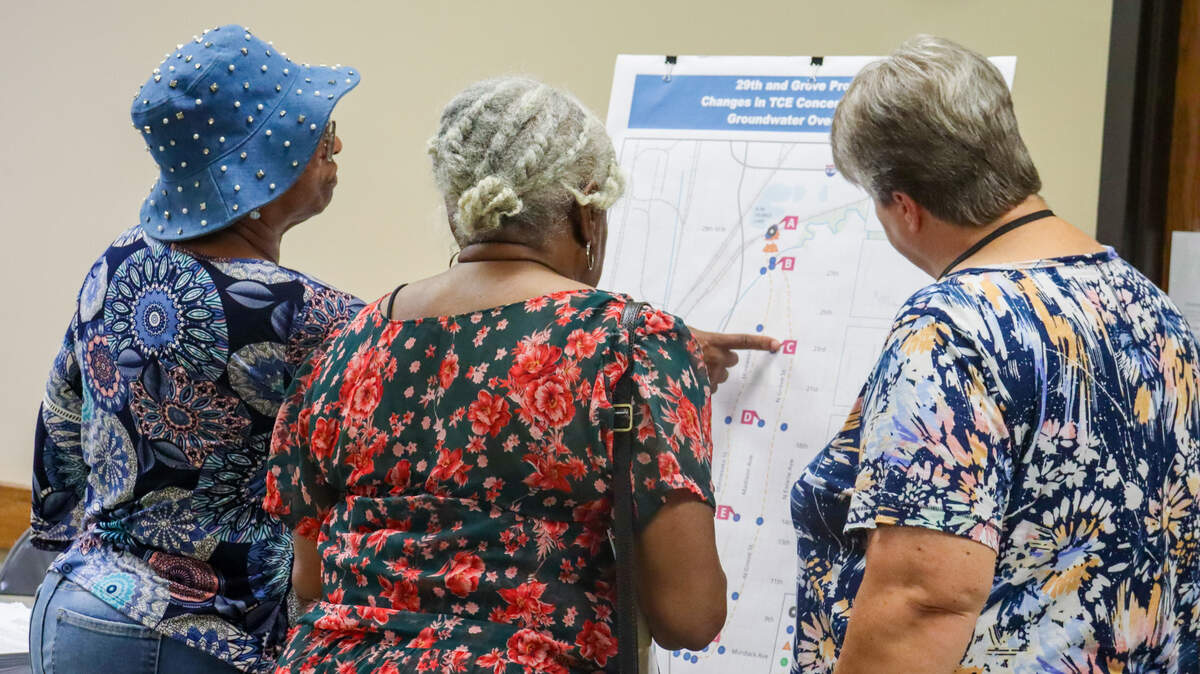
Gates was one of nearly 60 residents who attended an open house hosted by Union Pacific and the Kansas Department of Health and Environment on Saturday, hoping to learn more about the ongoing remediation of groundwater contamination at 29th and Grove.
Union Pacific announced that recent indoor air testing found no immediate health concerns related to air quality in the area. The railroad company also said it plans to install additional groundwater treatment systems throughout the affected neighborhood.
Some attendees, like Gates,left with more questions than answers — not just about health and environmental effects, but also about restitution and whether an open house was the best way to reach a community still searching for clarity.
“It should be continuously given an update on the news,” Democratic state Sen. Oletha Faust-Goudeau said. “Not just today, but a continuous update. People want to be heard and they want to be informed. ...”
The spill at 29th and Grove
In 1994, Union Pacific Railroad employees discovered a chemical contamination in the soil and groundwater at their rail yard south of K-96, between I-135 and N. Grove. Testing showed that trichloroethylene or TCE, a chemical commonly used as an industrial solvent and a known carcinogen, had polluted a plume of groundwater extending nearly three miles, from the rail yard to Murdoch, affecting several predominately Black neighborhoods. At the time of discovery, amounts of TCE were above Tier 2 risk levels, meaning contaminants pose a human health risk according to KDHE.
The cause and date of the spill are still unknown, but it is thought to have happened in the 1970s.
Since the early 2000s, Union Pacific — under the supervision of the KDHE — has been testing and conducting cleanups, according to a timeline on the Action for 29th and Grove website. More than 1,200 tons of contaminated soil have been removed and groundwater extraction wells have been installed to prevent the spread of polluted groundwater.
Many living in the affected area, however, said they heard little or nothing about the spill until a public meeting in 2022. Since then, Union Pacific has hosted additional public meetings, conducted surveys and tests and continuously monitored groundwater treatment progress.
Updates from Union Pacific
Union Pacific invited Wichitans to the open house on Saturday to learn more about ongoing remediation and to announce the results of the recent indoor air testing. TCE can enter the air when chemicals from contaminated soil or groundwater migrate into buildings as vapor. The tests, conducted at more than 20 properties, determined there are no immediate health concerns in the area’s air.
Matt Graham, the director of Pacific Union’s environmental group, KDHE geologist Mary Daily and other environmental specialists showed attendees the latest plans for testing and cleanup, offering printed resources and information sheets as well as display boards detailing vapor intrusion steps, water well survey results and groundwater treatment maps.
During a media briefing, Graham said Union Pacific has been working with the city, county and state to implement a long-term groundwater treatment system. Currently, about 5 million gallons of groundwater are treated every month through a system that’s been running since 2009.
“It has been very effective,” Graham said. “We’re very encouraged by that system and the results we’re seeing.”
The long-term plan includes constructing four additional groundwater treatment systems at various locations above the plume. He said the success of the first system is promising for the effectiveness of new installations.
He estimates that in about 10 years, any residual TCE contamination will be below state risk levels.
Continued concerns
Some, like Gates, are still concerned about the prolonged health effects of the spill. Conflicting studies published by KDHE at one point suggested that there were higher rates of liver cancer near the contamination site. But it has proven to be difficult for residents and medical professionals to attribute health conditions to the contamination with absolute certainty.
Gates’ mother had breast cancer, and her sister died of kidney failure. She said she’ll probably never know for sure if exposure to TCE contributed to their illnesses.
“I just don’t know,” Gates said. “Was it natural causes that she died from? Or was this (the spill) a factor?”
Although KDHE, the county and city secured funding for health screenings for residents living above the contamination site, no entity has committed money toward treatment costs if that is needed. Gates worries what she’ll hear from doctors at her future appointments and, if they do find something, how she’ll cover the costs.
Chavous Nichols also has concerns about the potential impact on health. When he was a teenager in the 1970s, he tended more than 50 horses at the Wichita Round Up Club’s barn, less than two blocks, he said, from the spill site.
He remembers the routes and roads he used to ride horses on in the neighborhood. They were often oversaturated with water.
“It was like a swamp,” Nichols said. “It looked like oil.”
He wondered about contamination’s effects on club members, as well as the horses, who were exposed to and drank well water.
According to the Sedgwick County fact page about the spill and remediation, TCE can enter the body through affected air, water, food or soil. The county has determined it’s safe to use groundwater from wells for watering lawns and gardening, but does not recommend using well water for swimming pools, drinking or bathing.
“We were in wells that were only 15 feet deep — that’s how we watered the horses,” Nichols said.
The depth of contaminated groundwater in the plume ranges from 14 to 25 feet below the ground’s surface.
What’s next for 29th and Grove?
Gates and Faust-Goudeau questioned the intention of Union Pacific’s open house. The event was presented as an opportunity to update the public and share information, but both said they were concerned that it was more about controlling the narrative than offering real transparency.
“So are you really being honest with me, or are you just telling me what you think I want to hear?” Gates asked. “... (Are we going to) resolve this issue, or is this going to be one of those ‘Have a cookie and be quiet’ scenarios?”
Faust-Goudeau said something similar.
“Union Pacific is going to ask me, ‘Senator, do you think that event was beneficial?’ And so I think I’ve got to say no, because every person that’s walked out has had the look like, ‘Is that all?’ Or the information that they’ve received, they’re calling it like a science fair. And that’s not the way it should be presented,” she said.
Graham encouraged Wichitans to continue asking questions throughout the process, emphasizing that transparency and community involvement remain important.
“We want to make sure, you know, that everybody understands Union Pacific is going to implement a long term, sustainable approach, a solution to this challenge, and we want to make sure folks are aware of the resources that are out there,” he said.
Gates said she thinks residents aren’t just seeking information, but also financial restitution and direct support for those affected.
“I pray that we are reimbursed or compensated for something, you know, even though it was a long time ago,” Gates said.
Faust-Goudeau said restitution should be given serious thought, citing concerns about the spill’s potential impact on the health and economic stability of the community.
Asked about Pacific Union’s perspective on restitution, the company’s Media Relations Manager Robynn Tysver responded in an email: “All the residents are on public drinking water. The contaminated groundwater is not being used for public consumption. This is not where people get the water they drink.”
She did not address whether people might have been using well water for drinking in past decades.
The city has determined no private wells are now being used for drinking water. There are still at least two active lawn and garden wells in the neighborhood.
Union Pacific plans to host another open house after the state approves the new groundwater treatment system designs.
Residents and former residents with concerns or questions can also schedule one-on-one meetings with a project manager, environmental manager or someone else, Tysver said, by emailing 29grove@up.com.Additional information is available on the Action for 29th and Grove website and social media accounts.
This story was originally published July 15, 2025 at 2:57 PM.