
City Council denies zoning change for Happiness Plaza, derailing its parking lot plans
The owners of Happiness Plaza in College Hill — which includes popular restaurant The Belmont — won’t be able to add their new parking lot behind their business after the Wichita City Council on Tuesday voted to deny its zoning change request.
Council members voted 6 to 1 in favor of a motion by Vice Mayor Brandon Johnson, who represents the district that includes Happiness Plaza, 3555 E. Douglas, to deny the zoning request. In making the motion, Johnson cited not only the results of a recent parking study showing that the area had plenty of unused parking but also the wishes of nearby residents he’d heard from who were opposed to the parking lot. He also cited a “potential risk to public safety” that the proposed parking lot could cause after residents expressed concern about its planned exit onto the 3300 block of East Oakland, a narrow residential street.
Council member Bryan Frye opposed the motion.
The council vote came more than two months after the Metropolitan Area Planning Commission’s Oct. 8 vote, which was 8-2 in favor of a motion to allow the parking lot.
After the meeting, College Hill Neighborhood Association president Trish Hileman, who has become a spokesperson for the neighbors opposed to the project, celebrated outside the council chambers with about 10 College Hill residents and their supporters who had been in attendance.
“These neighbors have worked so hard, and to see it actually pay off is validating and encouraging and exciting,” Hileman said.
Happiness Plaza owners Ryan and Anthony Francisco, who can refile the zoning change request in one year if they choose to do so, could not be immediately reached after the vote on Tuesday.
They and their partner in The Belmont, Tory DeMarce, had been reluctant in recent weeks to discuss what they might do if the zoning change was rejected, saying all their energy was being devoted to moving forward with the lot and the new businesses they had planned for the plaza, including a revival of the old Larcher’s Market.
They said they’d need 19 additional spaces to make the Larcher’s project work, and they proposed that the lot be constructed with about 26 spaces — fewer than the 40 it had room for. They also said they planned to add landscaping that would give the parking lot a park-like feel that would fit into the neighborhood.
Last week, the Happiness Plaza owners had two of the three houses they purchased behind the plaza — at 123 S. Clifton and 125 S. Clifton — torn down in anticipation of building the lot. They’d acquired the home at 123 S. Clifton, which dates to 1923, when they bought Happiness Plaza in 2019. They’d since acquired the house at 125 S. Clifton that was built around 1925 and a smaller adjacent house at 3344 E. Oakland, built around 1907. The Oakland house still stands, and Happiness Plaza owners said last week they were negotiating with people who wanted to move it to another site.
Before the vote, the council heard from representatives from The Car Park, the Idaho-based company the city contracts with to manage its parking lots and who the council had asked to conduct a parking study looking at the core area along Douglas and the key areas on the Douglas corridor.
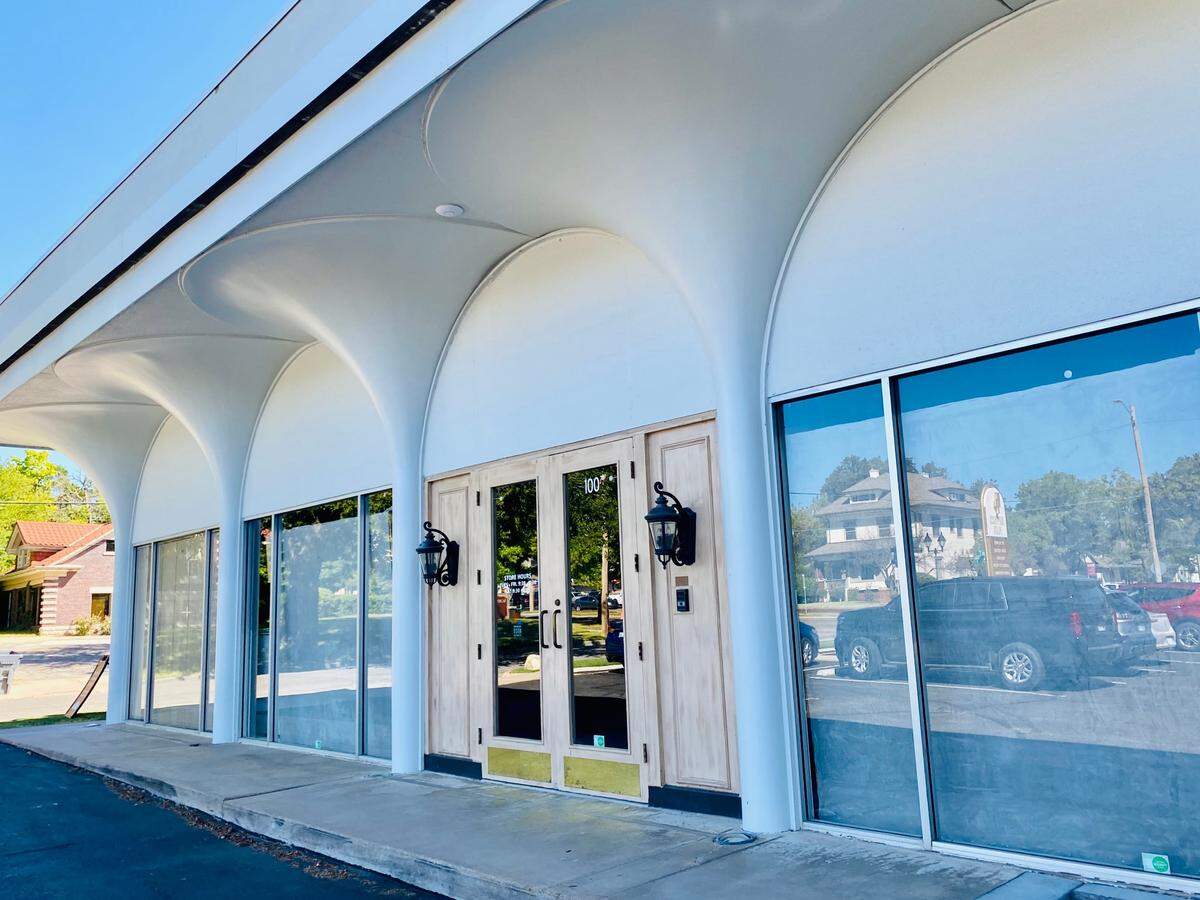
The findings, presented to the council by Steve Hernandez — vice president of governmental and institutional services for the firm — showed that about 310 parking spaces were available “within walking distance” of Happiness Plaza, including on-street parking and the lots at Happiness Plaza and near its Frost Bakery next door. The firm observed parking on two days — on Wednesday, Nov. 17, and again on Saturday, Nov. 20 — and determined that parking around the business was rarely at capacity.
The firm also spoke with residents and other business owners in the neighborhood, Hernandez said. Residents consistently said that they were opposed to the lot, he said, adding that one summed it up by saying, “College Hill doesn’t have a parking problem. College Hill has a walking problem.”
Business owners in the area largely said that their customers always seem to find parking places, Hernandez said, though they expressed concern about safe employee parking.
“Some expressed concerns that limited off street parking might hinder their long-term success in the College Hill neighborhood,” he said.
The firm recommended that in the short term, businesses should set up shared-use agreements with neighboring businesses who have parking lots available. It also recommended that the city consider ordinances that would allow for valet parking in College Hill and use curb markings and Google Map settings to help people find available on-street parking.
Before the vote, Johnson asked if the parking would still be sufficient if new businesses opened in the area.
Hernandez said the question was valid.
“If you’re adding additional businesses that are increasing demand, they may get to the point where we need additional parking,” he said.
This story was originally published December 14, 2021 at 2:21 PM.
.jpg)