
Wichita’s record quake on Wednesday has to be near highest expected, scientist says
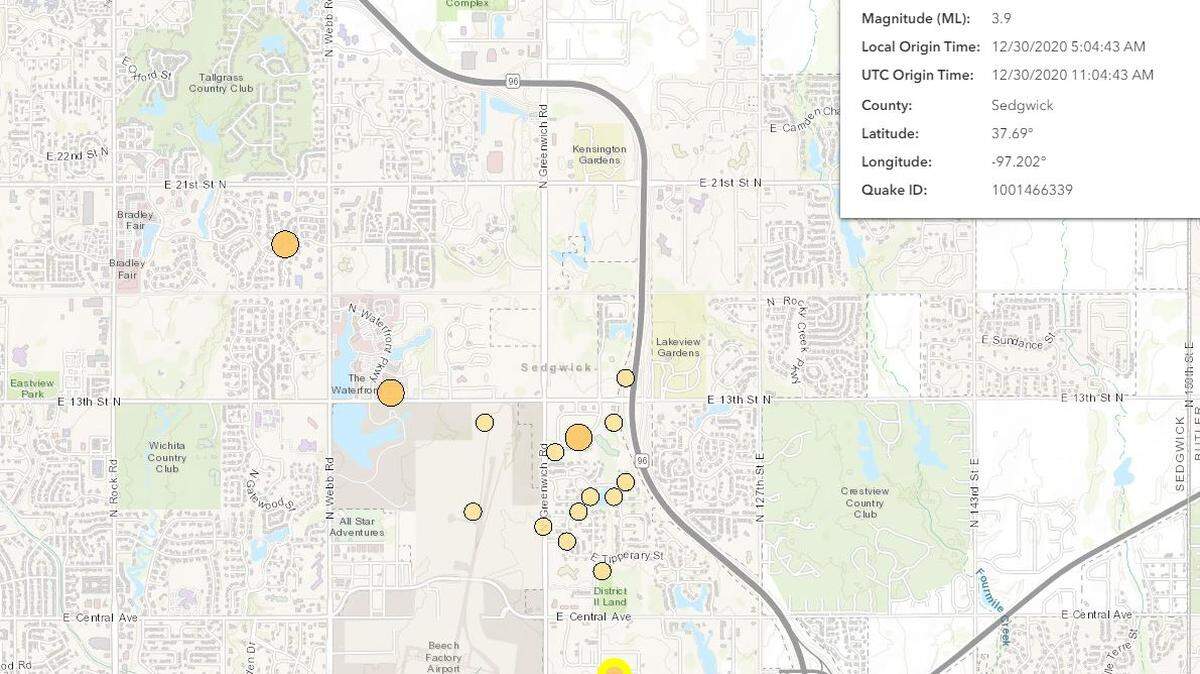
One of two earthquakes Wednesday morning was the largest in a recent series of quakes and the 32nd strongest in Kansas data, according to the Kansas Geological Survey.
Based on historical data, KGS senior scientist Rick Miller said the magnitude of any approaching earthquakes shouldn’t be much higher than Wednesday’s record earthquake. That’s if there are any additional earthquakes in the near future at all. He believes the 18 quakes to hit Wichita recently are a natural event that will subside once the suspected fault causing them has released its built-up energy. Wednesday’s earthquakes included a 3.9 magnitude one at 5:04 a.m. east of Greenwich between Central and Douglas and a 2.0 magnitude one at 5:23 a.m. with an epicenter just north of Towne East Square.
“We shouldn’t expect anything too much bigger than a magnitude 4,” Miller said. “We’re getting up there toward the maximum size that we would expect in this cluster at this time.”
Miller said there could be a larger event since what they know now is a one-month snapshot in time, but the suspected fault causing the earthquakes could have been doing so for millions of years.
Miller said each earthquake adds information to the limited database the KGS has.
In 2015, funding allowed the KGS to put a sufficient amount of measuring instruments in the ground, he said. Kansas has had instruments measuring earthquakes since the 1970s. The data before then, and dating back to the 1860s, comes from newspaper accounts of people reporting feeling it.
Miller, looking at the pattern of the earthquakes since November, suspects they are from a fault line that runs from northwest to southeast and could be a fault that was mapped in drilling data in the 1970s. He said the fault wouldn’t be far from the Nemaha Ridge, where it would be expected to find faults.
Nine of the recent earthquakes have occurred east of Greenwich and between 13th and Central. All but two other earthquakes fall within 2.5 miles from there.
The KGS reports earthquakes above a 2.0 in a measurement equivalent to the Richter scale. Wednesday’s earthquakes included the fourth one that broke the 3.0 magnitude since Nov. 26.
A 3.9 would set off an investigation by the Kansas Corporation Commission, which concluded earlier this month that it “does not believe” the earthquakes are tied to “oil and gas activities in the area.”
The 3.9 magnitude ties for the 32nd largest in Kansas history, Miller said. The available data goes back to 1865. He said the two highest magnitude earthquakes recorded in Kansas were a roughly 5.2 in Manhattan in 1867 and around a 5.0 in Sumner County in 2014.
The generally considered threshold for feeling an earthquake is a 2.5 magnitude, Miller said. It takes a 5.5-plus magnitude earthquake to cause structural damage.
Miller said the actual drilling associated with fracking to extract oil or gas has been proven to lead to earthquakes in other areas, including Oklahoma, but not in Kansas.
However, wastewater injection associated with fracking has changed pressures and volumes of water in south-central Kansas. Those changes correlate with earthquakes in areas like Kingman, Harper, Sumner and part of Sedgwick counties.
“We don’t see that here” in Wichita, he said.