
Holiday air travel forecast: tighter seating, higher prices and more uncertainty
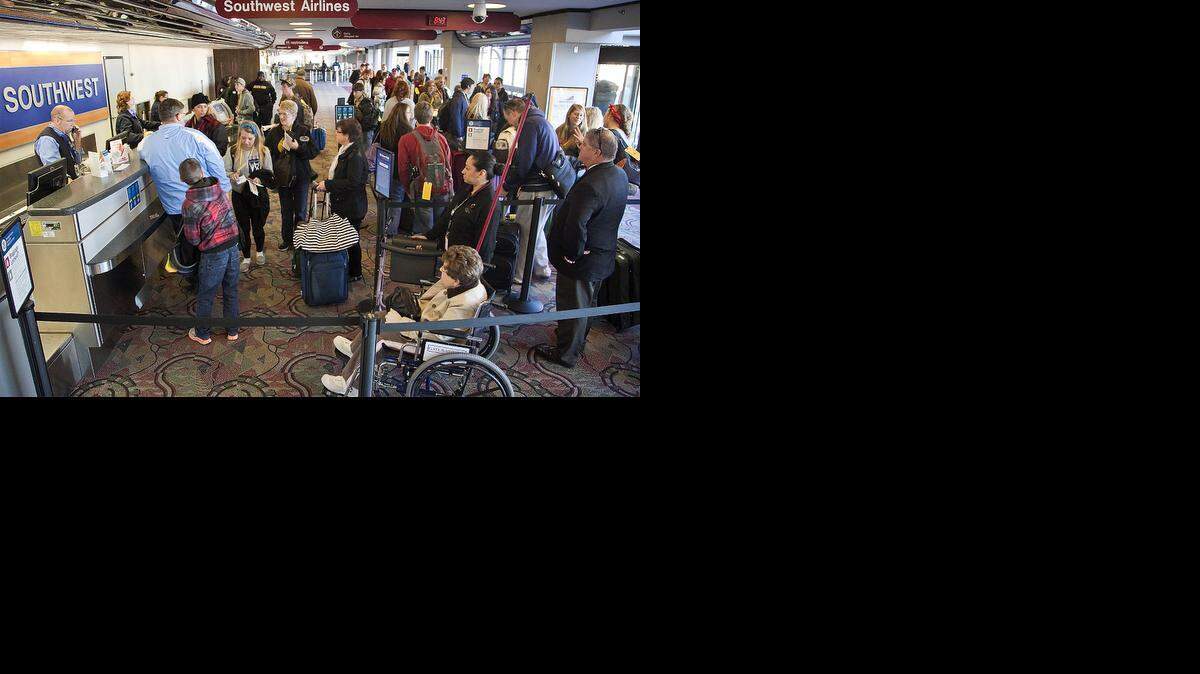
Airline travel this holiday season will feature tighter seating, higher costs and more uncertainty, according to a forecast released Monday by Wichita State University professor Dean Headley, co-author of the annual Airline Quality Rating.
While industry airline performance has generally improved every year since 2007, mostly because there are fewer delays and canceled flights, Headley said, the actual in-flight travel experience has gotten worse.
Flying has become more stressful and uncertain and will be especially so around Thanksgiving and Christmas.
His tips for flying this holiday:
Travel as early before the actual holiday or as late as possible afterward.
When booking flights, leave at least an hour and a half to two hours between connections in case flights are delayed or changed.
Avoid flying through Chicago and Denver during the late fall and winter. Bad weather is one of the biggest reasons flights are delayed and canceled.
Pack as lightly as possible to avoid the possibility of lost checked baggage. He likes the idea of shipping some items, such as Christmas presents, by UPS or FedEx.
In the quality rating for 2013, the overall best performing airlines were Virgin America, Jet Blue, Hawaiian, Delta and Alaska. Southwest had the lowest rate of customer complaints.
The worst overall were American Eagle, SkyWest, Express Jet, United and Frontier. American Eagle, ExpressJet, and Frontier had the worst on-time performances. SkyWest had the worst rate of denied boardings. American Eagle had the highest rate of mishandled baggage. Frontier had the highest rate of customer complaints.
The number of flight delays and cancellations has fallen in recent years, improving the annual quality ranking, he said, because the companies are flying fewer planes and have learned to cancel problem flights more quickly.
Higher occupancy makes the surprise flight cancellation all the more difficult, he said. The cancellation of a flight and all of its connections – usually caused by weather or mechanical problems – actually makes sense for the system as a whole because it keeps the delay from cascading through the system, affecting other airplanes. But the stranded passengers have to wait hours or days to get rebooked because flights are so full.
“It will be busier this year,” Headley said. “Traveling volumes are going up 2-3-4 percent every year. You can’t put 3 percent more people in a tighter space without somebody getting unhappy with it.”
Since the recession, airlines have cut back on their airplanes and boost occupancy in their planes, even shrinking the width and legroom of seats to squeeze in more passengers – to the point where people are fighting each other over whether the seat in front of them should recline.
“For me, the industry is all about money,” Headley said. “They say they are customer-oriented, but when they take an inch out of each seat area to put in two or three more rows, it’s not helping me any. Seems like I’m paying more and getting less.”
He said he expects airlines to eventually get rid of reclining seats because of the conflict they cause, but said they will wait until they feel they have to because of the expense.
The cycle will eventually turn, he said, and airlines will start trying to make passengers happy and comfortable again, but not in the immediate future.
What that means this holiday season, he said, is that people have to keep their good humor in the face of aggravation.
“I guess that’s my biggest piece of advice: Stay in the holiday spirit; help your fellow traveler as much as possible,” he said.
Reach Dan Voorhis at 316-268-6577 or dvoorhis@wichitaeagle.com. Follow him on Twitter: @danvoorhis.
This story was originally published September 8, 2014 at 10:07 AM with the headline "Holiday air travel forecast: tighter seating, higher prices and more uncertainty."