
KU doctor reflects on ‘year of unmeasurable sorrow’ as Kansas reports March 1 COVID data
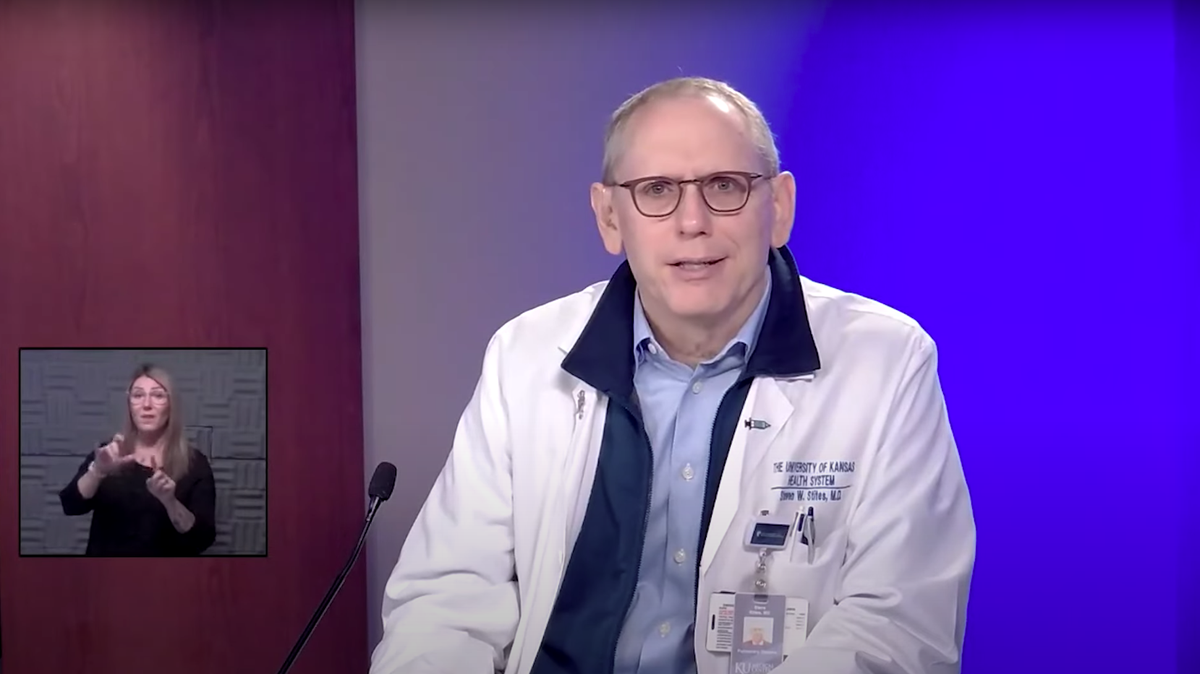
Doctors are urging Kansans to continue following health guidelines as coronavirus pandemic indicators improve after a year of fighting COVID-19.
Entering the 13th calendar month of the pandemic in Kansas, the better trends do not mean COVID-19 is gone and people can stop wearing masks and abiding by other recommendations, officials say.
“We have got to continue that behavior, because it is winning the day,” Dr. Steve Stites, chief medical officer at the University of Kansas Health System, said during the hospital’s virtual media briefing on Monday. “We’re going to get a little challenged as the weather gets nicer and people want to get back out and get together again. I think the (recent cold weather) probably helped us.”
Stites attributed the lower infection numbers to good behavior by the general public.
“For all of us, we still have to take COVID-19 seriously,” Stites said. “It’s still out there. I think we are still concerned about the next possible surge that could occur in April and May as people get back out, they get together again, the bars and restaurants are clearly opening more and we see people coming together in different venues, I know there are concerts starting to be planned.”
The threat of coronavirus variants has health officials concerned. The Kansas Department of Health and Environment reported eight new cases of the United Kingdom variant in the Wichita area, all from a single household. No information was released on potential community exposure.
There have now been 10 cases of the U.K. variant identified in Kansas, and state and local officials advise people to continue following health guidance, and to get vaccinated when it is your turn.
In Sedgwick County, the local health department reported on Monday a 14-day rolling average of 3.8% test positivity. Coronavirus disease hospitalizations at Wesley Medical Center and Ascension Via Christi St. Francis are the best they have been since before the fall surge.
The two hospitals had a combined 63 COVID-19 patients on Monday, down from 90 the previous Monday. The number is the fewest since Oct. 5. The hospitals had 21 of those patients in intensive care, down from 33 the previous week and the fewest since Sept. 22.
The hospitals had 27 available ICU beds as of Monday morning.
County Manager Tom Stolz said during a news conference that hospital numbers have improved because of vaccinations and community compliance with health orders.
Wesley Healthcare announced it is relaxing its visitation policy starting Tuesday, citing the improving positive test rate locally. Patients will now be allowed two visitors at a time, but the visitors must be at least 12 years old. Screening, masking and temperature checks will continue.
Patients in COVID-19 units will not be permitted visitors.
“Throughout the pandemic, we have been sensitive to how difficult it has been for families who have loved ones hospitalized in our facilities,” Wesley CEO Bill Voloch said in a statement. “The recent drop in COVID-19 testing positivity rates, coupled with an ongoing drop in related hospitalizations, have created an environment in which we are able to grant families greater access while still maintaining an extremely safe environment for care.”
As of Monday, the KDHE reported that the state has now had pandemic totals of 294,302 confirmed and probable cases, 9,290 hospitalizations, 2,521 ICU admissions and 4,743 deaths. The increase from Friday to Monday was 639 new cases, 41 new hospitalizations, 11 new ICU admissions and eight new deaths.
For the seven-day period that ended Monday, Kansas averaged 370 new cases per day. That is the lowest rolling seven-day average since early July 2020, the Associated Press reported.
Sedgwick County, according to the KDHE, has now had 53,679 cases, 1,432 hospitalizations, 418 ICU admissions and 694 deaths. Wednesday’s report contained 108 new cases, 10 new hospitalizations, three new ICU admissions and zero new deaths.
KU doctor’s reflection on the past year
With the start of March 2021, Kansas is nearing the one-year anniversary of its first confirmed case of COVID-19. Stites, the KU doctor, reflected on the past year.
“I think that all of us are a little bit of a weary soldier,” he said. “It has been a long journey. Not one any of us anticipated it lasting this long, but as you look back at it, you have to ask ourselves, why wouldn’t we have thought it was going to last this long, given that the coronavirus can mutate and do the things it does.”
“This has been the year of unmeasurable sorrow as we try to understand what we have experienced together and what we still face yet to come.”
“I think the tragedy and the sorrow is that it did not have to be this hard nor really this long. Because you see places around the globe where they have taken this much more seriously and with much greater community sharing around the risk and the success, and they’ve experienced success in ways that we have not been able to do. And I think had we just had a very open, honest conversation without the hyperbole and without the disinformation from the very beginning, we could have done what we’re doing now.”
Vaccination statistics
As of Monday, the KDHE has had 584,468 total doses reported as administered out of 805,480 distributed to Kansas.
There have been 393,860 total first shots reported as administered, or about 13.5% of the population. There have been 190,587 second shots reported as administered, or about 6.5% of the population.
Over the weekend, the KDHE logged 23,360 new first shots given and 16,845 second shots given.
Last week, Sedgwick County was allocated 15,530 doses by the KDHE. Numbers for this week were not immediately available.
Data from the Centers for Disease Control and Prevention has Kansas ranked as the fifth-worst in the country for total doses administered per capita. Kansas ranks ahead of Tennessee, Georgia, Alabama and Texas.
The Sedgwick County Health Department has administered 46,705 doses in total, including 31,183 first doses and 15,522 second doses. On Saturday, the county administered 1,007 new first doses and 468 new second doses.
Those numbers do not include vaccinations from other providers, such as hospitals and pharmacies.
The health department has transferred almost 9,000 doses to community partners, including 7,470 doses to Wichita Public Schools, the county manager said.
Increased testing capabilities
On Monday, the KDHE announced the launch of three mobile testing units that will help expand access to testing across the state. The units will also provide rapid response in the event of an outbreak.
“Ramping up testing capabilities in Kansas has been critical to identify COVID-19 in our state and stop the spread,” Dr. Lee Norman, KDHE Secretary, said in a statement. “We must remain vigilant and continue following proven public health measures. I urge you to utilize the free testing locations in your area.”
One unit will be in Sumner County, stationed at Cowley College campus in Wellington every Tuesday in March. Another will be in Butler County at the Andover Police Department every Wednesday.
The third unit will be in Douglas County at the Baldwin City Public Library every Monday.