
Something stunning is happening in downtown Wichita, and it’s time to pay attention
There’s something happening in downtown Wichita that, no matter how you measure it, is nothing short of stunning.
Sudha Tokala, a pharmacist-turned-developer, is transforming the city’s core in a way that most Wichitans don’t yet realize.
It’s not only that she had a vision for the new nonprofit Kansas Health Science Center and its Kansas College of Osteopathic Medicine, which opens to students in August. It’s also that she developed numerous ancillary plans following that idea — a new hotel, a culinary school, a food hall, an event center and student housing — all in five large downtown buildings in desperate need of revitalization.
Jeff Fluhr calls it an “incredible trifecta.”
Fluhr, president of the Greater Wichita Partnership, cited the scale, number of concurrent projects and potential impact on downtown in terms of hospitality, commercial space and residential housing.
“It truly is remarkable,” he said.
Dave Burk, the longtime Old Town developer, said that “probably there hasn’t been as much square footage converted at one time by one developer” as what Tokala is doing.
“That has a tremendous impact on our downtown.”
Two important questions
So what exactly has Tokala done and how has she done it?
Those are questions worth examining, in part because of where Tokala started.
Aside from some hotel deals and duplex construction she’d invested in previously, Tokala didn’t have a lot of experience either developing real estate, working with government entities or rehabbing historic buildings. She said pretty much the most she’d done was remodel her house.
“This is the first one I’m actually here all day doing it.”
A native of India who grew up in South Africa, Tokala went to the University of Kansas to earn a master’s in pharmaceutical chemistry. In 2001, she and her physician husband, Chandra Tokala, moved to Wichita after his residency and fellowship at Harvard University because she said they both missed Kansas.
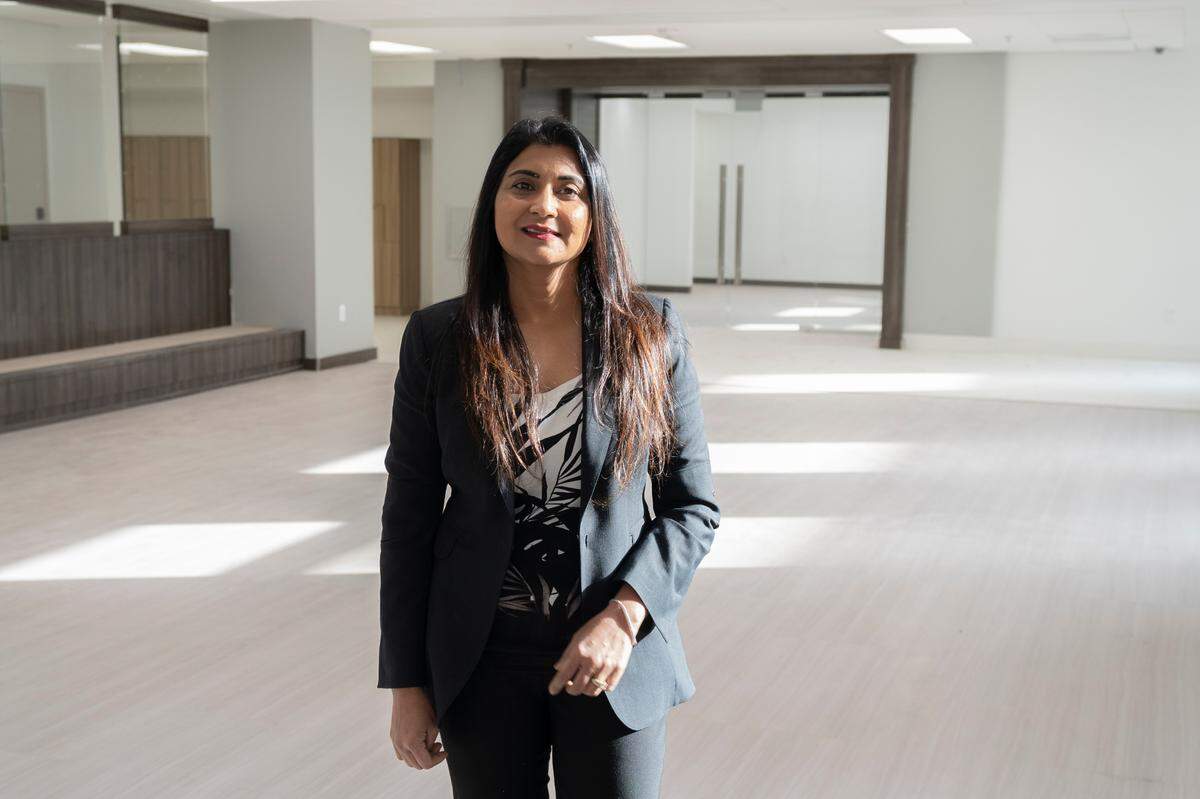
Sudha Tokala worked as a pharmacist until 2008, and she became involved with business ventures in 2010 from the investment side.
In 2017, when she was the surprise winning bidder for the former Finney State Office Building (which actually is two buildings the Innes Department Store built — one in 1927 at 230 E. William and one in 1947 at 130 S. Market), she seemed to almost come out of nowhere.
As she bought adjacent buildings, she was met with skepticism.
“A lot of people were like, ‘Who?’ ” said Assistant City Manager Scot Rigby. “I never heard of her.”
Mere months after announcing plans for a heath science center in 2018, Tokala declared — without explanation — she was dropping them.
A week later, the plans were back on.
Tokala still won’t go into what was behind her vacillations, but former Mayor Jeff Longwell said he believes it was “partially because there was pushback from the community. Obviously, the KU School of Medicine didn’t like it at all.”
Longwell called Tokala an “incredibly intelligent woman. Don’t ever underestimate her.”
“She just had a drive like very few people have.”
An overwhelming process
Despite that drive, Tokala said there were “many, many, many times” she felt like giving up.
“The accreditation process . . . was just overwhelming.”
She noted that others actually were more involved with that — Tokala is not involved in operations with the school — while she redeveloped buildings.
The Commission on Osteopathic College Accreditation last month granted the school its pre-accreditation status. As is customary, the final accreditation does not happen until after the first class graduates, which is scheduled for 2026.
The school is taking applications now and already has 175, and that’s before its marketing campaign has even started. A total of 1,500 or more are expected by May.
There will be 85 students in the first class, about 127 in the second and 170 in the third. At full capacity, there will be 680 students earning four-year degrees.
Tokala said it’s difficult for her to explain why she believed she could start a school and renovate five historic buildings to boot.
“I don’t think there’s one single answer to that.”
She built a team, including local and national consultants, who helped her see it through. Tokala particularly credits CrossFirst Bank in Wichita, which “had to believe in me to help me.”
Funding for the approximately $80 million development is coming from Tokala’s own money and what she’s borrowing from CrossFirst. It also will be partially offset by historic tax credits (which aren’t awarded until everything is completed but will account for almost 30% of the project) and almost $12 million in city facade-improvement loans.
“If she’d known how daunting it was up front, who knows if she would have carried on,“ said developer Jerry Jones. “I think she just kind of one step at a time has worked through that.”
Jones, Burk and a couple of others were partners with Tokala in the Finney building for a time but realized it was her dream, not theirs.
“She was passionate about the DO school,” Jones said. “We knew it was going to be an uphill battle to get that in place.”
He said Tokala had the perseverance and focus it took, though in some cases that may have been off-putting to some.
“That’s why developers in general, I think, kind of get a bad name,” Jones said. “She’s just doing what it’s taken to put together a mammoth project.”
Longwell said he’s seen Tokala “do nothing but reach out and be very engaging and try to bring everyone along.”
“She’s a strong woman and gets miscategorized for being a strong woman.”
Tokala agreed.
“I guess I intimidate people, which is what I hear.”
She said being a woman in a male-dominated field colors perceptions, too.
Dealing with the city has been a learning curve for Tokala, and she said learning about incentives has been a chore.
“But she approached it and was reasonable in her discussions with us,” Rigby said.
Tokala also is using tax increment financing for the AC Hotel by Marriott that she’s putting in the former Broadway Plaza building at the southwest corner of Douglas and Broadway, though in a different way than developers normally do.
Usually, developers ask for the tax-abatement mechanism to divert their first decade of taxes on a project to finance infrastructure improvements in a redevelopment district.
However, instead of asking for this money herself, Tokala — in a gesture of goodwill — suggested that the city use the $1.3 million to expand and remodel the pocket park on East Douglas between Broadway and Market, which is named for civil rights leader Chester I. Lewis.
Rigby said that the park redevelopment probably wouldn’t be happening without Tokala’s redevelopments.
“So there’s a public benefit.”
And there’s one to Tokala, too, she said.
Redeveloping an area “cannot be one building. It has to be the whole area.”
Passing the baton
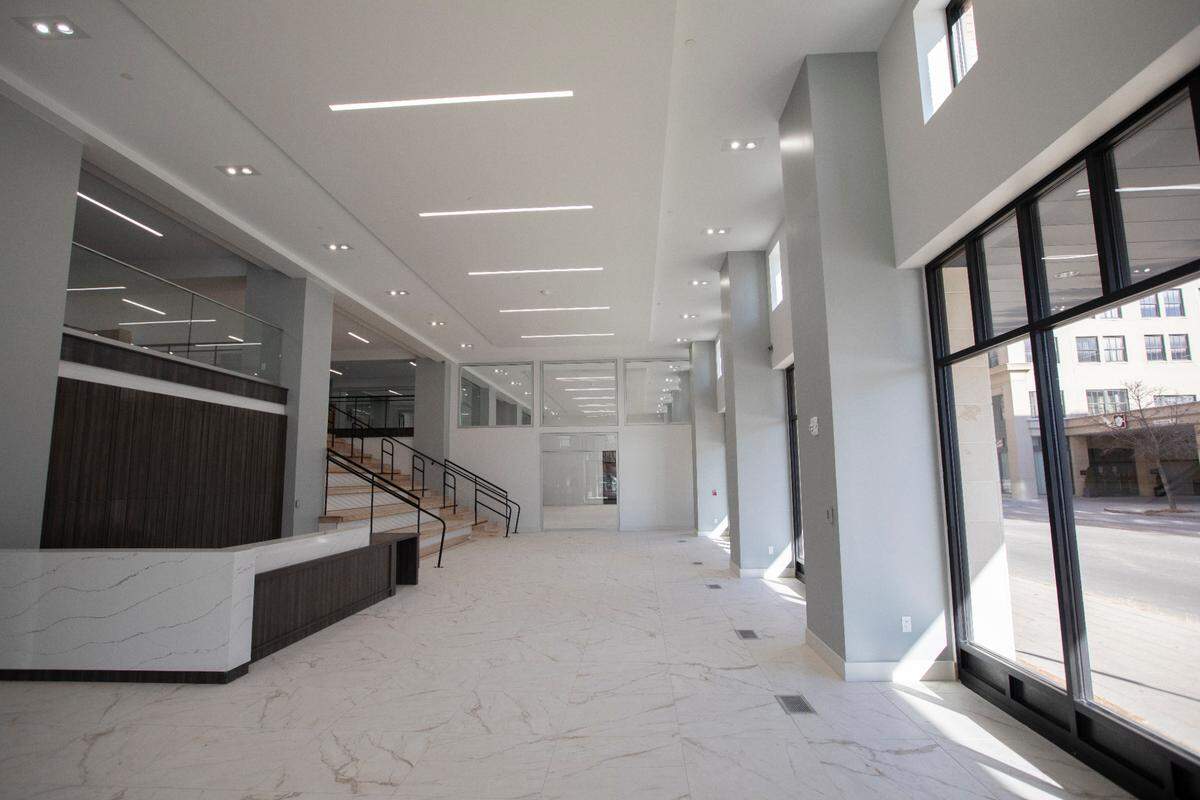
Tokala and school president Tiffany Masson toured several other medical and dental schools to learn what theirs should have to train students in the way they want and to rethink how medical education is taught.
“We wanted to really design our facility to reach those end goals,” Masson said.
Tokala said she will have no problem relinquishing control of the school to Masson and her team — so far there are more than 50 employees, and there will be almost 100 by August — who will move into their new space in the coming weeks.
“Oh, I’m so happy,” Tokala said. “It’s something to have a vision, but it’s something to have people that are there that are passionate enough to make that vision come true.”
Following the conversion of the school space, Tokala can turn her attention full time to her other projects, which she’s been working on simultaneously.
That includes the 110,000-square-foot, 11-story Sutton Place at the southeast corner of William and Market for 119 one- and two-bedroom apartments for the exclusive use of students.
That will house only a small percentage of students, so many are expected to seek other lodging downtown.
At the northeast corner of William and Broadway is the old Henry’s department store where, when Tokala finishes renovations to the 60,000-square-foot building, it will look almost identical to when it opened in 1948 except for the fourth floor she’s added.
Tokala made a deal with WSU Tech to start its new culinary school there. There also will be a food hall and a 500-person event space on the top floor. There are already deals for new restaurants there — a national chain called Jinya Ramen Bar and a school-run venture called BVI Bistro.
Interior and exterior work is underway at the space, which will open in August along with the culinary school.
Henry’s is the last piece of the city’s Block One redevelopment to be finished. That was an effort a decade ago to revitalize a full city block around the new Ambassador Hotel.
Then there’s the AC Hotel by Marriott that she’s putting a half block north from Henry’s at Douglas and Broadway where Tokala is converting the 70,000-square-foot 11-story Broadway Plaza, which formerly was offices.
Plans for each of the buildings grew somewhat organically. As she negotiated for a hotel flag and the culinary school, Tokala continued to consider other possibilities as well.
“I always had a backup.”
‘Beyond the scope’
The school estimates a $1 billion economic impact to Wichita and the region in the first dozen years of its operation.
When the Wichita Public Building Commission that owned the Finney building put out a request for proposals in 2016, Rigby said city officials discussed how “it’d be great to have some type of a health education component” to whatever came to the space.
He said what Tokala envisioned “was even beyond the scope of what we even thought about.”
Longwell remembered back to city staff’s recommendation for the building, which had been to sell to a Memphis group with plans for office space.
“The reality is, what she’s going to bring to downtown Wichita is a different kind of energy than an office building would ever bring,” he said.
“It’ll do more for downtown than the ballpark will for the river corridor,” Longwell said, referencing the new Riverfront Stadium, which was his administration’s signature project.
“I would say we need more Sudhas in the world,” he said. “When everything’s said and done, people are going to look back and go, ‘Wow, that really helped Wichita.’ ”
This story was originally published January 16, 2022 at 5:00 AM.
CORRECTION: Funding for the redevelopment of the Innes building will be offset by almost $4 million in city facade-improvement grants; the full project’s funding will be offset by almost $12 million in such grants. This story has been updated to reflect the full amount.