
A sneak peek with artists selected to help Gallery Alley break the art world’s rules
Downtown Wichita has selected the five artists who are going to help break the art world’s rules with the next phase of Gallery Alley, an outdoor gallery at 616 E. Douglas between the Renfro and Old Town Apartments.
“There’s sort of a no-touch rule to artwork,” said Emily Brookover, Downtown Wichita’s director of community development.
That won’t be the case with these five new pieces, which will be unveiled in the spring.
“We wanted this artwork to be able to be experienced,” Brookover said.
Downtown Wichita issued a call to artists this summer.
“Part of the challenge we put on the artists was to create work that everyone could enjoy,” Brookover said.
That includes the blind and visually impaired along with anyone who “just experiences the world a little different than others do,” she said.
Three representatives from Envision, a nonprofit that serves the blind and visually impaired, were on the committee that helped make the selections.
“It was a joyful . . . very exciting moment for us,” said Sarah Stewart, an art education teacher who runs Envision’s arts program.
Stewart said a lot of public art is available for people to touch, “But this is actually stating . . . that this is going to be made for all audiences.”
Gallery Alley has already been through a few phases since it started in 2017.
It was supposed to be a temporary installation but now is permanent.
The space has featured rotating exhibits, concerts and movie nights, but the activity it drew didn’t always make surrounding neighbors happy.
Now, the focus mainly will be on the art since Naftzger Park is reopening across the street and can host some of the events — including the noisier ones that neighbors didn’t appreciate — that Gallery Alley used to have.
Downtown Wichita is revamping Gallery Alley and starting its new Alley Doors project with the help of a $56,850 grant from the Knight Foundation Fund at the Wichita Community Foundation.
There currently are three sculptures still at Gallery Alley, and they’ll remain even when the new pieces are installed.
They include Marc Durfee’s Wheat to Wichita Gateway Arch and his Shift Your Energy sculpture featuring tires that visitors can play with.
There’s also Mike Miller’s Machine-Nature Interface 88 (Arachnid), which is a giant spider climbing a brick wall.
Miller also is one of the artists selected for the next phase of Gallery Alley.
“I really enjoy that space,” he said. “It’s an interesting idea to repurpose an alley, and it’s got a piece of history.”
He said the alley is particularly narrow because “when it was built, the widest car on the road was a Model T.”
Here are the five Gallery Alley artists and a look at their plans. Brookover said in the coming months as the artists progress, Downtown Wichita also will share some peeks at their work on its social media pages.
Tomiyo Tajiri’s universal flowers
Marriage brought Tomiyo Tajiri from her native Japan to Wichita.
When her husband later died, art is what helped Tajiri heal, she said.
“My heart (was) so down.”
Tajiri turned to the Japanese paper-folding art of origami.
“That was so pretty, so gentle.”
She said she realized she wanted to share the art with others locally.
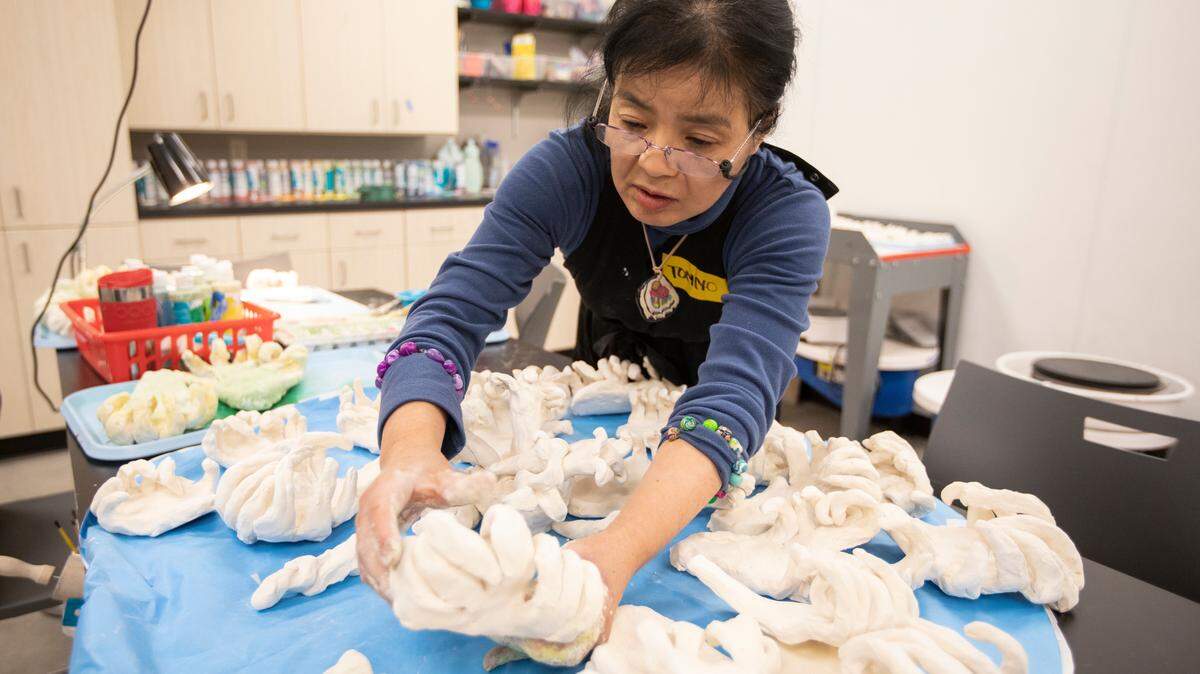
Creating art is especially challenging for Tajiri because she is visually impaired. She began losing her eyesight around 1995 and said she is now down to 5%.
Even without her eyesight, Tajiri said, “My brain had the memory.”
She said she can see color and design in her brain and then translate that through her hands onto ceramics.
Tajiri’s Gallery Alley piece has a “universal flowers” theme.
She’s creating three floral pieces — one circular, one triangular, one square — each of which will feature ceramic flowers native to where she is from.
Tajiri said the flowers represent home, peace and harmony.
Mike Miller’s ‘hanging wave’
Mike Miller, a Wichita native, is a sculptor who is best known for his kinetic pieces — sculptures that are powered by things such as wind, motors or children swinging.
He said he likes that because “it attracts people’s attention that don’t normally pay a lot of attention to art.”
In addition to adding movement to his pieces, Miller adds other layers of detail, such as using a hawk’s feather or even a Ford transmission.
Those layers are part of what piqued his interest in the latest phase of Gallery Alley.
Miller said he wants “the challenge of making a sculpture that is . . . more about tactile, more about what it feels like when you touch it.”
He said he also likes the idea of color and how it fits with the brick behind it.
Miller said both the outdoors and his budget make for constraints on what materials he can use.
He has opted to use the exterior of double-braided rope to sheath PVC pipes to create a “hanging wave.”
“So if you’re standing at one end of the piece, you can start wiggling one of the tubes and all 60 of the tubes will start wiggling in a wave form.”
Miller said this project will inform other pieces he does in the future.
“It’s a fun idea to build art that’s designed to be touched.”
Armando Minjarez’s moving abstraction
Chihuahua, Mexico, native Armando Minjarez came to Kansas in 2001 and Wichita in 2012. His one-time status as an undocumented immigrant prompted him to become involved in immigrant issues in particular and social justice and community development issues in general.
After getting an art degree from Kansas State University, he said, “I wanted to really explore the intersection of activism, social justice and art.”
Minjarez was project director and curator for Horizontes, a large-scale community art project with 20 murals, including the centerpiece grain elevator mural.
Though he’s still interested in public art, Minjarez said he’s been missing his own studio work in ceramics and painting, which is why he answered the Gallery Alley call. Plus, he said he liked its focus on inclusivity.
“I like to really focus on underrepresented communities.”
Minjarez is creating a waist-high sculpture that visitors can walk or wheel around. The narrow, almost 8-foot-long creation will feature various pictures and materials.
“The primary idea . . . is abstraction,” Minjarez said.
He said abstraction traditionally is focused on sight, but he is taking the idea of abstraction to a three dimensional space.
Laura Shank’s mystery piece
Wichita native Laura Shank has been dabbling, as she put it, in art since she was a child. She’s mostly done work for the private sector. She’s currently an interactive media designer for Great Plains Industries.
Shank said she has been wanting to have more artistic pursuits outside of work, and Gallery Alley “just kind of happened at the right time.”
Now, she’s creating a 3-D printed piece — the kind of medium usually found more in industry — and is taking it down a more artistic path.
“I wanted to kind of explore using it for an art piece.”
A memory game Shank used to play with her grandmother was her inspiration for the piece.
“That part of it was important to me, but also the piece itself . . . represents something that I think is important to a lot of people.”
Shank doesn’t want to share too much about what she means, but she says it has something to do with the environment.
There will be doors that can be opened and patterns to be experienced on the doors.
“It is a really special project to be involved in,” Shank said. “I’ve really never given enough thought to what . . . it’s like for people who can’t experience (art) visually.”
Denise M. Irwin’s singing sculpture
El Dorado native Denise M. Irwin, who now lives in Wichita, is a full-time artist who does ceramics and sculpture. A lot of her work can be seen in Arkansas City, where she used to live.
“It’s all meant to be held and touched,” she said.
Irwin’s inspiration for the Gallery Alley project is her mother, who was blind for the last three decades of her life.
That’s part of why Irwin “had a real interest in this kind of project.”
“My mother really enjoyed birds, even before she lost her eyesight,” Irwin said.
Her sculpture will feature meadowlarks who will sing when motion detectors sense someone is near.
Irwin’s mother died in May.
Irwin said it would have been great for her mother to have experienced the birds she’s creating.
“She was always a very creative person herself,” Irwin said. “She’ll just have to be there in a different way, I guess.”
The estimated unveiling of the five new sculptures is May.
While some cities have more well-established art scenes than Wichita, Miller said it’s “actually more fun to be involved in a city where it’s growing.”
With projects like Gallery Alley and the Alley Doors, he said, “The art scene’s . . . just taking off in all different directions.”