
7 ways to squeeze the juice out of late summer
In many ways, this has been a great summer in Wichita. (Except that it’s going by way too fast, as usual.) A walk in the park is enough to knock your socks off with its lush green grass and leafy trees from the drenching rains. (The rains have also caused some problems, though, and killed some plants.)
This last week of July is a good time to take stock of summer and be sure you’re taking advantage of the season’s bounty. There are also some things you can do to inject some oomph back into the garden and prolong the beauty as long as you can.
Here are seven ways to squeeze the remaining juice out of summer.
1. Go to Tomato Day
Have you had your fill yet of gooey grilled cheese with tomatoes, fresh spaghetti sauce on hot pasta, homemade salsa ribboned with cilantro? Don’t let any more of the summer go by without tasting it. The last Saturday of July traditionally is Tomato Day at the Extension Center at 21st and Ridge Road. In addition to being able to sample some tomato varieties and learn about growing and cooking with tomatoes, you can buy bunches of them at the farmers market in the parking lot.
The event is from 7 a.m. to noon Saturday inside and outside the Extension Center. Food trucks will be in the parking lot, the iris club will have tall bearded and other iris rhizomes for sale, and there also will be plant-problem diagnosis and activities for kids. Admission is free.
The seminar schedule: 8 a.m., composting demo; 8:45 a.m., tour of tomatoes in the demo garden; 9 a.m., cooking demo by chef Paul Myshka of Sweet Basil; 9:30 a.m., tour of squash (including pest and disease prevention); 10:15 a.m., tour of accessible gardening; 10:45 a.m., preserving the garden’s bounty; and 11 a.m., tour of herbs and flowers.
2. Attract hummingbirds
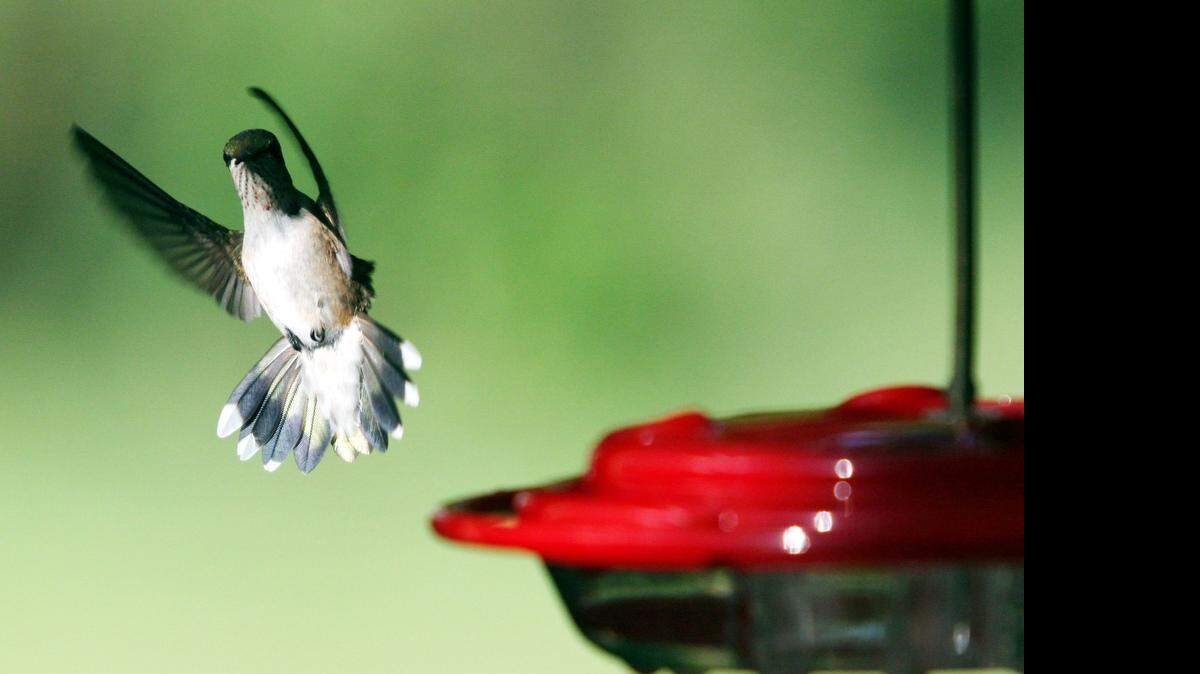
The latter part of July sees hummingbirds finishing up their nesting for the summer and being more active at feeders to fatten up for migration. We’re coming into high hummingbird season, says Nick Clausen of the Backyard Nature Center. Put out at least one feeder and, to see more birds, put out more than one, because the birds “don’t share very well,” he said.
Ideal placement would be a feeder 8 to 10 feet on either side of a shrub, because a bird can’t guard more than one feeder at a time, Clausen says. “You can see several at one time that way.”
Make the nectar for the feeders by vigorously mixing one part sugar into four parts water. Add no food coloring. And then the important thing is to maintain the feeders, changing out the sugar water every three to four days maximum, Clausen says. There is a new product called Nectar Defender that is supposed to make the water stay fresher longer, but it’s unclear how much longer, Clausen says. He’s sticking with the untreated water and frequent changes.
You can also attract the birds with red flowers, “because they see red where insects don’t,” Clausen says. At his house, there is a big bed of red cannas, along with red salvia and trumpet honeysuckle (lonicera sempervirens). This is a type of honeysuckle that is not to be confused with out-of-control trumpet vine, Clausen says.
“They’ll check out anything that’s flowering,” he says. If the flowers have nectar, so much the better. Tubular flowers such as columbine, cardinal flowers and beebalm are ready for their long beaks.
3. Fertilize
The rains have washed nutrients out of the soil, and one thing that could really make a difference in the rest of the season is fertilizing, said extension agent Rebecca McMahon.
“I’m seeing at home parts of my garden that were just lush and awesome last year are kind of wimpy this year,” she says. “The plants aren’t as big, and they’re not very productive, and I’ve fertilized them some but not enough.”
She’s noticing the problem especially on vining plants such as cucumbers that “are struggling even to think about climbing the trellis.” Tomatoes that have set fruit may also look wimpy or weak with not as much foliage.
The double whammy of lots of rain and alternating very hot and cooler temperatures are probably to blame, McMahon says.
“We’ve probably got some compromised root systems, and with the rain flushing nutrients out of the soil, I’d encourage folks to do a little bit of supplemental fertilizing and maybe even consider a soil test if it seems like they have a big problem.”
Nitrogen is most likely to be deficient, but use a light hand in applying it, McMahon says, especially in hot weather, because you can burn plants by putting too much on.
After you’ve put on a little quick-release fertilizer such as urea, if things are looking better in seven to 10 days, go back with a bit more, she says. Be sure to water in the fertilizer.
4. Deadhead
Flowers, including roses, also need fertilizer, along with removing spent flowers to keep new ones coming. Annuals can be fertilized throughout the growing season, but get the last fertilizer on perennials by mid-August. At that point, the plants need to know that they are heading for dormancy and should not be encouraged to push on new growth.
On shrub roses, you can often just take a broom and sweep off old flowers rather than needing to actually prune them off, says Wichita rosarian Cindy Vadakin.
5. Add new plants
As long as you keep them watered, fresh plants and seeds can go in the ground, or containers of plants can be added to punch up the color in your yard where it has faded. You can often find plants on sale, and it feels good to give them a home while there’s still good growing time left.
Market flower grower Mary Buffo says there’s still time to plant sunflower seeds for another flush of blooms if you select the pollenless type. They take a shorter time to mature than other types – 55 to 60 days.
You can also start your fall garden, planting beans, cabbage, carrots, broccoli, endive, cauliflower and beets.
6. Share the bounty
If you can’t keep up eating the tomatoes or zucchini that you’re picking, consider donating produce in peak condition to Plant a Row for the Hungry for the needy.
You can leave produce during business hours at these locations: Kansas Food Bank, 1919 E. Douglas; Augusta Ace Home Center, 316 W. Seventh, Augusta; Brady Nursery, 11200 W. Kellogg; Hillside Nursery, 2200 S. Hillside; Hillside Feed and Seed, 1805 S. Hillside; Johnson’s Garden Centers at 21st and Woodlawn and 2707 W. 13th St.; Valley Feed & Seed, 1903 S. Meridian; and Woodard Mercantile, 4160 N. Maize Road.
6. Hit the farmers markets
We’ve mentioned the farmers market at Tomato Day, but there are other markets in Wichita, and they’re not all on Saturdays. Here are some of the area markets by day:
Saturday
▪ Old Town, 7 a.m. to noon, 150 N. Mosley; www.oldtownfarmersmarket.com, Old Town Farmers Market on Facebook
▪ Kansas Grown, 7 a.m. to noon, 7001 W. 21st St. (at Ridge Road); kansasgrowninc.com, Kansas Grown Farmers Market on Facebook
▪ Derby Kansas Grown, 7 a.m. to noon, 611 N. Mulberry in Derby
Tuesday
▪ Kansas Grown at GreenAcres, 3 to 6:30 p.m., 21st and Rock Road in Bradley Fair
Wednesday
▪ Lincoln Heights, 7 to 11 a.m., Douglas and Oliver
Thursday
▪ Kansas Grown at Normandie, 3 to 6:30 p.m., Central and Woodlawn
▪ Kechi, 4 to 6:30 p.m. starting June 4, United Methodist Church at 4533 E. 61st St. North; sponsored by the Kechi Chamber of Commerce.
7. Water, water, water
We won’t spend much time on this, but make sure you spend enough time watering. Because the root systems of some plants have been damaged by all the rain, the roots are not able to take up water as efficiently as before. So when it’s not raining, they’ll need more water. Get to know your plants and make it a habit to check them for water needs – year-round.
Reach Annie Calovich at 316-268-6596 or acalovich@wichitaeagle.com. Follow her on Twitter: @anniecalovich.
If you go
Tomato Day
When: 7 a.m. to noon Saturday
Where: Extension Education Center, 21st and Ridge Road
How much: Free admission
Seminar schedule: 8 a.m., composting demo; 8:45 a.m., tour of tomatoes in the demo garden; 9 a.m., cooking demo by chef Paul Myshka of Sweet Basil; 9:30 a.m., tour of squash; 10:15 a.m., tour of accessible gardening; 10:45 a.m., preserving the garden’s bounty; 11 a.m., tour of herbs and flowers.
This story was originally published July 23, 2015 at 7:15 PM with the headline "7 ways to squeeze the juice out of late summer."