
Indoor hive gives look at honeybees during festival
My co-worker Brian was reminding me of going to Stuckey’s when he was a kid, when the stores had beehives indoors with a little opening for the bees to come in and go out.
I think but am not sure I remember. Certainly not as much as I remember the pecan log. But we have an indoor beehive in Wichita, and I certainly felt like a kid as I went to see it for the first time ahead of this weekend’s Honey Bee Festival at the Great Plains Nature Center.
At the free festival, which runs from 10 a.m. to 3 p.m. Saturday, visitors also will be able take a nature hike in adjoining Chisholm Creek Park, taste different flavors of honey, take part in crafts and games for kids, watch the film “The Vanishing of the Bees,” talk to beekeepers, and learn what to plant to attract pollinators to the yard.
For $1, they’ll also be able to make ice-cream sundaes with honey topping and beeswax candles.
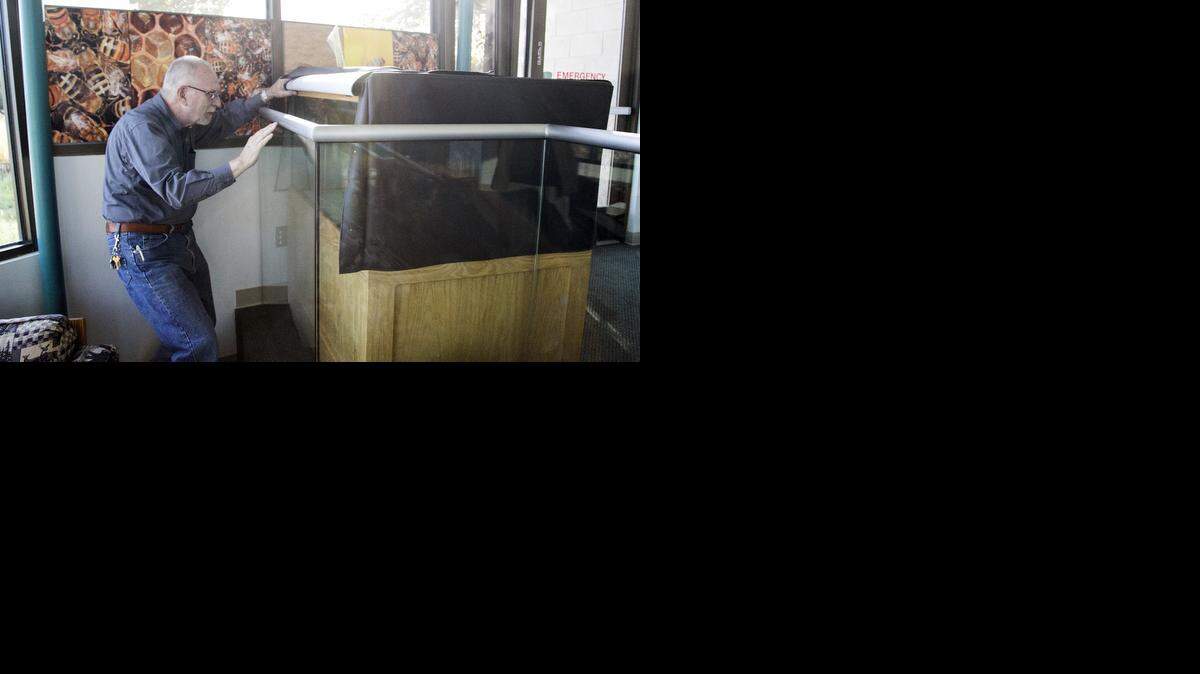
As I envisioned the indoor beehive, I expected a tall structure of some sort visible in the round. But this hive is actually in a square aquarium-like box at the back of the center, in an observatory room with large windows that overlook grassland and wetland to the north.
The hive’s keeper, Mike Leck, flipped up a panel of heavy black-out material to reveal one side of the hive, placed at eye level for a child. An adult can kneel down to look straight into the hive, or look down into a mirror that reflects the hive. I knelt down.
The population of the hive is at about 45,000 honeybees, though only a fraction of those can be seen crowded along the glass walls. But most of them are quite busy there, demonstrating where the term “a hive of activity” comes from.
The most mind-bending part of an indoor hive, of course, is its connection with the outside. We’re so trained from the time we’re toddlers to keep the screen door shut so the flies don’t get in the house that it’s impossible to think of putting a hole in the wall for the purpose of actually inviting bees in. At Great Plains, there is a see-through tunnel that leads from the hive to that hole in the wall, where the inner-and-outer exchange takes place.
In the observatory room, you can look out at the yellow flowers that the bees are pollinating, and you can watch the bees coming in with pollen on their legs. This time of year, honeybees are still finding nectar and pollen in wildflowers to build up food supplies for the winter, Leck says. Bees gather nectar for the carbs, pollen for protein. Their main sources now are goldenrod, Jerusalem artichoke sunflowers, and ragweed, giving that notorious allergen a positive role to play.
The bees will continue to build up the honeycomb and fill the combs with honey as we get closer to winter, Leck says. Bees laying eggs and cleaning out for the next generation are not as visible within the hive. In addition to the queen and worker bees, there are also housekeeping bees that take the dead ones out and far away from the hive. “Like us they’re aware that disease may be involved,” Leck says.
But as the comb is growing, the population of the hive will soon diminish. Worker bees live six weeks through the spring and summer; the number of bees in the hive drops to a low of 3,000 to 5,000 over the winter, Leck says. A visit in late January will starkly show the diminished numbers.
The hive was started three years ago, encased in plastic. It was switched out for glass last year.
Leck takes the hive apart three or four times year to expand the space for the bees. The last time he did it, even though the hive was taken outside, about 200 bees found a hole into the tunnel and managed to set themselves free within the observatory room. But they were all carefully collected back into the hive, Leck says.
He considers himself a hobbyist when it comes to bees, but professional beekeepers also will be on hand for the Honey Bee Festival, along with honey for sale.
Five types of honey will be available for tasting, stemming from the type of flower that the bees used for nectar. Buckwheat, for example, looks like molasses. Leck puts a tablespoon of that in the coffee pot when he brews Southern pecan coffee from the Spice Merchant, producing what he calls Southern pecan pie.
Tupelo honey is darker yet, with a flavor heading toward coffee. “Tree flowers have a different flavor,” Leck says.
Goldenrod is the greatest contributor to what is labeled as wildflower honey, he says.
For a $1 donation, people will be able to make a small beeswax taper candle by rolling a sheet of beeswax around a candle wick. Beeswax candles are smokeless.
Leck has another use for beeswax: waterproofing his shoes.
These events are scheduled during the festival:
▪ Presentations by Pheasants Forever/Quail Forever on plants that attract pollinators to the yard, at 10 a.m. and 1 p.m.
▪ Readings by Shakespeare in the Park from the Bard’s works that celebrate honey bees, at 10:30 a.m. and 1 p.m.
▪ Music by The Stagehands, from 11 a.m. to 1 p.m.
▪ “Vanishing of the Bees,” at 1:30 p.m. in Coleman Auditorium.
Apart from the festival, the indoor hive can be visited anytime the center is open, from 9 a.m. to 5 p.m. Monday through Saturday. Admission is free. Leck says that whenever he goes back there, he always sees some visitor checking out the hive.
Whether visiting the bees or looking out the big north-facing windows of the Bob Gress Wildlife Observatory where they’re housed, I like to envision many sweet returns.
Reach Annie Calovich at 316-268-6596 or acalovich@wichitaeagle.com. Follow her on Twitter: @anniecalovich.
If you go
Honey Bee Festival
When: 10 a.m. to 3 p.m. Saturday
Where: Great Plains Nature Center, 6232 E. 29th St. North
How much: Free
Information: www.gpnc.org
This story was originally published September 19, 2014 at 12:41 AM with the headline "Indoor hive gives look at honeybees during festival."