
Good things happen when herbs go to flower
I must not have done much cooking last summer.
I remember that my herbs – including the basil – went to flower early, without me harvesting them so much as once. We’ve been told that we’re supposed to cut culinary herbs regularly to keep them from going to flower, because once they do, the leaves start to lose their potency.
But while I might have wished that I’d eaten at home more, I didn’t mind the herb flowers, because I'd remembered the bees on them the year before. Maybe there was an upside to my negligence. Maybe unconsciously I knew it would be better this way.
This year the experts confirm my hunches. While you don’t usually see herbs – apart from dill and fennel – on the lists of plants that are beneficial for pollinators such as bees and butterflies, herb flowers do make a contribution, master gardener Lisa LaRue and bee-friendly farmer Debbie McSweeney say.
“They’re awesome,” says McSweeney, who has six hives on her bee-friendly farm between Peabody and Walton. She’ll give a talk at Botanica on June 3 about bees. “Mints are good, oreganos are good, sages are good. So many of the medicinal herbs. … Even my horseradish is blooming, and I see them on them it.” Now I bet that would make for some interesting-tasting honey.
I talked to the herb growers in anticipation of Herb Day, the annual early-May, kick-off-to-gardening party thrown at the Extension Center by the master gardeners and the Herb Society of South Central Kansas. Herb Day is May 2 this year.
A new interest in bees and butterflies caused organizers to put them on the seminar list of Herb Day, organizer Judy Tector says. A talk on container planting to attract bees and butterflies will be at 9 a.m., and the benefits of beekeeping at 11 a.m.
McSweeney went to culinary school and was taught there to cut her herbs back before they flower. But “it’s hard for me to do because my bees love them. So I think, ‘OK, how much do I really need?’ I’ll plant one basil plant for me and I’ll leave the rest for them.” And she still will harvest leaves once an herb flowers.
“Perennnials like sage, rosemary and thyme, they bloom in the spring,” points out LaRue, who in addition to being a master gardener is a member of the herb society. “Thyme is blooming now in the (master-gardener) demo garden, and there’s not a lot else blooming. Bees are coming to it.”
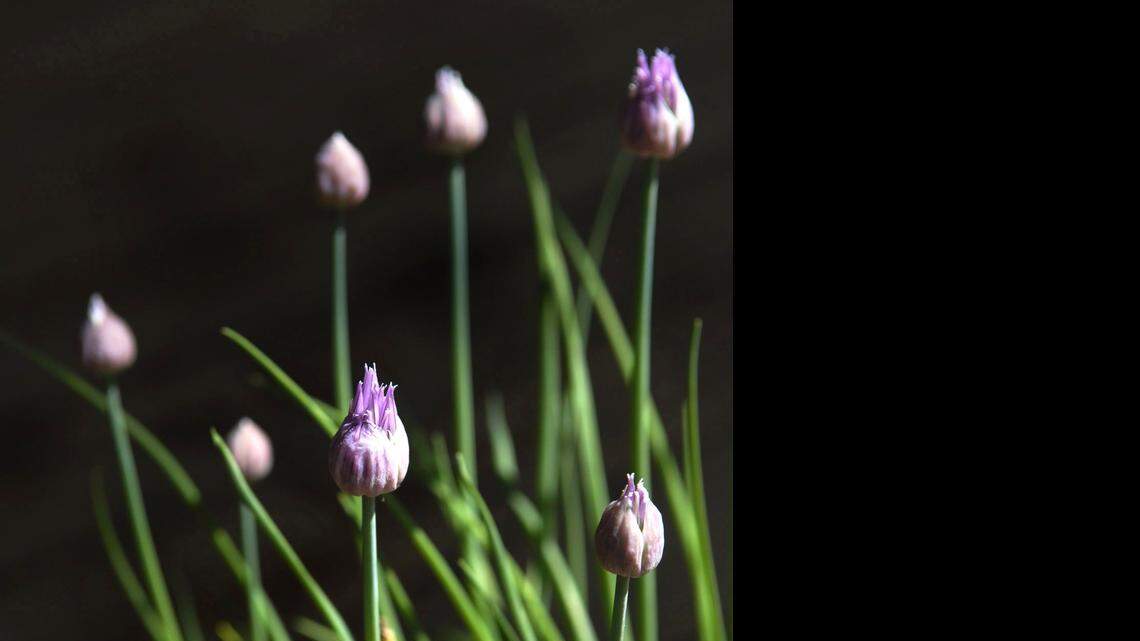
The same with chives. The pink flowers are my favorite part. They’re edible for both people and bees, LaRue says. Garlic chives bloom in white, and the flowers should be removed before they go to seed or they will spread aggressively, she says.
McSweeney recently was in one of the large greenhouses at Arnold’s Greenhouse in LeRoy and saw three plants that had bees on them. One was a perennial geranium that had a strong fragrance; three other varieties had no bees on them. McSweeney bought the plants that had the bee activity.
“I always tell people: Watch.” Whatever plants draw bees, plant more of those.
“The human being is very visually-orientated, so they want big beautiful double flowers, and everything we like, bees don’t,” she says. And often, it seems, what we humans don’t like – i.e., dandelion and other “weed” flowers – bees do. Herb flowers might even make that list. But they don’t always make the pollinator plant list because they might not be the most highly valued plants for bees and butterflies, McSweeney said. That doesn’t mean they don’t feed the bees, though.
“What you plant, it may not be their favorite thing, but if it’s all you have flowering, they’ll go to it.” One day in her garden McSweeney saw a honey bee go around to the back of a larkspur flower and pierce it there because the larkspur was the only thing flowering, and the back side of it was the only way the bee could get into the flower.
“That’s not beneficial to the flower, but the bee was getting something,” she says.
LaRue recommends in particular a couple of annual herbs for bees, butterflies and hummingbirds: pineapple sage and Magical Michael basil. The latter is not the best basil for culinary purposes, and bees love its flowers, so master gardeners are planting it strictly for the bees in their demo garden at the Extension Center at 21st and Ridge Road this year.
“Fennel, parsley and dill, not only will the flowers attract butterflies and bees, but the caterpillars use them for hosts. They do dual duty,” LaRue says. The plants usually bounce back after being eaten, but if you’re concerned that there won’t be enough for you, “plant an extra one. That way you can share.”
Reach Annie Calovich at 316-268-6596 or acalovich@wichitaeagle.com. Follow her on Twitter: @anniecalovich.
If You Go
Herb Day
What: Seminars, plant sale, box lunch sale, children’s activity, garden magazine sale, vendors selling herbs and other garden items, door prizes, farmers market in the parking lot
When: 7 a.m. to 1 p.m. May 2
Where: Extension Education Center, 21st and Ridge Road
How much: Free admission
Seminars: 8 a.m., composting; 8:30 a.m., meet the herbs; 9 a.m., container planting to attract bees and butterflies; 9:30 a.m., chef demonstration by Susie Hanna, executive sous-chef at Reflection Ridge Lifestyle Community; 10 a.m., walk in the Great Plains Garden; 10:30 a.m., bee-hive demonstration; 11 a.m. benefits of beekeeping by Wes Wolken; 11:30 a.m., basics of herb bread baking; noon, Herb of the Year: savory.
Tips for using herbs
Mix it up: Many herbs are pretty enough to grow alongside flowers. Thyme makes an attractive ground cover, with delicate early-summer blooms that are popular with bees. You can plant thyme with perennial bulbs, or in the front of a flower bed.
Make a hedge: Winter savory has attractive glossy foliage and spikes of small pink or white flowers that grow on woody branches. Try trimming it to form a low hedge separating sections of your garden.
Think small: You don’t have to nurture a 4-foot dill plant to grow fresh dill. Look for dwarf varieties such as Fernleaf at the garden center. Dill needs space for its taproot, however, so if you’re patio gardening, use containers that are at least 10 inches deep.
Chicago Tribune
This story was originally published April 25, 2015 at 7:30 AM with the headline "Good things happen when herbs go to flower."