
Gardeners favoring containers for the hottest plants of 2015
Let’s start with the best names for the new plants of 2015. It’s best to say them out loud, if you can:
Luscious Bananarama lantana.
Portulaca maraca.
Whoops-a-Daisy ... daisy.
Each year’s crop of names brings its own clever twists, as well as nods to cultural and culinary trends: Flash Mob petunias, for example, and Espresso Frappe Rose dwarf petunias.
But attributes that are more than name-deep are what really get gardeners excited.
This year, impatiens that resist downy mildew, big-bloomed salvias, tomatoes that grow like Rapunzel’s hair, and really hot peppers are showing early popularity. More plants are going into containers and fewer into the ground, Dan Parcel of Kaw Valley Greenhouses says, and that means compact versions of plants continue to be introduced.
Some people already have done their flower and vegetable shopping – and already have stripped the shelves of some varieties – but the spring planting season is young. Reality check: The forecast still calls for nighttime temperatures dipping into the 40s. Tomato planting season doesn’t typically start until early May, with peppers, vinca and basil in the same warmer-soil camp. (Perennials, shrubs and trees, however, can be planted in cooler weather.)
Succulents continue to be popular. Look for them in a wide range of colors, texture, sizes and shapes. Local cactus grower extraordinaire Ronnie Hardesty said in a talk to master gardeners this week that as long as temperatures are in the 40s, he’s not putting his succulents out. Wait until the weather warms up, he advises, and then introduce succulents gradually to the outdoors, being careful not to plop them out in full sun immediately or their leaves will burn and not recover.
While you can buy four- or six-packs of older annuals for lower prices, single plants with heftier price tags include a royalty that is a tip to new breeding, Parcel said recently at a Botanica lunchtime lecture.
Each garden center has found its own gems among the new plant introductions, and surprises that pop up in each place are a big part of the fun of shopping (as well as being budget-busters. But you just have to have them).
Here are some of the plants that area nurserymen and women are touting for their new or improved characteristics this year:
▪ Bounce and Big Bounce impatiens. Arnold’s Greenhouse in LeRoy did its own trial of New Guinea impatiens vs. Bounce and Big Bounce impatiens and found that the Bounces kept going in the hot weather and bloomed until just before the first frost, owner Rita Arnold says. They’re also resistant to downy mildew.
“We’ve tried to steer customers away from just putting their eggs in one basket because of the threat of the downy mildew,” Arnold says. Once it gets into a bed, the spores can continue to persist even after the plants are removed, and they can infect new impatiens. Caladiums and begonias are other shade annuals that can go with impatiens or in place of them, she says.
The Bounce impatiens are good for a northern exposure and also can take some sun, Arnold says.
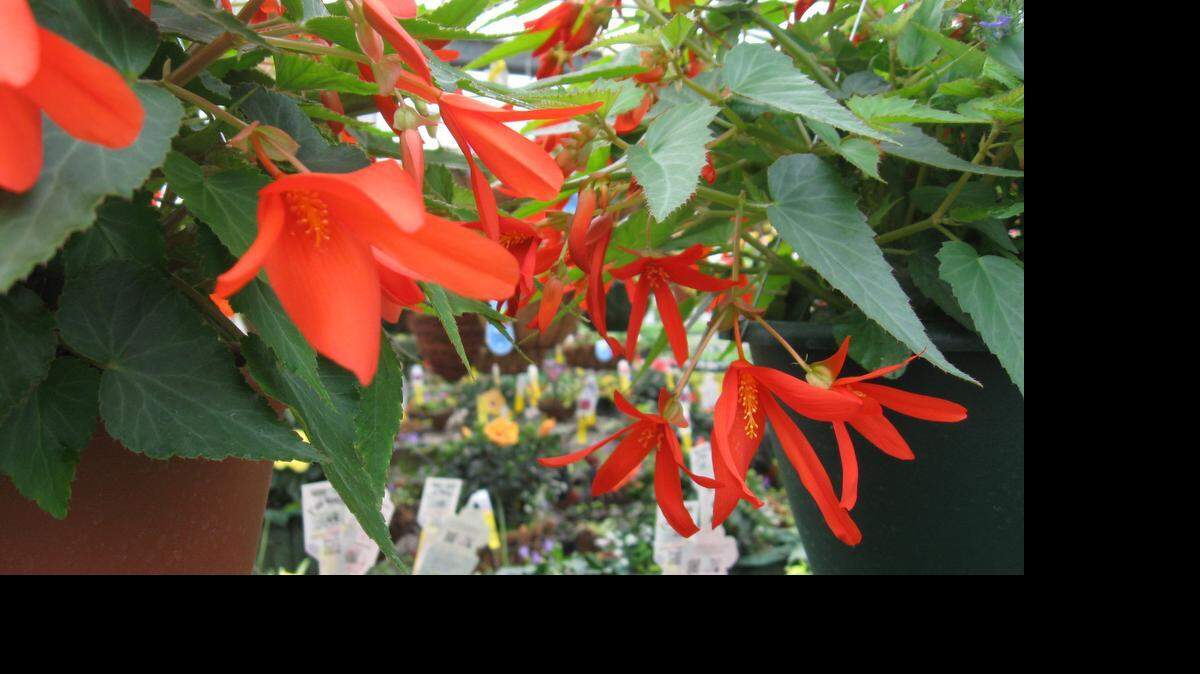
▪ Bossa Nova Orange begonia. “It has a good bloom, and it requires no pinching,” Becky Denning of Denning’s Greenhouse says. “It doesn’t get leggy like some things. This guy stays compact and blooms its little heart out.”
▪ NuMex Easter ornamental pepper. The little ornamental peppers on this compact, well-branched plant are in pastel Easter colors ranging from yellow to lavender, maturing to light orange.
▪ Among the new petunias are those Flash Mob varieties. “Great plants,” says Ron Marcum of Dutch’s Greenhouse, in new and vibrant colors, including Magentacular – magneta flowers with yellow-green veins.
▪ Calibrachoas, the mini petunia-type flowers meant to go in pots, not in the ground. They are fun to mix and match with other colors according to taste. The new Aloha Hula Godiva is a reference to its chocolate color and looks good with a coppery sweet-potato vine, for example, Arnold says.
▪ Lunchbox Mix mini sweet peppers. These are edible sweet peppers that you’ve probably seen in the grocery store, in red, orange and yellow, that are more the size of a jalapeno. They are perfect for snacking, especially since they have very few seeds, Parcel says.
▪ Cleome Pequeno Rosalita. “The seeds are sterile, and it bloms at a shorter height than the regular ones,” Denning says. “It blooms for a long time. Once it starts it just keeps going. The hotter it gets, it seems, the better it does. To me it’s kind of a lavenderyy pink – a really pretty flower.”
▪ Cuphea Vermillionaire. A more compact, floriferous form of firecracker plant whose tubular flowers draw hummingbirds. Marcum planted one in a container with orange purslane for a beautiful combination.
▪ Celosia Tornado Red and Hot Topic Pink for vibrant color.
▪ “Everyone loves coleus,” Marcum notes, and there are types for sun and for shade.
“I love people to get in there and pick out sun coleus,” Arnold says. “It’s easy to play off the coleus to see what other components to their baskets or containers they want to go with.”
A new line is called Under the Sea, with varieties including King Crab, Lime Shrimp, Bone Fish and Sun Fish. Coleosaurus, Finger Paint and Abbey Road also are among the noteworthy. Terra Nova of heuchera fame is now coming out with coleus, such as Fying Carpet Zinger.
▪ Big-flower salvias. Two new annual salvias and a new perennial are prime examples of people going for bigger flowers, Arnold says. Perennial Blue Marvel, for example, is five times bigger than East Friesland or May Night. The annual Mannequin Blue Mountain is the largest salvia farinacea, Arnold says, having four sets of chromosomes instead of two.
“It takes something for my husband to be impressed with anything because he sees so much, and he says, ‘We’ve gotta have that.’ ”
▪ Rapunzel tomatoes. Cherry tomatoes that grow in trusses, which could also be called tresses for the purpose of their name. Each truss holds as many as 40 tomatoes for a “let down your hair” look. Dutch’s just seeded a new batch last week after selling out. “It would be fun for parents or grandparents,” Arnold says. It can be planted in a container, as long as it’s at least 5 or 7 gallons, she says – about the size of a whiskey barrel.
▪ “Marriages” of heirloom tomatoes that cause them to produce earlier, thereby avoiding some disease problems, Arnold says. Examples are Big Brandy and Genuwine.
Garden centers have a big challenge trying to guess what customers will like and to have just the right number of plants available of one variety while maintaining an overall variety of plants. Marcum has a tip: If you have a plant that does great this summer, let the nursery know in the fall so that it can have more on hand next year. By the time next spring rolls around, it’ll be too late.
Reach Annie Calovich at 316-268-6596 or acalovich@wichitaeagle.com. Follow her on Twitter: @anniecalovich.
This story was originally published April 16, 2015 at 9:48 PM with the headline "Gardeners favoring containers for the hottest plants of 2015."