
ICTrees tries to make up for Wichita tree deficit
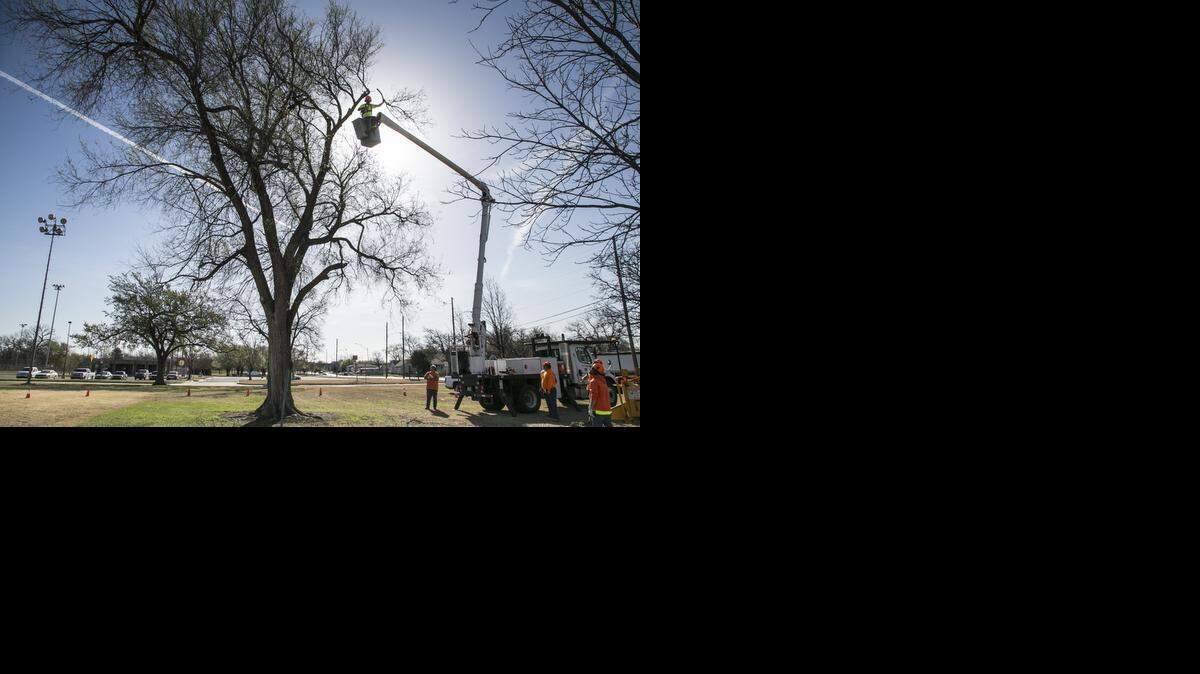
It’s because Wichita has been suffering a continual loss of trees for many years — victims of drought, extreme temperatures, storms and disease — and are not being replaced at anywhere near the rate at which they are being removed.
“We have a lot of trees that have been lost,” says Reed, a member of the grounds committee for his homeowners association in Spinnaker Coves in west Wichita and a Botanica volunteer. “The city is replacing what they can. We need a lot more. Unfortunately, Wichita’s one of them cities that’s too windy, too hot, too cold ... It makes it rough for plants to survive.”
Since 2009, the city has lost 28,000 trees on city property alone. Current city staff can only handle planting and maintaining about 500 a year maximum, city arborist Gary Farris said this week in the midst of cleaning up after the latest wind storm. He expects that cleanup to take another three weeks. The last time the city planted more trees than it removed was in 2000.
“The need is enormous,” the arborist said. “The need for tree work in Wichita is exceptional. .... If you take all the trees away, what are you left with? I guarantee people would not look at Wichita as a place they would want to live or move their business or their family. ... To have a sustainable, high-quality-of-life place, we need more trees.”
But there’s hope — and more branches — on the horizon. A new master gardener, Barney Barnhard, has started a non-profit organization in partnership with the city to help with Wichita’s reforestation, called ICTrees. The effort is already starting to gain traction, extension agent Bob Neier says.
“There’s a lot of interest out there,” said Barnhard, who will give his latest talk on ICTrees this weekend at the annual Tree Fest at the Extension Center, at 8:10 a.m. Saturday. “This is a topic that people just needed someone to give them a focus to express their passions with.”
While there used to be unbroken bands of beautiful trees around town, it’s now hard to find a treescape where thinned-out canopies, broken branches or dead patches don’t mar the scene. While Farris said that the city is over the hump of removing trees that died in the recent drought, “we are still seeing trees in decline that prior to the drought were not.”
And while it can take two or three years for the effects of bad weather to finally be seen in a tree, other losses continue to happen and are immediate. If you visit Botanica while the tulips are at their peak this week, for example, you’ll see new vistas of color where a big cedar used to cover the north face of the pavilion. It went down in the wind storm last week.
Barnhard extrapolates the city’s losses out to private property and estimates more than 100,000 dead trees across Wichita in the past several years. He wants to encourage and help individuals, HOAs and the city start to get the numbers back up. Farris said the private sector’s involvement is vital.
To be realistic, Wichita should be planting two times the number of trees it is removing, he said. That would be 12,000 trees a year at the current 6,000-trees-a-year removal pace. However, “it would be really unrealistic to think the city’s going to staff a reforestation team to handle 12,000 trees and maintain them for a three-year period, which is what we do,” Farris said.
“ ... That can be private individuals going to a nursery and planting trees. That can be ICTrees getting together a group and planting 1,000 trees. The accumulation of all that is what’s needed.
“ICTrees is one of those avenues where people can get involved, which is really exciting.”
People have started donating money to ICTrees, and a couple of corporate sponsors have signed on, Barnhard said. There is an opportunity for 60 volunteers to get involved on Arbor Day, when help is needed to plant 50 trees that Westar Energy is donating for Dr. Glen Day Park on April 24 (email Barnhard at trees@ictrees.org).
“We really need to build a committee,” Barnhard said. “We need some people who want to work in an advisory or forestry capacity to help us spread the word and do fund raising and publicity.”
Barnhard has a vision of “an awful lot of property” in the city being restored by starting trees from seeds inexpensively, and of an ICTrees nursery where entities such as homeowners associations could find an inventory of trees they could draw on. ICTrees would work with Wichita’s private nurseries to make it a benefit for everybody, he said.
While some people don’t need to be convinced of the value of trees, others who see a dead branch and focus only on that are missing the forest for the trees, Farris said.
Among the benefits of trees, Barnhard says:
▪ They reduce the air temperature.
▪ They clean the air and absorb carbon dioxide.
▪ They reduce energy costs as much as 30 percent.
▪ They help keep waterways clean by reducing stormwater and fertilizer run-off and reducing soil erosion.
▪ Their roots create channels to recharge groundwater and aquifers.
▪ They reduce noise pollution.
▪ They encourage us to be outside. People are more likely to picnic, for example, under the shade of a tree than on a sunlit lawn.
▪ Studies have shown that people in hospitals who can look outside at beautiful trees feel better, and students who look outside and see beautiful trees learn better.
▪ They increase property values.
“The thing that I think a lot of people don’t understand (is that) each and every tree you can attach a dollar figure to how much good that tree is doing for the surrounding area,” Farris said. “The cumulative effect of that is in the millions of dollars that our urban canopy gives back to us in cleaning the air, sequestering carbon, helping in stormwater management.”
But it takes a long time for trees to grow. “Trees have to be planted every year ... year in and year out,” Barnhard said at a recent talk at Botanica.
Reach Annie Calovich at 316-268-6596 or acalovich@wichitaeagle.com. Follow her on Twitter: @anniecalovich.
If you go
Tree Fest
What: Seminars, demonstrations, vendors, educational exhibits, tool sharpening, bake sale, pancakes and sausage, youth activities, vendors
When: 8 a.m. to 1 p.m. Saturday, April 11
Where: Extension Education Center, 21st and Ridge Road
How much: Free admission
Here is the schedule of seminars:
8:10 a.m.: “ICTrees – Replanting Wichita,” by master gardener Barney Barnhard
9 a.m.: “Trees for Kansas,” by Jason Griffin, director of the John C. Pair Horticultural Center
10 a.m.: “Elms: No Longer a Four-Letter Word,” by community forester Tim McDonnell
11 a.m.: “Structure Pruning of Immature Trees,” by Josh Murray of Ryan Lawn & Tree
Demonstrations: 9:15 a.m., composting; 10 a.m., rose pruning; 10:30 a.m., tree planting, mulching and watering
Tours: 11:30 a.m., arboretum tour, by Cathy Brady of Brady Nursery; 12:15 p.m., Nature Trail tour
This story was originally published April 10, 2015 at 1:43 PM with the headline "ICTrees tries to make up for Wichita tree deficit."