
Real bunnies have real consequences. What to know before getting a pet rabbit
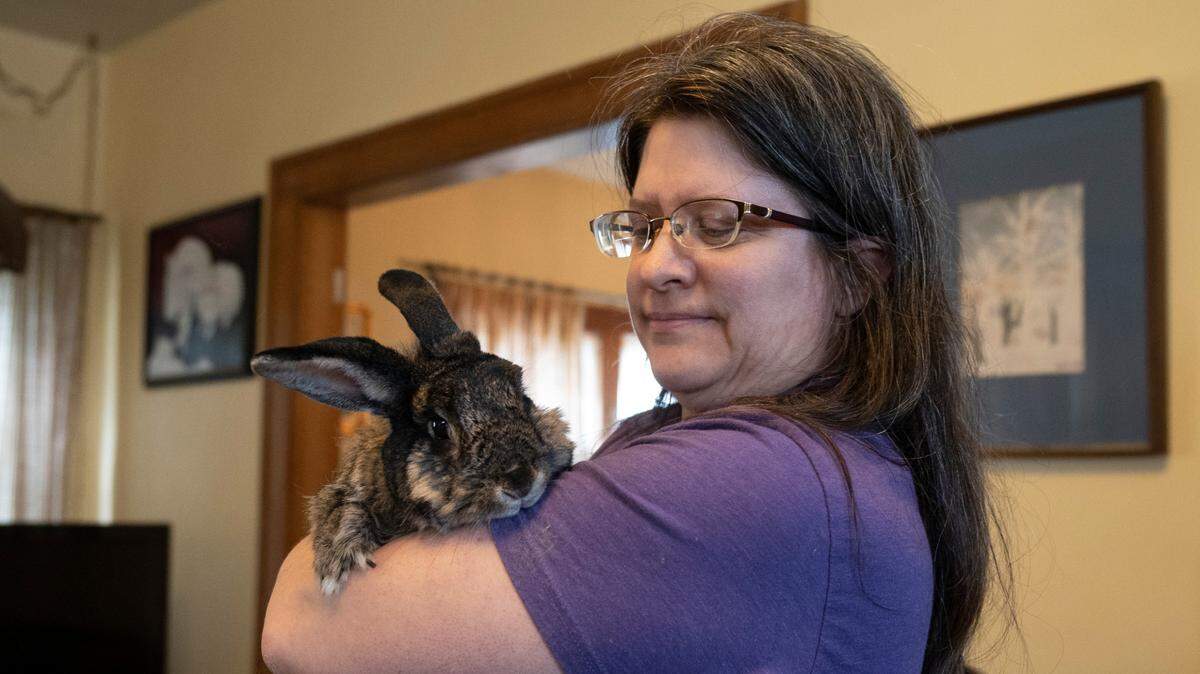
Meet Harley, a 7-month-old harlequin-colored lop lionhead rabbit. He’s a fluffball of light brown fur with a chocolate swath covering half his adorable face.
That cuteness is what gets Harley and thousands of other bunnies in trouble this time of year. Well-meaning but uninformed families across the country add a live Easter bunny as a pet. Weeks or months later, they realize a rabbit isn’t a simple starter pet.
While dog and cat rescues command the public’s attention, rabbits are the No. 3 adopted mammal in the U.S. because they also are the third-most returned or abandoned.
“Unfortunately, nationally we do see a lot of people who buy rabbits at Easter, but also throughout the year, who haven’t done their homework on what rabbits need to live long, healthy lives,” said Anne Martin, executive director of the House Rabbit Society, a national nonprofit based in California.
It’s a year-round challenge in Wichita that escalates each Easter when bunnies get the spotlight, one local groups says, and the situation is compounded this year by an influx of COVID bunnies.
“We have two issues this year: the usual Easter problem and the rabbits that people got during lockdown when they were home more,” said Joan Gedraitis of Bunny TNT, the only rescue organization in Wichita dedicated solely to rabbits.
Some of the new owners have either realized a rabbit was more of a commitment than they expected or determined they don’t have the time to care for the animals now that life is starting to get back to normal.
Bunny TNT, however, has maxed out its limited space and can’t meet the need for rehoming surrendered and abandoned domestic house rabbits in the area.
“We have 32 in care with more coming in every week,” Gedraitis said recently. “We haven’t even had Easter yet and we’re already getting overwhelmed. Keep in mind a big influx usually comes in July or August. That’s when all the baby bunnies people got at Easter start to get mature and they get hormonal. That’s when most of those people who got their bunnies from a store or a breeder realize bunnies need to be spayed or neutered for behavior reasons as well as health reasons.”
Gedraitis is Bunny TNT’s executive director and senior caretaker for bunnies. Her mother Joyce, known as Grandma Bunny in the community, started the group with two fellow rabbit enthusiasts in 2006 as a way to connect for TNT: training through education on proper care and feeding, nurturing their pets by organizing social activities for the bunnies and offering bunny-assisted therapy in the community. Joyce now serves as volunteer coordinator.
The need for rescue was always there, Gedraitis said, and as more people learned about Bunny TNT, requests for the group to take in displaced rabbits increased. In 2018, Bunny TNT became incorporated as a nonprofit to formalize its rescue efforts and its status as a sanctuary for elderly bunnies or rabbits with a chronic condition that need a place to live out their days.
She said Bunny TNT hopes to inform potential rabbit owners about the ownership experience before they make the decision. Among the top facts they want people to know:
▪ Domestic rabbits need to be treated as pets not livestock, including living indoors.
“This can be a challenge in a community where well-meaning grandparents might have grown up on a farm,” Gedraitis said. “They want to get a rabbit for the grandkids and they think they’re just gonna stick it in the backyard in the hutch. Rabbits need a lot more care than that.”
According to the House Rabbit Society, a new virus in the U.S. that kills rabbits started spreading in 2020 and is expected to spread to Kansas this year. Keeping rabbits indoors, taking biosecurity precautions and vaccinating once there are cases in the state are the main actions to keep a rabbit safe from Rabbit Hemorrhagic Disease Virus.
▪ Bunnies can live to be more than a decade.
▪ A rabbit’s diet is more complicated than pellets and carrots. In fact, Gedraitis said, carrots are the equivalent of Oreos for humans. For a healthy digestive system, a rabbit should have a constant supply of hay as well as a daily diet of high quality pellets, greens and vegetables plus specific treats.
▪ Bunnies need more space than most people think — either free rein of a main living space (that has been make safe for them) or a pen large enough for at least five hops. They should get at least three hours a day to run around freely and be rabbits, she said.
▪ They also need socialization. Bunnies like to be around their people, though often want all four feet on the ground so by your feet might be their preferred spot. They also like being with other rabbits. Get a pair if you can, or find other bunny owners looking for social activities for their pets. Among the current adoptable rabbits on the Bunny TNT website (bunnytnt.org) are four bonded pairs.
▪ Spaying and neutering not only prevents accidental litters, it makes rabbits healthier. According to the House Rabbit Society, 80% of female rabbits that haven’t been spayed will develop uterine cancer by age 4-6, and if fixed, they can live 8-12 years or longer. It can cost several hundred dollars and requires a specially trained veterinarian.
Bunny TNT only adopts out rabbits that have been spayed or neutered. The Kansas Humane Society, which typically finds homes for 70 to 90 rabbits, said that because it’s a difficult procedure the clinic is not well equipped to perform, it does not generally spay/neuter rabbits before adoption.
Harley came to Bunny TNT last August with his mother, Clover, and four litter mates. Their situation is too common, Gedraitis said, and reveals the quick multiplication of rabbits: a family kept male and female rabbits together without spaying and neutering, and mama Clover had five litters before she was 1 year old.
Harley was the smallest of the four-day old kits and Gedraitis wasn’t sure he would survive the first few days in her care. He quickly caught up to his brothers and sister in size and fluff, though, and made it to 6 months, the age when he could be neutered. Now he’s a well-socialized bunny with three families interested in adopting him. Brothers Hazel and Smudge and sister Snowball also are available for adoption.
Besides owner surrender, some rabbits come to Bunny TNT after being taken in by the Wichita Animal Shelter as strays, such as Sebastian, a 2-year-old male with beautiful spots. Others are found abandoned by the public or volunteers, such as Flora Flo, a velvety coated mini Rex breed that Gedraitis trapped after getting reports she’d been living in the Towne East parking lot for months. At Bunny TNT, Flora Flo bonded with Emerson and the duo will be adopted together.
The organization adopted out a record 22 rabbits in 2020 and they’re maxed out at 32 rabbits in care right now. The need is greater but to accommodate more rabbits, Bunny TNT needs a facility, Gedraitis said. The majority of rabbits in their care live at the Gedraitis home—a College Hill residence known as the Bunny House—and a few foster homes. More fosters would help, too, though the program requires experienced rabbit owners.
While community events were limited in 2020, the organization’s dozen volunteers have boosted social media efforts, including videos on YouTube and Facebook, to provide resources for existing owners, help find homes for displaced rabbits and educate the public on the joys and realities of welcoming a bunny into their home.
“We’re not necessarily saying don’t get a rabbit, we’re saying do your homework first to know the commitment,” Gedraitis said. “These are not low maintenance pets and they are not starter pets, which means they’re not really ideal for children. If you want to get something for the kids this Easter, get a plushie or a chocolate bunny.”
This story was originally published March 28, 2021 at 5:01 AM.