
Opinion: The biggest mistake in the Wichita sales tax proposal is . . .
One of the most oft-repeated arguments in favor of imposing a 1% sales tax in Wichita is that it would collect $150 million to reduce property taxes — and at least 20% of that would come from out-of-towners passing through.
It’s a compelling argument. Who wouldn’t want strangers to help out with their property tax bills?
But it doesn’t pencil out that way for Wichita.
As it turns out, the money we’d be getting from outsiders to help offset property taxes is practically equal to the amount we’d be giving in property tax relief to people who don’t live here.
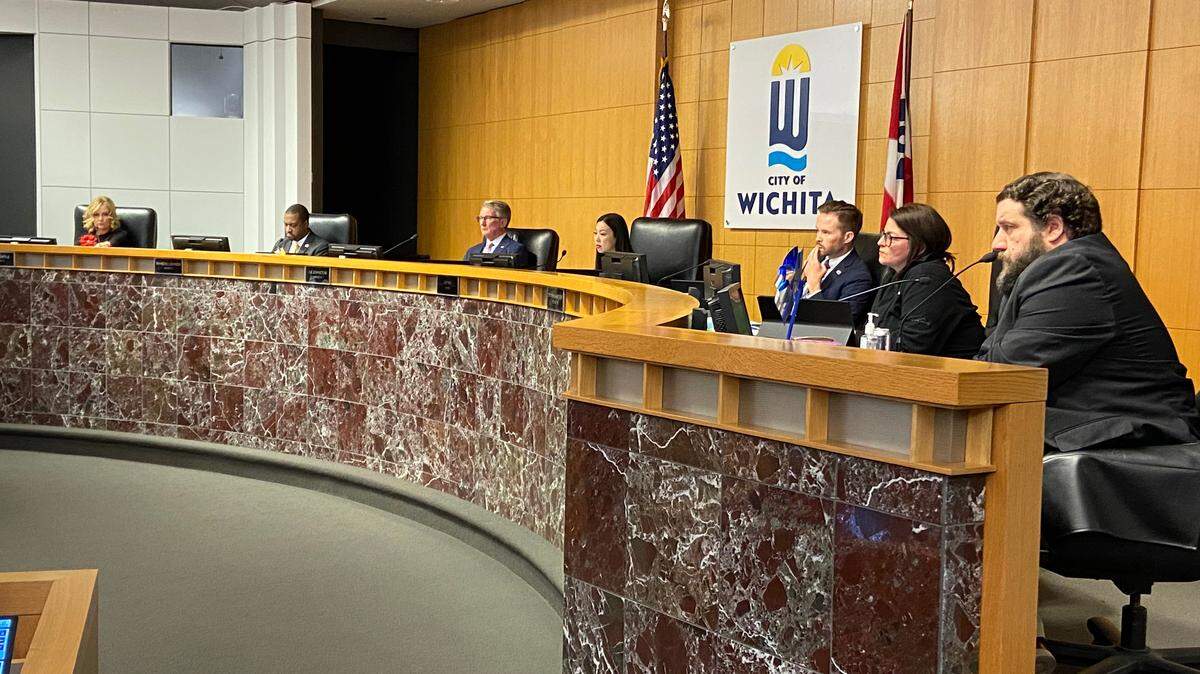
That’s something our City Council would be derelict not to consider on Tuesday, as they vote to finalize plans to put the sales tax on a special election ballot on March 3.
The City Council has been working at breakneck speed to set an election up since three weeks ago, when the plan was publicly proposed by Wichita Forward, a group led by three area CEOs.
The sales tax would indeed bring more money in from outside Wichita, but conversely, the corresponding property tax cut would send money out of Wichita, to businesses and individuals who own property here, but don’t live here.
In a May 27 report, city Finance Director Mark Manning said the current countywide 1 percent sales tax generates about $140 million a year, and “80% of that is paid by local residents, for example, and maybe the other 20% or so is paid by visitors to our community.”
But the problem is when you use sales tax to provide property tax relief, there are two sides to the balance sheet, and City Hall is only looking at one.
I raised this issue in a previous column, but no one at City Hall seemed interested in examining that before voting last week to hold a special election on Wichita Forward’s proposal — a decision the council is scheduled to finalize Tuesday. So I decided to take a crack at it myself.
I put in a data request to the Sedgwick County Clerk’s Office for the number of properties in Wichita whose owners have their tax bills mailed to out-of-town addresses, and the amount of taxes they pay.
Hat tip to County Clerk Kelly Arnold, his staff and the county’s Geographic Information Services Department for pulling it together in a timely manner.
As it turns out, one fifth of Wichita property tax is derived from owners outside the city.
And the amount of property tax relief those absentee owners would get is almost exactly the same as the amount of outside income Wichita would reap from the portion of the 1% sales tax that’s dedicated to property tax relief.
According to the figures provided by the county, the city of Wichita collected about $169 million in real estate property taxes this year. Of that, $34.55 million came from taxpayers outside the city.
That’s 20.44% of Wichita’s property tax income coming from owners elsewhere.
So let’s put that in perspective of the sales tax ballot measure.
The property tax cut proposed by the ballot measure is 4 mills, which equates to 12.37% of Wichita’s current mill rate of 32.34 mills.
That works out to $4.27 million a year in property tax relief that would go to out-of-area corporations and absentee landlords.
Meanwhile, the proposed 1% city sales tax is expected to generate $850 million over seven years.
The amount within that for property tax reduction is set at $150 million. Divided by seven years, that works out to about $21.4 million for property tax cuts per year. If we assume 20% of that would be paid by out-of-towners, it’s about $4.28 million a year.
So basically, we’d be collecting $4.28 million a year from non-residents via sales tax, and turning around and giving property tax cuts to non-residents worth $4.27 million a year.
That difference of $10,000 or so is basically a rounding error.
The property tax numbers I used in the calculation are real estate-only, and don’t include taxes on personal property, so it’s an “at least” number.
The data the county sent also showed the number of out-of-area property owners, the appraised value of their Wichita properties, and where they live.
There are 17,832 properties in the city owned by out-of-towners.
The largest chunk, 9,917, are owned by Kansans who live outside Wichita, with a total appraised value of slightly more than $2.2 billion.
The next largest groups of absentee owners (in terms of dollar value) are Oklahomans, with 735 properties worth $669 million; Indianans, 245 properties worth $538 million; Californians, 1,372 properties worth $437 million; and Texans, 1,343 properties worth $318 million.
Beyond the strong indication there’s nothing really to be gained by substituting sales tax for property tax, there are at least two very good reasons not to do it.
Reason one is that we’d be taking money from visitors to our city, who we should be welcoming, and passing about the equivalent amount to absentee property owners who couldn’t care less about Wichita except as a cash cow.
The second reason is that according to the Census Bureau, 41.6% of Wichitans rent their homes or apartments. Their property taxes are baked into the rent, and it’s highly doubtful that any landlords are going to cut their rent to pass along the property tax savings to their tenants. So tenants will be paying double taxes — once in their rent and again at the store.
The other pieces of the $850 million sales tax proposal are proposed for community improvements, including:
Public safety, $225 million — to fund all scheduled capital improvement projects and provide resources for existing and new initiatives.
Convention space, $225 million — to invest in facility renovations and additions.
Homelessness and housing, $150 million — to cover capital improvements and permanently fund the Second Light shelter and multi-agency center; and investments in affordable housing and homelessness prevention.
A new Performing Arts Facility, $75 million — To develop a public/ private partnership to build a new performing arts center in downtown Wichita.
Century II, $25 million — To revitalize and renovate Century II, the current convention and performing arts center.
Those are worthy items to discuss and decide as a community whether we want to raise a sales tax to pay for them.
But as far as I’m concerned, substituting sales tax for property tax is a non-starter. Not enough residents benefit from it and too many non-residents would.
I’d urge the City Council to take that out of the tax package when they finalize the ballot measure Tuesday.
Before it’s too late.