
A Kansas meteorologist relives the day of one of history’s worst tornadoes
Have you ever left for the office so filled with dread that you had a severely upset stomach? I did, once. The date was Friday, April 26, 1991.
At the time I was both CEO of WeatherData Incorporated, an international commercial weather company specializing in business risk management of extreme weather, and the chief meteorologist for KSN-TV 3.
Things looked so dangerous that, since Monday, I had been warning our viewers of a high risk of tornadoes at the end of the week. These forecasts violated an unwritten etiquette in meteorology at the time: “Thou shall not forecast tornadoes more than 24 hours in advance.”
By Friday morning, there was no question in my mind: eastern Kansas would see violent tornadoes and people would die. My job, and the jobs of Merril Teller at KWCH, the late Jim O’Donnell at KAKE, and the National Weather Service, was to keep the death toll as small as possible.
The morning had been stormy in Wichita as thunderstorms produced large hail. At 5:45, 11 homes were damaged by a rare pre-dawn tornado near Tonkawa, Oklahoma. I had been on the phone with the station off and on that morning to make sure we had enough people.
Normally, I arrived at the office around 10:30 a.m. and worked for about 12 hours. Because I knew it would be an extremely stressful day, I didn’t go in until almost noon. I arrived under a cloudless blue sky, but 10 minutes later the tornado watch for central Kansas and Wichita arrived. For the second time in the history of the National Severe Storms Forecast Center, they used their “strong language” format:
This is a particularly dangerous situation with the possibility of very damaging tornadoes….
Even though the second round of storms was hours away, meteorologist Rick Dittman emphasized the watch during the noon news on Channel 3. I broke into commercial breaks throughout the afternoon letting people know that their lives depended on monitoring the weather and then acting when warnings were issued.
Meanwhile, we frantically plotted weather maps behind the scenes to better hone in on the areas threatened while our office manager phoned on-call meteorologists telling them to come in.
The Doppler experiment
While not threatened by tornadoes, another meteorological drama was being played out 170 miles to the south in Norman, Oklahoma.
Since 1978, the National Weather Service had been attempting to install a network of Doppler radars across the United States in a program called NEXRAD. It was desperately needed because there were giant geographic holes in the existing network and the 30+ year-old radars were wearing out. “Doppler” capability would allow meteorologists to peer inside thunderstorms to find rotating or otherwise extreme winds. This would allow earlier, and better, warnings of dangerous storms, especially tornadoes.
But, the NEXRAD was in jeopardy.
The UNISYS company had received the preliminary go-ahead, but it had never manufactured radars. The company made several technical and political errors, which called into question its ability to fulfill the final contract, if awarded. A competitor, Raytheon, had a great deal of influence in Washington and a long track record of producing radars for military and other purposes.
The government told Unisys to install a prototype Doppler radar in either Oklahoma or Connecticut for evaluation. If unsuccessful, the contracting process would restart, meaning a five to eight year delay in deploying the Doppler network, likely resulting in unnecessary loss of life.
The prototype Unisys Doppler was activated just four days before, on Monday, April 22, at the Oklahoma City office of the National Weather Service and was monitored by the National Severe Storms Laboratory in Norman.
At about 3:30 p.m., the new NEXRAD depicted thunderstorms starting to develop about 75 miles northwest of Oklahoma City. They moved rapidly northeast toward Kansas.
An hour later those storms were converging on south-central Kansas. A severe thunderstorm warning was issued for Harper County at 4:36 p.m. Minutes later, Anthony experienced golf-ball-size hail and 65 mph winds. Soon after, a severe thunderstorm warning was issued for Sedgwick County.
Normally, I would not have broken into programming for a severe thunderstorm warning — we would have “crawled” the information across the bottom of the screen — but I was confident it was just a matter of time until that “supercell” (the type of thunderstorm that produces violent tornadoes) would produce a tornado.
Immediately after finishing the television bulletin, I went on the air on KKRD-FM where we also provided storm coverage. I did double-duty through the rest of the storm period. Three especially powerful supercells formed that afternoon, two in south-central Kansas and one in northern Oklahoma, which produced an EF-4 tornado.
At 5:15 p.m., the Harper County supercell produced the first of its four tornadoes as it moved northeast. Tornadoes number one and two produced nearly no damage. It then cut across northwest Sumner County near Conway Springs. Someone placed a video with a few of my April 26 weather bulletins on YouTube.
At 5:45, the danger period had begun.
A tornado outbreak
I cut into NBC Nightly News regarding two strong thunderstorms moving into Sedgwick County at 5:30. When I sprinted back into the weather office, our cloud camera — looking west from downtown — captured a lowering of the clouds along with rotation. It was a tornado forming. I turned around and returned to the studio.
By then, a tornado had touched down and it had become “rain-wrapped” which means it was invisible to the eye. Doppler would have been very helpful in this situation! The Oklahoma City NEXRAD, which measured the developing rotation in Harper County was too far away to measure it in Sedgwick County. Plus, because the radar was experimental, no one outside the Oklahoma City office could see the live data.
As I was on the air, an assistant held up a sign that said, “Tornado in Goddard.” Sirens sounded throughout Sedgwick County. That tornado, which touched down at 5:45, was only on the ground a few miles, caused scattered damage, and was rated F-3 or “strong” on the Fujita Tornado Damage Intensity Scale. That thunderstorm produced a second tornado farther northeast.
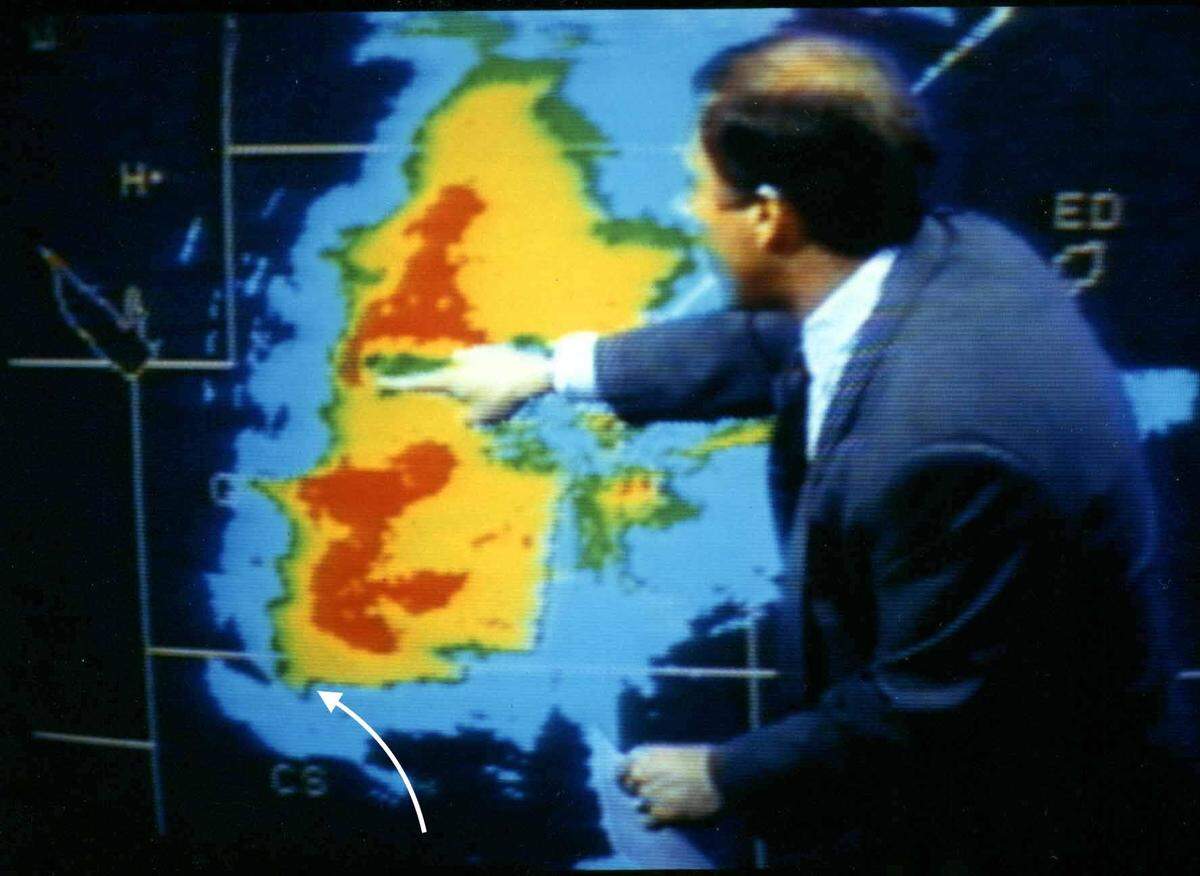
While that tornado was in progress, I was more concerned about what I believed was a developing tornado near Conway Springs. That tornado could potentially move into Wichita. While there was surprisingly little lightning with the storm, a power surge scrambled our connection with the National Weather Service. We could no longer receive their tornado warnings.
Given the stakes, it was too risky to reset the system since other information continued to flow normally. I based our warnings on our interpretation of events.
My worst fear materialized as the third tornado from the giant supercell touched down at 5:49 near Clearwater. It stayed on the ground for more than 60 miles — passing through Wichita, Andover and just missing Towanda before lifting just west of El Dorado Lake.
In the ‘80s and early ‘90s, because of the nature of television revenue (the networks deducted storm interruptions of its programs from the fees it paid local stations), continuous storm coverage was not done. We did the next best thing with frequent cut-ins as soon as we learned anything new. Between Channel 3’s trained storm spotters and our high-resolution conventional radar, which depicted a continuous hook echo showing the location of the tornado, we were able to provide highly accurate coverage, almost on a minute-by-minute basis.
At the start of the 6 o’clock news, the tornado was bearing down on Haysville. I broke in several times and, because of the River Festival over the weekend, I tried to also do a shortened weathercast. At 6:20, I reported the damage near McConnell, reiterated the warning for southeast Wichita and explicitly warned Andover that it was in the path of the tornado and, again, urged people in the path to take cover.
At 6:27, the tornado swept across the base causing extensive damage and injuries (no deaths) and was captured on the iconic video available on YouTube.
A minute or two later, the tornado cut across far southeast Wichita. Two little girls were killed when they were ripped out of the arms of their babysitter as she ran next door to a home with a basement.
At the same time, a violent tornado was forming in far eastern Sumner County that was crossing into Cowley County. While it was fortunate the storm passed between Winfield and Arkansas City, it killed a woman, caused serious damage and was rated F-4. That same supercell caused another tornado in Greenwood County and another fatality. We now had to cover the Andover tornado, the Cowley tornado and the “Goddard” supercell moving across southeast Harvey County that still had tornado capability.
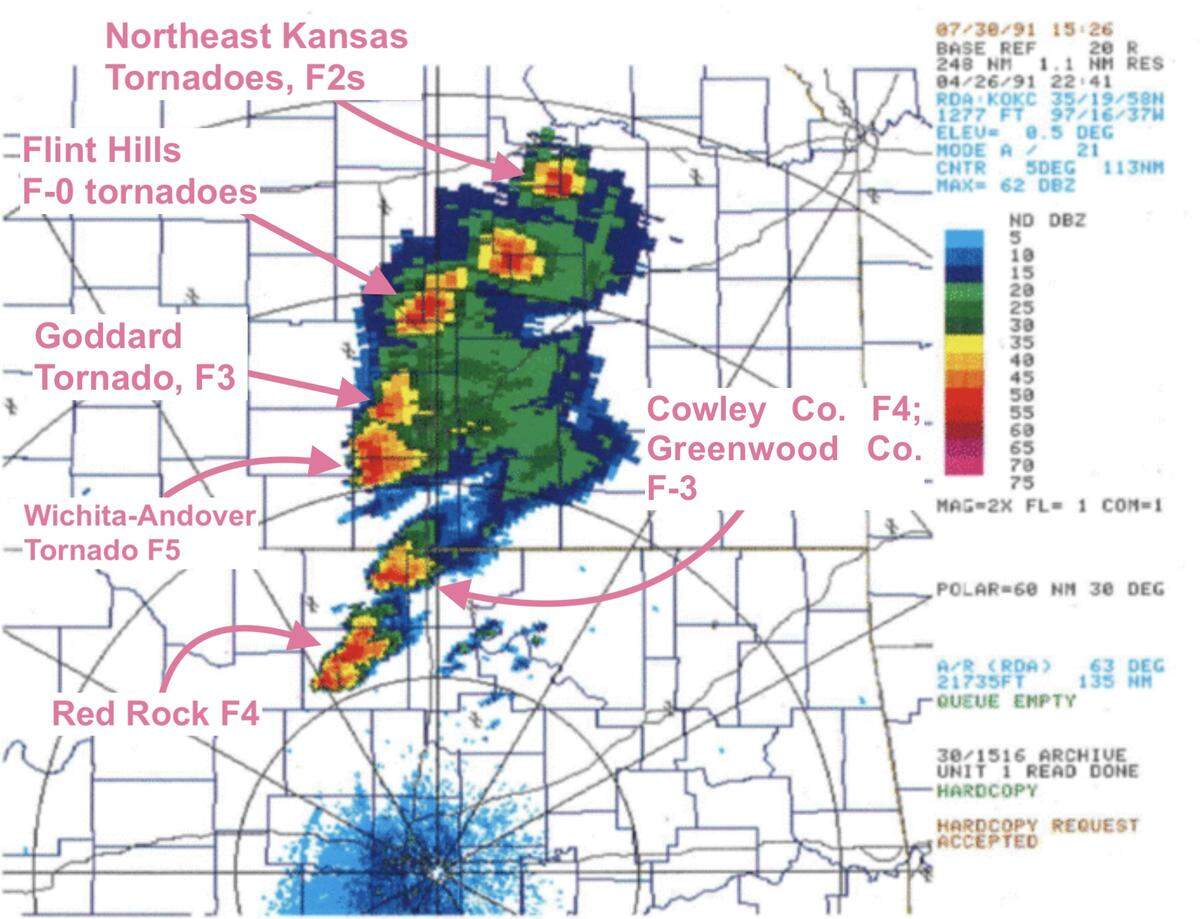
When combined with the merely “severe” (large hail and damaging winds) thunderstorms around our viewing area plus new storms developing west of Wichita, the workload was almost overwhelming. It was as if I could not speak quickly enough to get vital information to our viewers and KKRD’s listeners. Few outside of the industry understand what it is like with the pressure to get it right, the concentration needed to process all of that data and to – on the fly without a script or notes – present it in an understandable way, without having the time to eat or use the restroom.
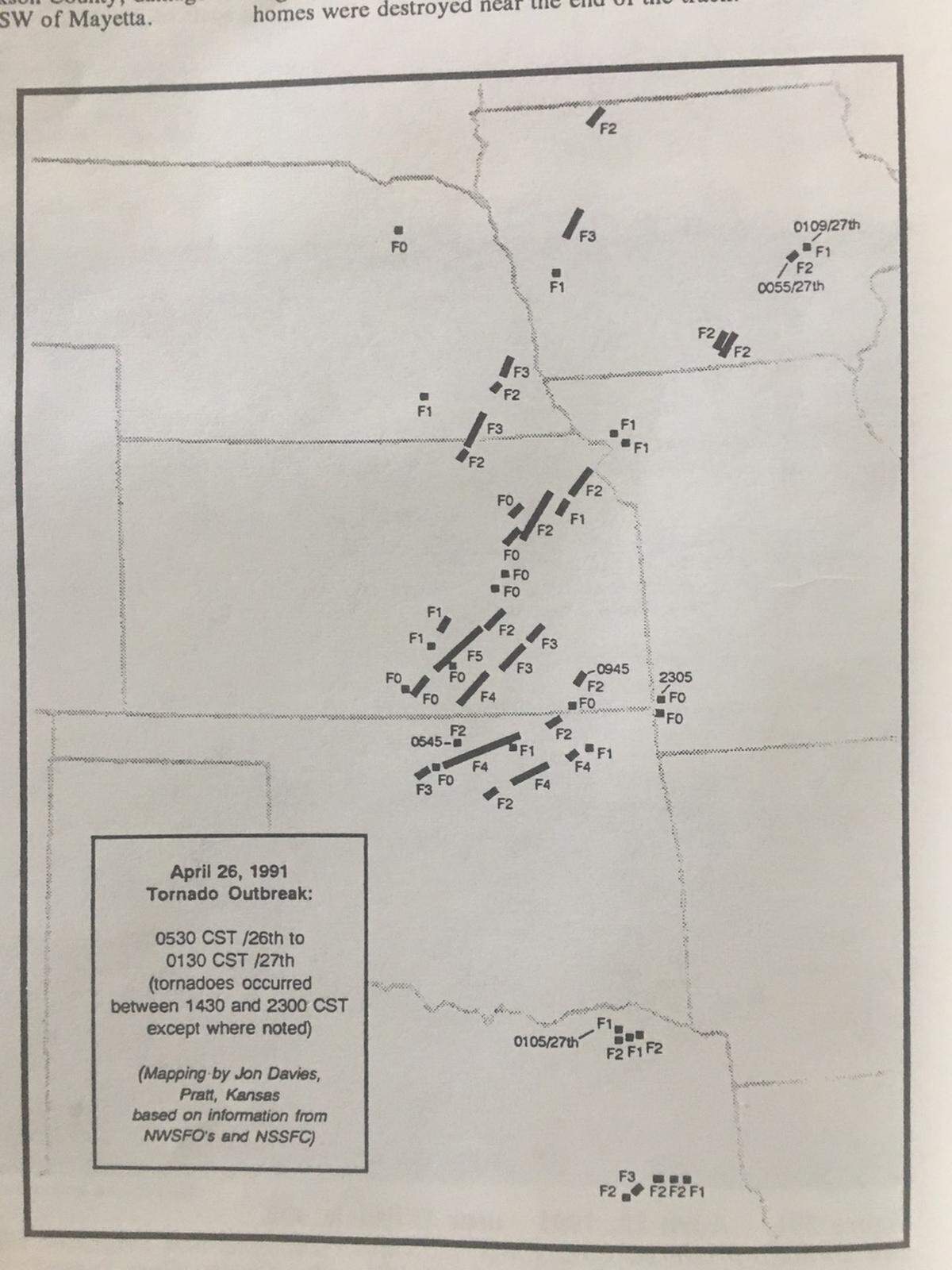
Siren failure in Andover
In Andover, things had gone terribly wrong.
The tornado siren system failed because it took three sequential tones to activate and police, fire and emergency management personnel were clogging the frequency with reports on the tornado. People at police headquarters frantically tried to activate the sirens but they never sounded.
An officer of the Andover Police Department slowly cruised through the neighborhood with lights and sirens to get residents’ attention that something was wrong, hoping they would turn on television for information. The video shows people running toward the park’s shelter, which had room for every resident.
Unfortunately, the tornado moved into Andover at about 6:37 and annihilated the Golden Spur mobile home park at 6:39. Fifteen residents perished, in part because some never got the warning.
The tornado traveled through largely open country as it moved northeast. When it lifted just west of El Dorado Lake, a fourth tornado from that supercell touched down on the northeast side of the lake. It caused no fatalities but it was the tornado filmed by a KSN crew along the Kansas Turnpike as the tornado passed overhead.
By this time, Wichita’s emergency rooms had filled with patients. More than 200 people were injured by the storm. Rescues were halted when a second tornado warning was issued for Sedgwick County as a line of thunderstorms swept across the area at around 8 p.m. Fortunately, no tornado occurred.
I continued to do on-air warnings for areas east of Wichita, storm analysis, and assisted the newsroom through the 10 p.m. news. About the time I got off the air, news of the tornado had made the national and international wire services. I was at the office until around 1 a.m. giving interviews to news organizations from The New York Times to the Australian radio network.
Kansas lives saved
When I arrived home my wife, Kathleen, was up waiting for me. One national organization was reporting 30 people had been killed. At this point, we didn’t know how many deaths would ultimately result (17) so I asked her, “How did I do?” I was concerned it wasn’t enough. Her impression was that it went very well.
Over the next few days, the “very well” evaluation solidified as people called and wrote the station with compliments and we were invited to two “survivors parties.” The Eagle’s book, “Like the Devil,” published an interview with a couple living 5 miles southwest of Haysville:
“Mike Smith was talking animatedly about a tornado.” They went to the window to check and saw it coming. They got into the basement seconds before their home blew away.
Months later, for the first time, we had scientific evidence of the warnings’ effectiveness. The Centers for Disease Control did its first morbidity study of a tornado. It found that, without the warnings, 94 would have lost their lives, meaning the warning system cut the death toll by 82 percent. That was extraordinary.
In the interim, the team and I suffered a form of PTSD. Our vice president was a friend of the family that lost the two little girls. Other members of our team knew people who had lost homes or suffered injuries. People spontaneously burst into tears.
In July, then-congressman Dan Glickman convened a hearing in Wichita to review the results of the prototype NEXRAD’s performance. It performed in an outstanding manner by pinpointing the rotation in each storm. The congressmen gave the director of the National Weather Service and Clinton administration offices the firm message: award the contract and get the new radars in the field. Within five years – record time for government programs – the entire network, including Alaska, Hawaii, and the territories, was completed.
The network was in place on May 3, 1999, when the tornado struck Haysville and south Wichita.
The Wichita NEXRAD failed that evening. But, because of the NEXRAD network, the northern Oklahoma radar perfectly depicted the tornado — which would not have shown up on a pre-NEXRAD radar — and, yet again, excellent storm warnings saved lives in our city.
The fifth most powerful tornado
What would happen if a tornado identical to Andover occurred today?
It would be significantly more destructive because there would be much more in harm’s way. Much of the area east of Greenwich Road that was open country in 1991 is filled with homes today. The same is true near Haysville.
The storm warning system wouldn’t perform much differently because it worked so well that Friday evening. What is different is the way the warning would be communicated:
▪ Sirens would go off only in the path of the tornado and not in areas like Cheney, many miles from the threat. The new generation of tornado sirens in the city of Andover would not fail.
▪ Apps would trigger on your smartphone that would alert you to threats at your specific location using GPS technology. AccuWeather has an excellent app for that purpose.
▪ The government’s Wireless Emergency Alert would trigger on your smartphone, if you have activated it, sounding a tone loud enough to get your attention.
▪ NOAA Weather Radio, with a tone alert, would trigger to awaken you at night if you were sleeping.
The CDC found that several of the people killed almost certainly were not aware of the warning. With these additional communications techniques, it is likely additional lives would have been saved. Since 1991, research has clearly established that people living in mobile homes must take other shelter to save their lives. If you do not live in a mobile home park with a shelter, arrange to spend the duration of the tornado watch with family or friends who live in substantial homes.
Quality tornado statistics began in 1950. Of the more than 68,000 tornadoes recorded nationally, one analysis says the Wichita-Andover storm was the fifth most powerful.
While I am retired from day-to-day weather forecasting, being part of a science that saved so many lives during highly difficult circumstances was and is a source of great pride.
This story was originally published April 25, 2021 at 5:01 AM.