
Claims made in Kansas governor’s race: True or false?
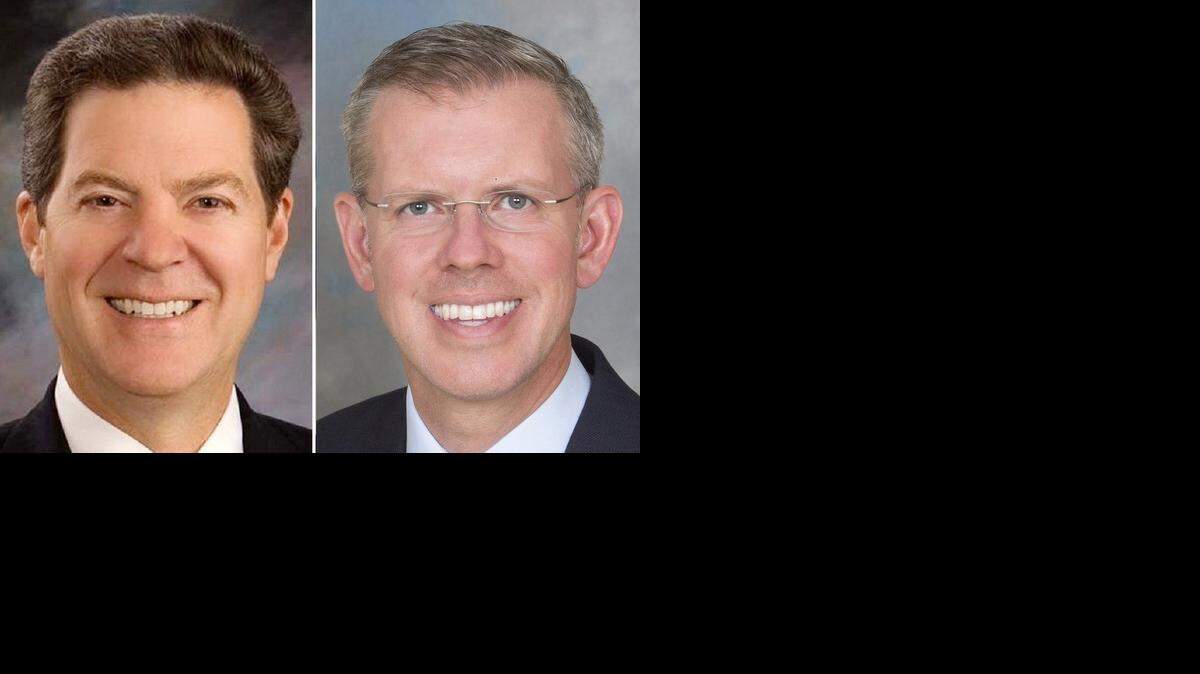
Both Republican Gov. Sam Brownback and Democratic challenger Paul Davis have stretched the truth during their duel for the governor’s mansion. Sometimes they’ve made claims that contain a kernel of truth but need clarification. Sometimes they’ve presented conjecture as fact. And sometimes they’ve said things that are false.
The Eagle looked at the candidates’ bigger claims – many of them focused on education – to determine how factual they are.
Education
▪ Claim: Brownback made the single largest cut to education in the state’s history.
Who made it: Davis, the Kansas Democratic Party, the Kansas National Education Association
True? Half-true. This claim comes with several caveats. First, the cut refers specifically to the state’s base education aid rather than total aid for schools. Brownback’s first budget reduced base aid per pupil to $3,780 from $3,937. Education funding saw a larger overall reduction under Gov. Mark Parkinson than it did under Brownback, but those cuts were spread out over a year, whereas Brownback’s cut happened at one time. That’s why the wording of “single largest” is key. Parkinson also benefited from federal stimulus money that allowed the state to stave off more cuts. Both base aid and total funding have increased in Brownback’s subsequent budgets.
▪ Claim: The state is funding education at record levels.
Who made it: Brownback, Republican lawmakers
True? Half-true. If we’re talking about dollar figures, this claim is true. Total funding for education in fiscal year 2015 is more than $6 billion compared with $5.6 billion the year Brownback took office (that includes state, federal and local funds).
However, this claim also comes with some caveats. Not all of that money goes toward the education of students. Some of it goes toward teachers’ pensions or toward capital improvement projects.
If we look at only the money that goes into educational programs, the total dollar amount is $4.4 billion for this year, $200 million more than when Brownback took office. However, the state has more students than it did four years ago, and these numbers are not adjusted for inflation. If the numbers are adjusted for inflation, money for educational programs was about $300 million higher when Brownback took office than it is now, according to the Kansas Association of School Boards. If we use the inflation-adjusted numbers and divide by the number of students, that shows schools received about $765 more to educate each student when Brownback came into office.
▪ Claim: Income tax cuts have caused cuts to education.
Who made it: The National Education Association, various Davis supporters
True? False. The cut to school funding for which Davis attacks Brownback occurred during the 2011 legislative session. Brownback’s income tax cuts were passed during the 2012 session and did not go into effect until January 2013. So the tax cuts did not result in a cut to education. The Democrats can say the tax cuts may threaten future education funding, but they can’t blame the tax cuts for previous education cuts.
Davis hasn’t explicitly made this claim, but he has tied education funding to tax policy, and in national news reports, several of his supporters have incorrectly blamed the tax cuts for education funding cuts. An ad campaign from the National Education Association, the country’s largest labor union, which supports Davis, takes footage of an interview with Brownback on the tax cuts and couples it with claims about education funding.
▪ Claim: Kansas has the fifth-best school system in the country.
Who made it: Brownback’s campaign
True? This claim needs clarification. Brownback’s campaign has repeatedly said that Kansas has the fifth-best school system in the country, citing a list from the Wallethub, a website that helps inform consumers about how to get the best value for their money. That’s a bit like citing a Zagat’s ranking of the best barbecue in Kansas – it may be worth noting, but it’s not necessarily fact. Wallethub did include academic factors such as test scores and dropout rates, but it was not a scientific study of school outcomes. It also used factors that were not academic, including school safety and incidence of bullying.
On the most recent National Assessment of Education Performance, which the U.S. Department of Education refers to as the “nation’s report card,” Kansas was No. 10 among states in fourth-grade math scores and No. 22 in fourth-grade reading. The state was No. 8 in eighth-grade math and No. 27 in eighth-grade reading.
▪ Claim: The state has had thousands of teacher layoffs since Brownback took office.
Who made it: Davis
True? False. During the early stages of the campaign, Davis repeatedly claimed that thousands of teachers had been laid off under Brownback. The Lawrence-Journal World proved the claim was an exaggeration – about 811 teachers lost their jobs during Brownback’s first three years – but Davis continued to make it. The Davis campaign later said that the candidate misspoke and meant to say “a thousand.”
Budget/taxes
▪ Claim: When Brownback took office, the state had $876.05 in its checking account.
Who made it: Brownback and his campaign
True? False. This has been debunked many times over. When Brownback came into office, there was more than $200 million in the state’s checking account. The state’s funds did drop to $876 on June 30, 2010, the end of fiscal year 2010 and about six months before Brownback came into office. Sometimes the governor correctly states that this number was the end of the fiscal year before he took office, but he, his campaign and the governor’s office have often misrepresented the number in public statements as being from when he took office.
The governor has been a bit more careful lately – after being called out on the misstatement in the Kansas State Fair debate – and specified the exact date during the second gubernatorial debate in Johnson County. But the governor leaves out the reason state coffers had filled up significantly by the time he took office: a temporary sales tax increase signed by Parkinson, a policy Brownback campaigned against in 2010 but later sought to keep.
▪ Claim: Brownback will cut money from T-Works.
Who made it: Davis
True? This is conjecture. Davis has claimed that the governor will take money out of the state’s transportation construction plan, T-Works, in order to cover a projected shortfall of $260 million by the summer of 2016. Brownback has said this is not true and traveled around the state announcing new highway construction projects, many set to begin in 2017. Davis can say that the state will have to find the money to cover its expenses in the long term if the current outlook does not improve, but he cannot say for sure that T-Works will be the source.
▪ Claim: Job growth will cover the state’s projected budget shortfall.
Who made it: Brownback
True? This is conjecture as well and comes with very little evidence. The state faces a $260 million shortfall over the next two years, which balloons to more than $1 billion over five years, according to the state’s nonpartisan Legislative Research Department. Brownback has promised to add 100,000 jobs to the Kansas economy over the next four years and promised that economic growth will cover any projected shortfall. This would mean doubling the job growth seen during Brownback’s term, which economists say is highly unlikely.
Brownback’s promise also comes with few specifics about what sectors will see the jobs and what pay they will provide. Ken Kriz, the director of the Kansas Public Finance Center at Wichita State University, ran an economic model based on Brownback’s promise that assumed the jobs would be spread proportionally across the state’s major industries. He concluded that the job growth would help significantly but still come short of filling the state’s budget hole. “There is just no way that the lost revenue can be recouped with job growth alone,” Kriz said. He compared budgeting on the basis of job growth to being like budgeting on the assumption you will strike gold.
Budget Director Shawn Sullivan has dismissed worries about the projected deficit, but he confirmed last month that the state did not have an official projection model that shows job growth alone will cover the budget hole.
▪ Claim: Brownback’s income tax cuts have caused local property taxes to increase.
Who made it: Davis
True? This is debatable. Davis and his campaign have frequently used figures from a June editorial by political scientist Ed Flentje, a professor emeritus at Wichita State University. Flentje’s numbers showed that money from property taxes was on pace to increase by $400 million statewide during Brownback’s term. The numbers showed that 71 counties had property tax revenue increases of 10 percent or more during this period. He blamed Brownback’s tax cuts, basing this assertion on interviews with local government officials. However, Flentje acknowledged in July that the $400 million increase was caused by more than Brownback – it includes inflation and growth, among other things.
It’s hard to draw a straight line from the income tax cuts to increases in local property taxes. And Republicans dispute that Brownback is responsible, noting property taxes rose under previous governors, too. Flentje’s study did not look at increases under previous governors.
Other policies are easier to connect with property tax increases. For example, when Brownback signed a bill to phase out a fee on mortgage registrations this year, that meant a loss of millions in revenue for many counties. Douglas County has already raised property taxes, citing that as the reason.
Economy
▪ Claim: Kansas had a record number of new businesses form in 2013.
Who made it: Brownback
True? False. It is true that more than 15,000 new businesses were incorporated in 2013, the first year of the governor’s tax plan. But Brownback ignores that more than 16,000 businesses were either dissolved or forfeited because of failure to pay fees. About 4,500 of these businesses were reinstated, putting the total increase in businesses at 3,600, less than the year before. However, all of these numbers are inflated, because some of the new businsses are also old businesses. The governor’s tax plan enabled certain types of businesses, such as limited liability corporations and S corporations, to pay no income tax, so many businesses that had other types of incorporation dissolved and then reformed as LLCs or S corporations. The Kauffman Foundation, looking at the number of new businesses created for every 100,000 people, ranked Kansas as 45th among all states in new business formation.
▪ Claim: Kansas leads surrounding states in private-sector job growth.
Who made it: Brownback, Lt. Gov. Jeff Colyer and their campaign
True? False. Brownback has repeatedly dismissed studies that look at total job growth – and show sluggish growth for the state – in favor of ones that look solely at private-sector jobs, contending that private-sector jobs are more reflective of the economy’s health than public-sector jobs. However, Kansas trails the national average in private-sector job growth so far this year, growing jobs at a rate of 0.6 percent compared to a national rate of 1.2 percent. The state has also trailed the bordering states of Oklahoma, Colorado and Nebraska in job growth every full year that Brownback has been governor. Kansas led Missouri during the first three years of Brownback’s term, as it also did the year before he took office, but trailed its eastern neighbor during the first half of 2014.
Poverty
▪ Claim: The number of children living in poverty has risen under Brownback.
Who made it: The Davis campaign
True? This claim is somewhat debatable, but it has a basis in fact. Conflicting statistics from the American Community Survey and the Current Population Survey, both of which are produced by the U.S. Census Bureau, create confusion about whether the rate has grown or remained flat. The Current Population Survey, which counts a person as a child up to age 18, shows that the poverty rate for children rose from 19 percent during Brownback’s first year as governor, spiked at 23 percent in 2012 and fell to 21 percent in 2013.
The American Community Survey caps the age of children at 17 and shows that the rate of children in poverty has stayed flat at 19 percent from 2011 through 2013. It had been at 15 percent in 2008 before jumping up to 18 percent for the next two years, coinciding with the recession. The Davis campaign has cited both surveys, but when it uses the American Community Survey on its website, it compares the pre-recession figure of 15 percent with the current 19 percent without mentioning that the biggest jump took place before Brownback took office. A separate study by the Census Bureau released last month showed that the overall poverty rate for the entire population has fallen since Brownback took office from 14.4 percent to 13.6 percent.
Eagle editorial board endorsements
▪ Governor, U.S. Senate, U.S. House
▪ Secretary of state, attorney general, treasurer, insurance commissioner
This story was originally published October 29, 2014 at 9:39 PM with the headline "Claims made in Kansas governor’s race: True or false?."