
Images of Sam Brownback can be contradictory
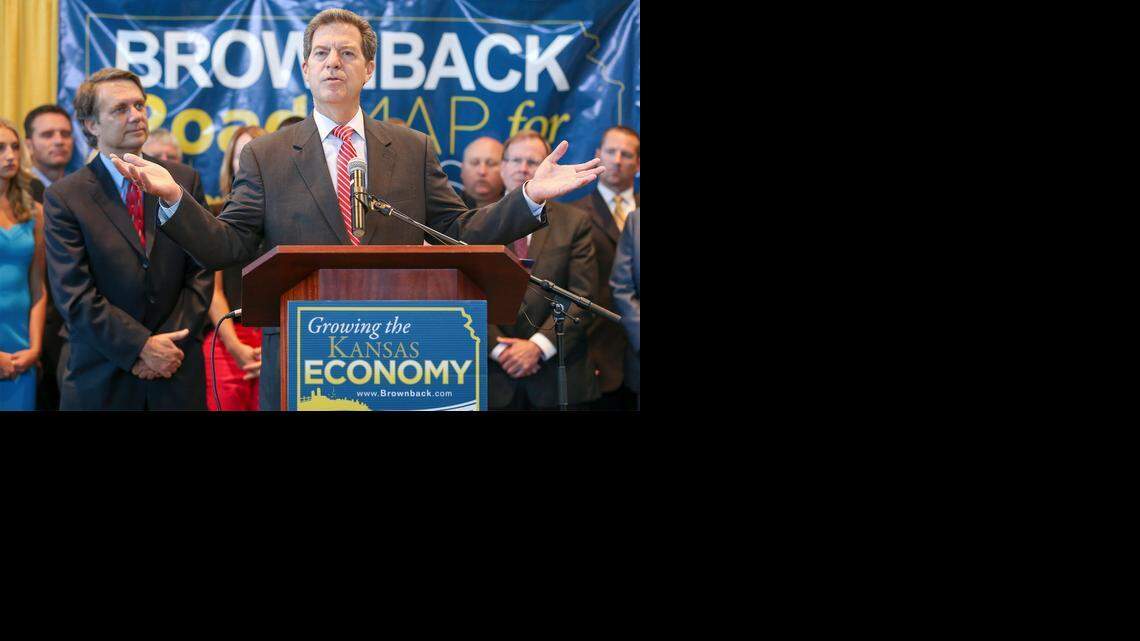
Walk into Gov. Sam Brownback’s ceremonial office and you’ll see a painting of Moses kneeling before the burning bush. Right above it, you’ll see the fossilized skeleton of a platecarpus, a sea lizard that’s been extinct for 81 million years.
The images – a biblical scene next to a dinosaur – might strike you as contradictory. It’s impossible to talk about Brownback without running into contradictions.
The governor has occupied the halls of power in Washington and Topeka for more than two decades, but his friends say he still acts like a humble farm kid. He has pushed for stricter restrictions on welfare, but he also regularly volunteers at homeless shelters.
“If you only read the newspaper, you have one image. But if you meet him in person, you have quite a different image,” said Senate President Susan Wagle, R-Wichita, one of Brownback’s closest political allies.
Wagle is intensely loyal to Brownback. When her son relapsed with leukemia in 2004 and no family members matched as blood donors, Brownback, then a senator, connected the family with an umbilical cord blood repository in New York.
“It was life-saving for us,” she said, explaining that Brownback also used his connections to help two other children being treated at same facility in Wichita as her son, Paul.
Brownback spent 16 years in Washington and at one point had eyes on the White House.
Landon Fulmer, his chief of staff, said he’s happier at Cedar Crest, the governor’s mansion.
“I think he likes being in Topeka because he’s around his family. You have to remember when he was a senator he would commute to Washington – his family lived in Topeka the whole time,” said Fulmer, who worked for Brownback for seven years in Washington.
But another term as governor is hardly assured.
Brownback was elected in 2010 with more than 63 percent of the vote. But now the one-time presidential aspirant who has won three Senate elections finds himself fighting for survival against Paul Davis.
Polls have shown the race deadlocked.
Jennifer Duffy, a Washington-based analyst with the Cook Political Report, said Brownback suffers from self-inflicted wounds. Political battles with public school teachers, moderate Republicans and other groups have weakened his support and buoyed Davis.
“I think his support has always been a mile wide and an inch deep,” said Senate Minority Leader Anthony Hensley, D-Topeka, one of Brownback’s fiercest critics.
‘Tough choices’
Brownback’s surprisingly tough fight for re-election has received national attention.
“I think there’s a part of him that is interested in the fact that we’ve become the center of the nation’s attention. It just hasn’t been like this before,” Fulmer said. “And I think that he believes that one of the reasons that we’re the center of the nation’s attention is that this is where ideas are truly mattering.”
The governor’s supporters say he has put the state on the path toward prosperity, while his detractors say he has sent it barreling toward financial ruin.
“We’ve had to make a lot of tough choices,” Brownback said, explaining the radically divergent views. “Any time you make changes in a policy field, people divvy up. They go ‘I agree’ or ‘I disagree.’”
Brownback contended that steep income tax cuts would act like “a shot of adrenaline” to the Kansas economy. But the state lags neighbors in job growth and his critics say the cuts have drained the state’s resources.
Brownback and his allies insist the policy will work. The governor has even promised that the state will add 100,000 new private sector jobs in the next four years. Economists remain skeptical about that kind of job growth, which would be about double what the state saw during his first term.
Average Kansans seem to be skeptical of Brownback’s policies, too. Polls from Public Policy Polling have consistently shown that more than half of Kansans disapprove of Brownback’s job performance, and his public appearances have repeatedly drawn protests.
His allies say that’s because Kansans haven’t gotten to know the real Brownback.
“When people meet Sam, they like him. And they like him because he’s sincere. And they like him because he’s one of them,” Fulmer said.
‘Hi, I’m Sam’
The governor and his staff arrive at Papa Don’s Pizza in Fort Scott for a campaign event on a rainy Thursday in October.
“Hi, I’m Sam,” he greets one of the owners. He orders two slices of vegetable pizza and insists on paying when she tells him it’s on the house.
Friends say Brownback hates receiving special treatment. For example, he would pay for parking at Reagan National Airport even though he could get it for free as a member of Congress.
The pizzeria is mostly empty.
Undeterred, the governor ambles up to a pair of women who are just here for lunch and begins chatting. It turns out that one, Sybil Chaplin, 89, used to attend church with his aunt.
She asks him about his cousin, Michael. The governor says he’s a veterinarian and doing well.
Chaplin, a Fort Scott resident, says she expects she will vote for the governor, but she’s not certain of her registration status. Her lunch mate, Marylou Heiser Hardy, 86, identifies herself as a Republican but says she’s undecided.
More people pour into the pizzeria. The governor poses for pictures and engages them in conversation.
A man tells him he’s up by 6 points in the latest Fox News poll. “Well, they’re more accurate than most,” the governor replies.
The man, retiree Jim Sackett, identifies himself as a tea party activist and says he’s confident that Brownback will pull out a victory in November.
“I really like his support with the tax (cuts), where he’s going with eliminating the income tax,” Sackett says. “We’re very, very strong on that. … But almost all his policies are in line with our conservative views.”
Controversial tax plan
Brownback’s tax plan – which sharply reduced personal income tax rates and eliminated them for business owners – has been a political lightning rod. Davis has repeatedly called the tax cuts a failed experiment on the campaign trail and warned that they’ll force cuts to education.
Brownback has said the state is not in trouble.
“We’re in great shape financially,” he said while announcing a $23 million highway construction project in Arma this month. “I know there are a number of people yelling differently, but the numbers just don’t support what they’re saying. They’re just trying to paint a ‘Chicken Little sky is falling’ situation, which is not true. It’s a bunch of lies.”
But it’s not just Brownback’s political opponents questioning the state’s long-term fiscal outlook.
Duffy with the Cook Political Report said Brownback damages his credibility “when he makes comments like this that are demonstrably false.”
The state faces a $260 million budget shortfall by July 2016, according to the nonpartisan Kansas Legislative Research Department. Both Moody’s and Standard & Poor’s downgraded the state’s bond rating in the last six months, citing tax cuts.
“If revenue doesn’t grow – and it’s not growing right now – if revenue doesn’t grow, then the state’s in the hole right now,” said Duane Goossen, the state’s former budget director who served under governors from both parties, including Brownback’s predecessor Gov. Mark Parkinson.
The state missed revenue projections by $338 million during the first year of the Brownback tax cuts. And the state missed projections by $23 million during the first quarter of this fiscal year.
“If you could just take the politics out of this and just look at it financially, the state should be acting on this right now,” Goossen said.
Brownback has promised that job growth will cover the shortfall, but Kansas has lagged surrounding states in job growth.
Revenue Secretary Nick Jordan said the governor’s policies are working. He noted that the state’s unemployment rate has fallen – from 6.8 percent to 4.8 percent – since Brownback took office. It was at about 5.6 percent in January 2013 when the tax cuts took effect.
But the job growth has coincided with the national recovery, and other states have grown at a faster rate.
The state saw 1 percent growth in employment in the past 12 months compared with 1.9 percent growth nationally, according to the Center for Economic Development and Business Research at Wichita State University.
“He had this grandiose idea,” said Hensley. “But it has been an absolute disaster.”
Help for business, the poor
Conservatives continue to staunchly back the policy.
“I have yet to have a business person come up to me and say, ‘Oh my God. You guys have made a heck of a mistake. Why are you doing this? Why are you letting me have my tax dollars so I can build my company?’” said House Speaker Ray Merrick, R-Stilwell. “I get the opposite, people saying, ‘Thank goodness, somebody’s finally doing something to help business.’”
Patty Koehler, president of JR Custom Metals in Wichita, credits the tax cuts for three of the 15 jobs her company has added in the past year.
“As we see what kind of dollars we have available, we invest it in equipment. We’ve been able this year to purchase a million-dollar fiber laser because of the fact that we didn’t have to pay taxes. It allowed us to invest in the piece of equipment and hire more people,” said Koehler, whose company hosted a campaign event for Brownback earlier this month.
The cuts have been criticized by Democrats as a handout to the wealthiest Kansans, but Jordan says the governor’s policies stem from a desire to help the poor.
Brownback’s administration ushered in rules that narrowed the number of people eligible for welfare benefits, which he said would push people to find work. And last year he signed legislation requiring drug testing for recipients. Democrats criticized the policies as mean-spirited.
“I have seen way too much of the government giving a little bit to people but not helping them out of poverty. I come from a low-income county and the way out – this in all the studies – it’s a job, it’s education, it’s family structure,” Brownback said.
“And I don’t want the government holding people down by just, ‘I’ll give you a little bit, but I’m not going to do what you need to get you out of poverty,’” Brownback said. “I think that people that have structured the poverty programs from the Great Society had every good intention, but it hasn’t worked. And I think we’ve got to get much more granular.”
Jordan recalls that the governor began a Cabinet retreat last year with a visit to the Salvation Army, where he and his Cabinet secretaries put together food bags for the needy.
Later that day as they were walking to lunch in downtown Lawrence, Jordan says, the governor “stopped twice and sat down on a bench with homeless people and spent I don’t know how many minutes just sitting and talking with them” before pulling money from his billfold.
“I don’t care whether you’re the wealthiest person in Kansas or you’re the homeless person on Mass Street, that’s the governor. He cares enough about you, he’s going to spend time with you. He’s going to be interested in what you are saying,” Jordan said.
Conflicting images
However, Brownback’s critics don’t find him so kindhearted.
Finn Bullers, a health care activist, asked the governor about Medicaid expansion at a campaign event in Olathe but got no answer.
“He simply walked away from us and without saying a thing,” said Bullers, who suffers from muscular dystrophy and trailed after the governor in his wheelchair. Video of the incident was posted by the Daily Kos.
Brownback’s critics have portrayed him as a ruthless politician who will go to great lengths to crush his political enemies.
They point to television ads that seek to link Davis to the recent Kansas Supreme Court decision to overturn death sentences for convicted killers Reginald and Jonathan Carr. The ads feature photographs of the Carrs, who are African American, and an ominous voiceover.
“I think that it’s a desperate tactic to interject race and to interject fear mongering, and it’s really undignified, especially of a sitting governor, to claw like that,” said Sen. David Haley, D-Kansas City, one of two African Americans in the Senate.
Brownback did not directly respond to a question about the ad and race at a news conference last week. “What we are pointing to is the decision made by the Supreme Court and that this is a key issue of what a governor does is pick justices,” he said.
The governor has also faced scrutiny after the Topeka Capital-Journal reported last spring that his former chief of staff, David Kensinger, was being investigated by the FBI for influence-peddling at the Capitol.
Former Sen. Dick Kelsey, R-Goddard, announced last month that the FBI had interviewed him about Kensinger. Kelsey also alleged that Kensinger had engaged in dirty tactics to unseat him and other Republican incumbents in the 2012 primaries.
“If I had a pit bull and it goes over and bites my neighbor, I’m responsible because I own the pit bull. Well, he owns the pit bull,” Kelsey said of the governor.
Kensinger did not return a request for comment.
Brownback said he still talks to Kensinger, whom he first began working with during his 1994 congressional campaign, but not about policy.
“I don’t talk with him about policy much at all,” he said.
“I hope you ask Paul Davis some of these type of questions,” he added with indignation.
Some lawmakers and lobbyists maintain that Kensinger continues to hold sway with the administration since his departure as chief of staff in April 2012.
“What do you think they’re talking about? The Royals?” said Rep. Jim Ward, D-Wichita.
The image of Brownback put forth by his critics seems to conflict with the man who writes “get well soon” cards to Statehouse cleaning staff.
“Probably every week or two he sends out a card or makes a personal phone call,” said Dave DePue, Topeka chaplain for the Capitol Connection, a Christian organization that’s active at the Statehouse.
DePue prays with Brownback regularly.
“A lot of people are consoling him that he might lose the election and he says, ‘Well, it’s up to the people of Kansas and God.’ He’d just as soon go back to being a farmer. It’d be a lot simpler,” DePue said. “But he feels he’s raised up to this position to serve the folks of Kansas.”
Eagle editorial board endorsements
▪ Governor, U.S. Senate, U.S. House
▪ Secretary of state, attorney general, treasurer, insurance commissioner
This story was originally published October 25, 2014 at 6:49 PM with the headline "Images of Sam Brownback can be contradictory."