
Roberts, Brownback – two sides of same coin?
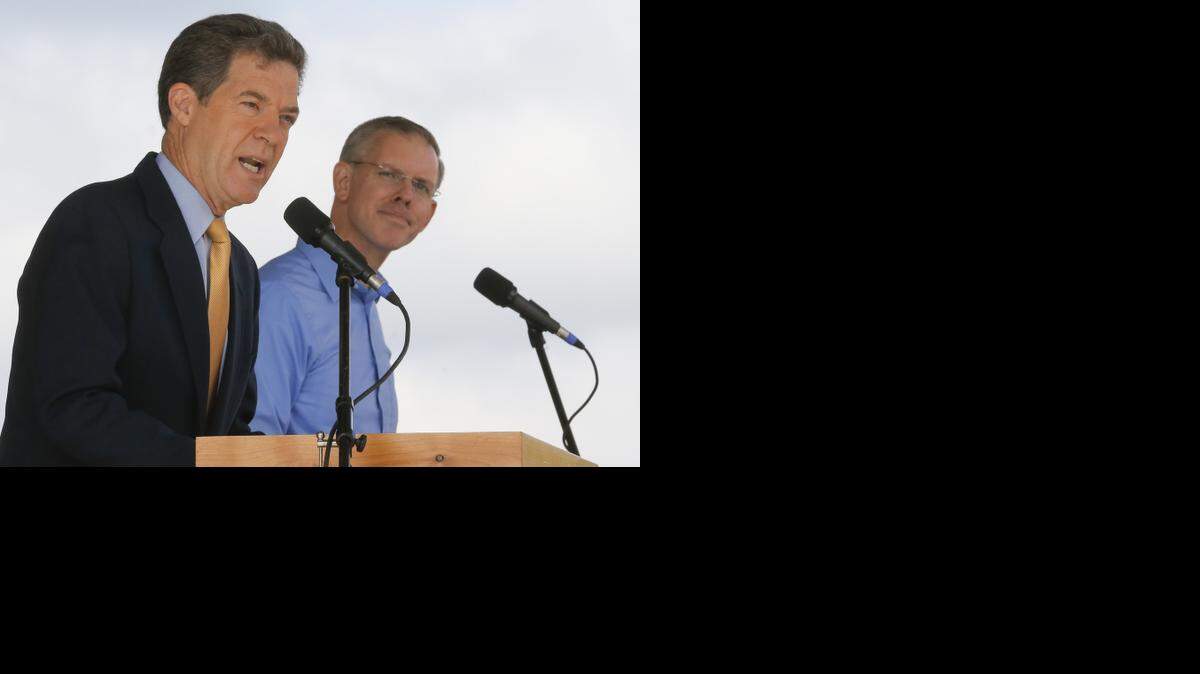
“The sun is shining in Kansas,” Gov. Sam Brownback says in a television ad. “And don’t let anybody tell you any different.”
Sen. Pat Roberts has other ideas. “Kansans are struggling,” his early commercial says.
The conflicting messages have caused more than a few political pros to chuckle. But the Republicans’ seemingly at-odds themes also reflect the complicated geometry of Kansas politics this year.
Roberts seeks a nationalized election focused on conservative ideology. Brownback, as a governor, must address a state electorate more interested in concrete results than philosophy.
Yet the two have much in common. They’re the most well-known and important Republicans in a Republican state. They’ve spent their adult lives in government, as colleagues. Many voters see them as two sides of the same coin.
As a result, Brownback and Roberts are strangely connected this election season, together yet apart. It’s a complex equation neither expected but both must now solve.
“There’s a surreal aspect to this election in Kansas that the candidates have to be feeling,” said Bob Beatty, a political science professor at Washburn University. “If either of them lose … they’re not going to believe it.”
Polls suggest Roberts trails independent Greg Orman in a race in which Democrat Chad Taylor has dropped out. Likewise, surveys find Brownback behind in his re-election fight with Democratic state Rep. Paul Davis.
Losing is a possibility for both Republicans.
Which would, in itself, be unusual: Neither man has ever lost an election.
Roberts to the right
Roberts was first elected to the House in 1980 as a wisecracking voice for farmers in the huge 1st Congressional District.
But longtime friends say Roberts, who moved to the Senate in 1997, has changed into an ideological Republican who may have lost focus on his home state, putting his re-election in jeopardy.
“Any good politician has to keep his ear to the ground and close to home at all times,” said Dan Glickman, a former Democratic Kansas congressman and U.S. secretary of agriculture. He’s known Roberts for three decades.
“Home is Kansas. Home is where you live. Home is where the voters are.”
Former GOP Sen. Nancy Kassebaum Baker, Roberts’ colleague and friend of more than 30 years, blames his rightward tilt for his struggles.
“There’s just disappointment around the state,” she said. “They feel they don’t know him now.”
Asked recently to tape a TV commercial for Roberts, Kassebaum Baker refused.
Roberts sharply rejects any suggestion that he’s moved to the right. He says he has simply reacted to overreach by President Obama.
“He’s moved really far left,” Roberts told the Kansas City Star this summer. “I have not changed.”
Roberts’ efforts to align himself with conservatives in Kansas could have been seen as an effort to head off a tea party primary challenge. He got one anyway from Milton Wolf.
Wolf has not endorsed Roberts, and some tea party members say they still are upset with Roberts.
So Roberts has tried to shore up his political right. He has brought in Sarah Palin and veterans of conservative campaigns.
Roberts might have also turned to Brownback for help with conservative voters, long the governor’s base of support.
As it turns out, though, Brownback has his own challenges.
Brownback plays defense
“Sam Brownback is not a half-measures kind of guy,” said Fred Logan, a friend of the Republican for more than two decades and district co-chairman of his re-election campaign. “He knew this was going to be a tough race.”
Brownback has long been considered more ideological and ambitious than Roberts.
He has run for president. He ran for the Senate in 1996 after just one term in the House – leaping over an appointed incumbent and Roberts for the job, to Roberts’ and other Republicans’ occasional chagrin.
Brownback easily won re-election to the Senate in 1998 and 2004, then left Washington to run for governor in 2010.
Brownback’s agenda in Kansas has reinforced his reputation as a conservative purist. Medicaid reform and tax cuts have drawn the attention of conservative analysts and lobbying groups. They see Kansas as a laboratory for a small-government, low-tax approach.
Yet Davis has mounted a serious opposition campaign, outsiders say, because Kansans view the governor’s office as more practical than ideological, unlike the U.S. Senate.
That makes the state’s credit downgrade and slumping revenue more significant to Kansas voters, turning the governor’s race into a referendum on accomplishments, not promises.
Brownback believes voters will see those issues as bumps in the road, not an indictment of his overall approach.
“Any time you change things,” he said, “you go through the tumult.”
At the same time, he has tried to center parts of his record. For instance, he says he increased spending for schools and has promised more job growth in the state in ads and speeches across the state.
“It’s not about Democrat and Republican,” he said at a campaign event Friday. “It’s about making things better for the people.”
Symbiotic or separate?
Caught in the together-yet-apart dynamic, Roberts and Brownback have largely pursued separate campaigns this fall. They’ve appeared together occasionally – and campaign staff members have stepped up their conversations, associates say – yet each is running his own race.
They seem to be drawing from similar bases of support. In a Fox News poll in mid-September, Brownback got 41 percent of those polled, Roberts 42 percent.
Months ago, some analysts suggested Brownback’s close race might help Roberts. Republicans and moderates feeling guilty about abandoning the GOP for Davis, the theory went, would ease their consciences by voting for Roberts.
Today, that theory is sideways. Republicans now fear moderates may turn out in greater numbers, voting against both Roberts and Brownback.
Republicans are also worried because Davis and Orman have something Brownback and Roberts lack: relatively thin public resumes.
In an anti-incumbent year, that’s considered an advantage.
“There are a lot of people frustrated with the whole system,” said Clay Barker, director of the Kansas Republican Party. “They’re willing almost to take a risk on an unknown person who says, ‘I’ll fix it.’ ”
If enough voters take that view, Kansans may see the rarest of phenomena: a state-based wave of an election, sweeping longtime incumbents aside.
“There’s certainly a dynamic where we could see a moderate Republican or an unaffiliated voter just saying, ‘You know what, let’s throw them all out,’ ” Beatty said. But “they’re hard to predict. How do you predict when people just have that feeling?”
Last dash
Win or lose, Brownback and Roberts will likely never run for statewide office again. (Brownback is limited to two terms as governor and probably won’t run for the Senate again. Roberts is 78.)
Despite their decades in public service together, they have shared a statewide ballot only once before: in 1996, when Bob Dole quit the Senate and the seat held by Kassebaum Baker was open. Both won.
Now the two colleagues face a final verdict from Kansas voters on their long political tenures. Each pursues a different campaign path, yet each seems to understand his time in the public eye is nearing an end, whatever happens in November.
“What a blessing and honor it’s been,” Brownback said. “I’ve had a great chance to serve.”
Roberts said, “We’ve had a pretty good partnership with people down the years.
“People keep re-electing me. And we’re still working on it.”
Reach Dave Helling at 816-234-4656 or dhelling@kcstar.com. Follow @dhellingkc.
This story was originally published September 29, 2014 at 6:52 PM.