
Paul Davis calls for more education funding
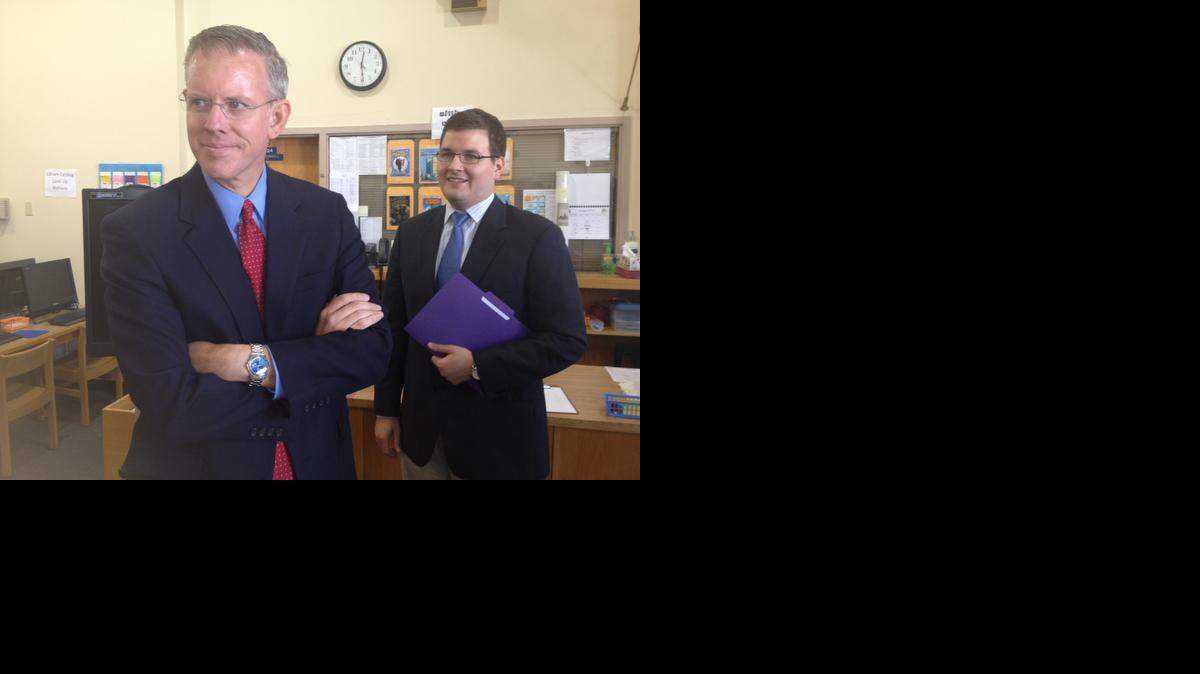
Paul Davis attacked Gov. Sam Brownback’s record on education at a Topeka elementary school Tuesday and promised to increase funding for schools if elected governor.
But when pressed by reporters, Davis struggled to say how he would raise more money for schools with the state facing a looming shortfall of more than $200 million by July 2016.
Davis made a proposal in June to freeze income tax rates at 2015 levels as a way to shore up the state’s revenue so that base education funding could be restored to pre-recession levels.
An analysis by the state’s nonpartisan Kansas Legislative Research Department showed that Davis’ plan would bring in $94 million more in revenue than the state is projected to take in during this and next fiscal year.
However, the state’s projected shortfall by the end of next fiscal year is $238 million, so Davis’ plan wouldn’t even get the state to zero.
“I have not given people the illusion that this is the magic bullet and it is the answer to all of our problems. It is a starting point for getting us out of this mess,” Davis said when pressed for how he expected to take in enough money to increase education spending. “But I will point out that there is only one candidate in this race that is willing to acknowledge that this state has a big problem.”
“This is a problem that was created by Sam Brownback. It was created by this economic experiment. He will not even acknowledge it,” added Davis, who met with reporters inside the library of Lowman Hill Elementary in Topeka.
Brownback has repeatedly asserted that tax cuts will lead to enough job growth to cover the state’s expenses despite projections.
Davis has criticized Brownback for wanting to “hit the accelerator,” but his own plan to increase school funding also relies on economic growth to cover the state’s spending.
“If we can get our economy performing at above the national average instead of below the national average, revenues will be better and we will have more dollars that we can invest in our schools,” Davis said. “I think we disagree about how exactly we’re going to grow our economy.”
Davis said that he wanted to use “proven ways” to grow the economy. When pressed by reporters to give an example, he said that improving the state’s transportation infrastructure was one method. He also said that the state needs to do a better job of partnering with local communities on economic development.
John Milburn, Brownback’s campaign spokesman, said in a phone call that Davis’ remarks were “more of the same” and criticized the Democrat for “lacking specifics on how he would raise the money and where he would spend it on schools.”
“It also continues distortions of the governor’s record,” Milburn added.
Davis repeated a popular talking point among Democrats that Brownback made the “single largest cut in history” to base state aid per pupil.
Base state aid per pupil reached its peak in 2009 when it hit $4,400. When Brownback took office in 2011 it was $3,937 due to cuts caused by the recession.
Brownback’s first budget dropped the number to $3,780. It currently sits at $3,852 for this current school year.
“All you’ve got to do is just go talk to the principals, go talk to the teachers, the parents, the superintendents about what the effect of that was. It cut their budgets. It cut the classroom dollars that we use to educate kids,” Davis said.
Republicans argue that the dollar figure went down because federal stimulus money, which helped minimize cuts in preceding years, went away.
Milburn accused Davis of misrepresenting the record by downplaying the cuts before Brownback took office and overlooking the loss of federal stimulus money.
“Paul Davis is once again tripped up by the facts. Today he slammed the budgets he voted for in 2009 and 2010 that had dire consequences for Kansas public schools, while criticizing those who have been cleaning up the mess,” Milburn said in an e-mail. “Davis voted for the budgets that slashed state education spending while also voting for the largest tax increase in state history.”
The Brownback campaign has repeatedly argued that total education spending has gone up. Democrats say this number is an ineffective tool for measuring classroom dollars because it includes money spent on pensions.
The number of students has also increased.
A report from the Kansas Center for Economic Growth, which was released this week, states that once figures are adjusted for inflation, total education spending per pupil declined by 7 percent between 2009 and 2013, which amounts to $966 less per student.
Davis said that if school funding is increased it could go toward acquiring technology for the classroom, reducing class sizes and expanding course offerings in rural districts.
“I can’t tell you exactly what the base aid budget per pupil is going to be in four years. But what I can tell you is our absolute No. 1 priority when it comes to building our state budget is education,” Davis said. “Because we know that’s the way that we build our state.”
Reach Bryan Lowry at 785-296-3006 or blowry@wichitaeagle.com. Follow him on Twitter: @BryanLowry3.
This story was originally published September 2, 2014 at 3:01 PM with the headline "Paul Davis calls for more education funding."