
Wichita mayoral candidates weigh in on funding projects
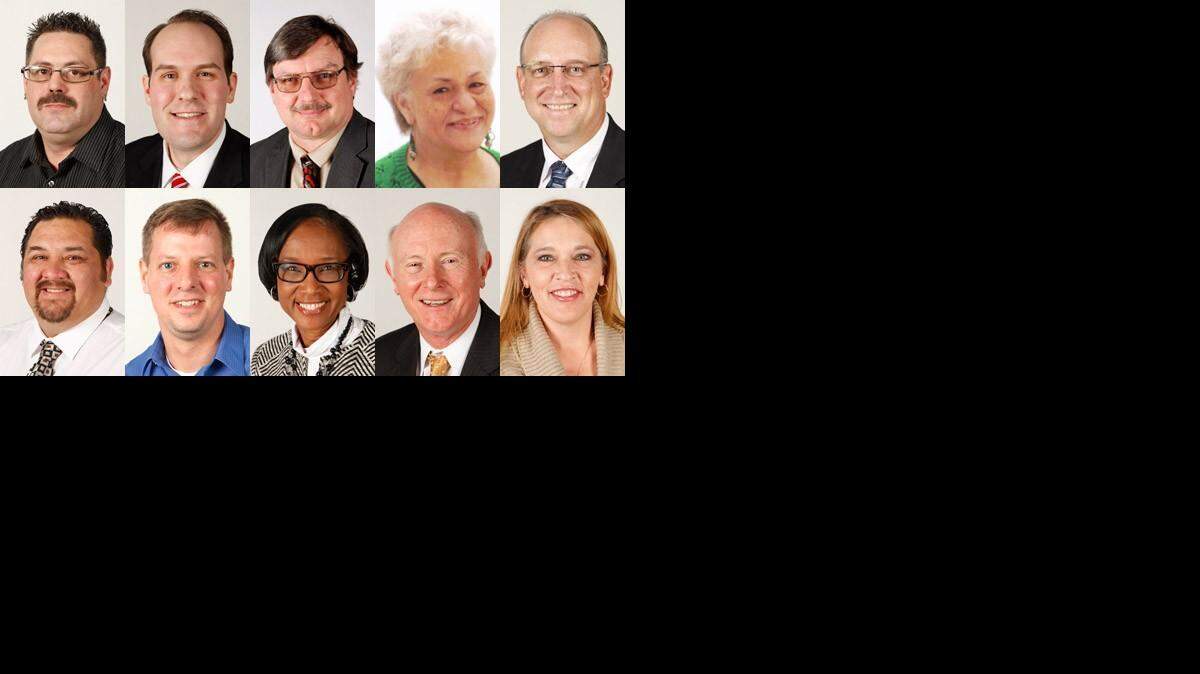
Wichita’s next mayor will face a variety of challenges, Mayor Carl Brewer made clear at his State of the City address last month.
The city’s water and sewer pipes are falling apart, and the estimated cost to fix them is $2.1 billion.
The transit system is struggling, and it will cost $21 million to replace the fleet over the next six years.
The city has not figured out how to pay for a long-term water source.
And nearly half of Wichita’s streets are ranked below national benchmarks.
Most of those issues, in addition to a jobs fund, were part of a proposed 1-cent-per-dollar sales tax that voters rejected last November. It would have generated an estimated $400 million over five years.
With a sales tax out of the picture – at least for now – The Eagle asked the 10 mayoral candidates how they propose to pay for these projects.
The March 3 primary will narrow the field of candidates to two ahead of the April 7 general election.
Robert Culver

Culver, 43, is a metal worker at Tennison Bros.
He thinks the city can find grants and loans that will help pay for water, sewer and transit improvements.
“I know there are probably programs out there that are specially designed to help cities become ‘greener’ or find different resources for water,” he said. “I don’t think the taxpayers should have to put out more money on top of what they’re doing for something that the city knew for years they had to fund and chose not to.”
As for new water sources, Culver suggests building a basin attached to the Big Ditch with a pump station to transport the water to the aquifer.
“That would eliminate a lot of the resources that we need to try to find adequate water,” he said. “Now it’s not going to always be running, which actually saves the taxpayers money.”
As a new source of revenue for street maintenance, he would impose a fee on companies that use heavy equipment or vehicles on roads.
“We have semis that go down our side streets instead of our highways, and those side streets are not structured for that kind of weight,” he said. “They should have some responsibility to help.”
To sustain the transit system, Culver suggests getting buses that run on propane or natural gas, expanding bus routes to other cities and charging all businesses a fee of no more than $100 a month.
“This will allow us to expand farther out,” he said. “I’m trying to find a way to keep taxes low, but yet increase the flow of money coming into the city so we don’t have to raise taxes. I understand a lot of businesses won’t go for it, and all it is is a service fee. We’re providing a service to their businesses to bring customers to their businesses.”
Sean Hatfield

Hatfield, 32, is an attorney for Maughan Law Group.
For water, he suggests the city consider things like selling water rights and structuring rates in a “tiered system that’s fair at every level.”
He said he isn’t opposed to sales taxes, as long as detailed plans are presented to voters.
“Ultimately, the sales tax vote was a signal to the city to go back to the drawing board,” he said. “What the city should take a look at is separating each one of those issues. I think that was the big mistake, lumping it all together. I think if the city comes up with a proposal for each one — water, infrastructure, transportation — and then submits a comprehensive plan, the voters can then choose specifically how to best proceed. That would be the best option. But the key here is detailed plan for each one.”
Hatfield thinks the city should consider privatizing the transit system and ultimately let voters decide the issue.
For street maintenance and repair, he suggests the city use a greater portion of its share of an existing 1-cent county sales tax. The city gets 58 percent of the proceeds, which translates to about $54 million annually, or $1 billion since the county tax was established in 1985.
By law, that money must be used to reduce property taxes and to pay for roads, bridges and freeways. The tax has helped fund expansion of Kellogg.
Dan Heflin

Heflin, 51, is a product engineer and owner of Nu-Ans Design and NoMar Self Storage.
Projects that have dedicated funding through fees and rates should have improvements funded from those sources, Heflin says.
“If we need to have water improvements, water fees should take care of those things. That’s because the people who use water and benefit from the use of water should be the ones paying for it,” he said.
Street maintenance should come from the city’s general fund since it’s “one of the primary responsibilities of government,” Heflin said. He also thinks street maintenance and repair should be privatized.
The biggest problem for transit, he said, is how it is marketed. He suggests a three-phase plan that starts with giving free rides from 10 a.m. to 2 p.m.
“The idea is, you get them on the bus, you get them riding the bus, and then if they need to use the bus during pay hours, they have to pay.”
He suggests that the city create an app to track the buses to see when they will arrive and create incentives for people who use the bus more often as a frequent rider program
Heflin criticized the use of sales tax, saying it’s an “extreme measure” to finance things.
Frances Jackson

Jackson, 75, is the semi-retired executive director of Youth Development Services Inc.
Jackson did not offer specific suggestions or ideas about how to pay for the city’s infrastructure needs.
“When you come with a solution, you cut off people from giving you ideas that maybe help you with the best solution,” she said.
“If I were to say I have a direct proposal, (that) would mean that I have the exact answer, and I’m feeling like there’s more wisdom in this city to help us come up with the best ways of solving those problems. And I don’t think we’ve tried, encouraged people or inspired people that still need to come forward to help us with those decisions.”
Jeff Longwell
Longwell, 55, is the owner of Ad Astra Printing and the District 5 City Council member for the past eight years.
The City Council’s approval of rate increases over several years will pay for most water and sewer infrastructure improvements, Longwell said.
But finding a solution for a long-term water supply is another matter.
“It’s fairly complex, because it’s a regional water supply enjoyed by a number of other entities that aren’t paying for ensuring that supply will be around for years,” he said.
The total cost of replenishing the Equus Beds should not just be on the backs of rate payers since other entities use that resource, he said.
Part of the proposed sales tax revenues would have gone toward expanding an existing water source, the city’s aquifer storage and recovery facility northwest of Wichita. The ASR pulls water out of the Little Arkansas River and stores it in the Equus Beds, a sprawling underground aquifer where the city has wells.
“We have to lean on our state and others to look at a more equitable way to pay for that water supply,” he said. “The funding for that is still to be determined. I think we know what the solution is, and that’s to create the right infrastructure to get water in the Equus Beds. We know that is a perfect place to store water because we lose more water to evaporation at Cheney Lake than we pump.”
As for streets, the city’s proposed 2016 budget allocates an additional $2 million for repairs, Longwell said. He adds that the city should reprioritize current funding and use the city’s portion of the county 1-cent sales tax to pay for more street repairs.
Transit needs long-term funding, Longwell said, and he suggests proposing a one-tenth-of-a-cent sales tax that would be permanent.
Property taxes shouldn’t be touched, he said.
“The climate of low (property) taxes encourages people to live here, grow here and move here, and it’s the right climate to portray,” he said.
Tony Rosales
Rosales, 38, is co-owner and operator of Twin Peaks restaurant in east Wichita.
Rosales said he doesn’t have specific ideas yet about how to pay for water, streets and transit, and he’s reviewing the city’s budget.
He thinks that a city bond of some sort might be a possibility to pay for all three issues.
Rosales says he’s not opposed to the idea of sales taxes in general. He says the one offered to voters in November didn’t make sense, particularly because it included job development.
Rosales said he didn’t really have a platform, but more of a vision of Wichita having a “big city atmosphere with small town values.”
Tracy Stewart

Stewart, 38, is a banker at Bankers’ Bank of Kansas.
Stewart says he thinks water rate increases alone should pay for improvements and a new water supply.
He also said that increasing Wichita’s property taxes may be an option to cover street maintenance and transit.
The use of sales tax is OK in certain circumstances, Stewart said, but that shouldn’t be the sole source of income for a government because it disproportionately affects the poor.
He voted against the tax last fall.
“My reason for doing that was the City Council, in that proposal, had combined all the things together and didn’t give a great explanation on how it was going to be used,” he said.
Lavonta Williams

Williams, 65, is a retired educator and District 1 City Council member for the past six years
Many people didn’t understand the sales tax proposal last November, Williams said.
“Many people say they would have voted for the initiative had they really understood or had it not had the jobs plan in there,” she said.
As the mayor and council look at how to finance those priorities, they will have to think about those items, and how to propose them to the public, differently.
Another sales tax vote by the public on water, transit and streets — without the jobs portion — is likely the answer, Williams said.
“In a sense I hope we do (put it to another vote),” she said. “Our sales tax is one of the lowest in the state, one of the lowest in the country. I think that we just probably should have approached that from a different perspective to help people understand.”
She said expanding the aquifer storage and recovery facility for a long-term water supply is also the right decision.
“I definitely rely on public works personnel to tell me the best decision and best way we can go,” she said. “Right now, we think that (ASR) is. Before we didn’t have a drought plan... I know they’re working as hard as they can to find the best solution. That’s part of our strategy as we go into strategic planning.”
Sam Williams

Williams, 63, is a retired executive from Sullivan Higdon & Sink, the state’s largest marketing firm.
The sales tax issue divided the community, said Williams, who would not say how he voted on the failed sales tax proposal last November.
“I really don’t want to answer that question because it throws the whole conversation I’ve had up to this point,” Williams said.
“Do I think water and transit and jobs and streets are important? Absolutely I do. And I also stated publicly to people I did not think the process was done properly.”
Williams said he is open to the idea of sales taxes, but that efficiencies also have to be realized in the system.
He is not convinced any of the long-term solutions proposed so far for a water supply is the right one.
“It’s much bigger than a Wichita problem. It’s a regional issue and also the state has some involvement and I believe that process needs to be worked out.”
Transit needs a long-term funding solution, he said, and a sales tax is one possibility. Ideally, Williams would like to see the transit system be self-sustaining, but he’s not sure how that can happen.
“I know that we have to have transit…. Transit is one of those basic services that a modern community has to provide.”
For streets, Williams said he’d like to re-evaluate the city’s priorities in the budget and see if more money the city already collects could be used on repairs.
Jennifer Winn

Winn, 44, is owner of Landscapes Inc. and ran against Gov. Sam Brownback in the Republican primary last fall.
Before deciding on specific ways to pay for Wichita’s infrastructure needs, Winn thinks the city should cut waste in its current budget.
“How much money is truly going toward projects? Having a construction-related background for more than 20 years, I’m pretty confident in being able to identify those expenditures and making sure they’re true and accurate,” she said.
She said she is not opposed to sales taxes, but does not support bundling issues.
“Am I opposed to raising taxes if that’s what we have to do? No. We have to do what we have to do. But the reality is we have to see where that money is going.”
One of Winn’s top priorities is the water supply. She would like to look at the city drilling directly from the water treatment plants to the aquifer and to add to the city’s current aquifer storage and recharge plan.
“We don’t have enough natural rain and natural permeability to recharge the system, we’re using it faster than we can replenish it... People don’t have a problem owning up to what we need to do to make sure our children’s water supply is secure. What I think people have a bigger problem with is the vague way that we laid it out and we bundled it with other issues.”
Winn also supports further review of transit overhead expenses and potentially implementing a 24-hour system with smaller buses and more routes.
“I’ve never seen a city bus with more than six (people) ever,” she said. “I believe (waste) is there. No differently than my own business. I know what my overhead expenses are and if I’m losing money, there’s a reason.”
Reach Kelsey Ryan at 316-269-6752 or kryan@wichitaeagle.com. Follow her on Twitter: @kelsey_ryan.
How to vote in advance
By mail
Get an advance voting application from the Sedgwick County Election Office, 510 N. Main, Suite 101, in Wichita, or online at www.sedgwickcounty.org/elections. Fill it out and fax or mail it to the Election Office. Advance ballots will be mailed to those who apply by Feb. 27. Voters can fill them out and mail them in; they must arrive by 7 p.m. on Election Day.
In person
Beginning Wednesday, you can vote at the Election Office from 8 a.m. to 5 p.m. Wednesday-Friday and Feb. 23-27, and 8 a.m. to noon March 2.
You can also vote at an advance voting center from Feb. 26-28.
Election Day is March 3.
This story was originally published February 14, 2015 at 1:33 PM with the headline "Wichita mayoral candidates weigh in on funding projects."