
Could Kansas politics swing towards the center this year?
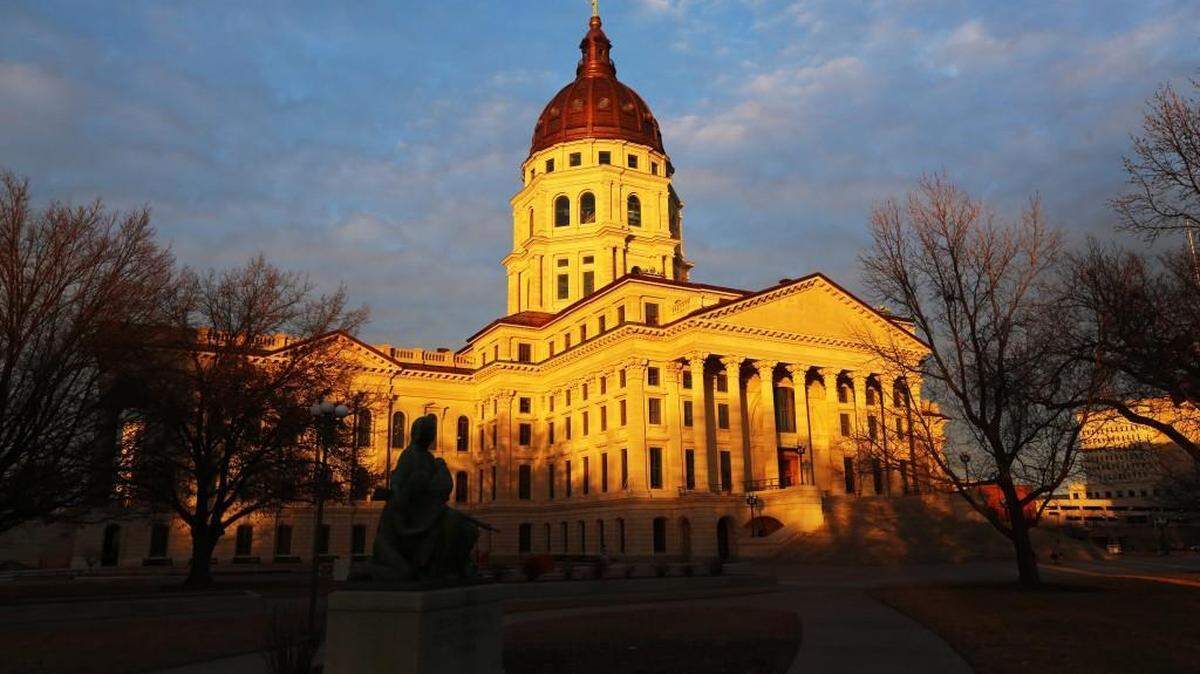
Democrats and moderate Republicans have been pummeled in recent Kansas elections, but this year they’re hopeful they can make gains in legislative races and push the state back toward the political center.
Conservative Republicans hold strong majorities in both the Kansas House and Senate. But political scientists say a number of factors — including the unpopularity of Gov. Sam Brownback and both parties’ presumptive presidential nominees — could help moderate and Democratic challengers this summer and fall.
“Whether that’s going to be a wave or a nudge, I have no idea,” said Patrick Miller, a political scientist at the University of Kansas.
Republicans hold 97 of the 125 seats in the House and 32 of the 40 seats in the Senate.
Clay Barker, executive director of the Kansas Republican Party, acknowledged that it will be difficult to increase the party’s numbers in the Legislature beyond its current supermajorities.
I’m always torn between being the cheerleader who says we’re charging forward and the realist who says we’ve gotten close to the maximum and the pendulum swings.
Clay Barker
executive director of the Kansas Republican Party“I’m always torn between being the cheerleader who says we’re charging forward and the realist who says we’ve gotten close to the maximum and the pendulum swings,” he said.
All 165 seats in the Legislature are up for election this year.
Republican incumbents who will face the toughest tests in August and November are those who serve districts won by Democrat Paul Davis in the 2014 gubernatorial election, Miller said.
Only 26 percent of respondents approved of Brownback’s performance as governor in a Morning Consult poll released last month, and Miller said the governor is likely to be a drag on Republican candidates — especially incumbents.
“No matter how anyone spins this, the guy is not popular … and you don’t want to be associated with him if you’re a Republican in the Legislature,” he said.
Barker said he thinks the governor will have a limited impact on legislative races, with the presidential race constantly in the news. “People either love him or hate. I think he’ll be more in the background.”
But he does expect “another conservative-moderate fight within the party.”
“It’s organized,” Barker said of the moderate efforts to knock out incumbents. “These guys are walking in teams, campaigning on the same issues — school funding, Medicaid expansion, roads, things like that. Always attacking Brownback, trying to link people to Brownback.”
Competitive race
Miller pointed to Senate District 28 in southeast Wichita as a race that would be competitive.
Sen. Mike Petersen, R-Wichita, a conservative who was first elected to the Senate in 2004, faces challenges from both a moderate Republican and a Democrat in the district, which also covers parts of Derby and McConnell Air Force Base.
“My race is always very competitive. It’s just the nature of our district,” Petersen said. “We saw Pat Roberts won it by a fairly large margin and then Paul Davis won. I am in a swing district. Always have been.”
My race is always very competitive. It’s just the nature of our district.
Sen. Mike Petersen
R-WichitaPetersen won the district by 5 percentage points in 2012 over Democrat Keith Humphrey. Davis beat Brownback in the district by 5 percentage points in 2014.
“My message is pretty much the same. … We need to create more jobs, create an environment for more jobs,” he said.
He’ll also focus on public safety and highlight his work to pass stiffer criminal penalties for gang activity, burglary and scrap-metal theft. He said that his familiarity with voters will be an asset in a close race.
“I’ve lived in my district almost all my life and that is a huge advantage,” he said.
First, he’ll have to face a primary opponent, Jo Hillman, a former aide to U.S. Sen. Nancy Kassebaum who describes herself “as an independent-thinking Republican.”
Hillman, a former deputy treasurer for Sedgwick County, said she has grown increasingly concerned about the direction of the state over the last six years.
“I feel like we have managed to alienate anyone who had any common sense from running for public office and we’ve just kept trooping straight down the road to fiscal irresponsibility and possibly the bankruptcy of our state with our current tax policy,” she said. “I’m very disappointed that our Legislature chooses to denigrate the teaching profession instead of recognizing that education is one of the most valuable tools we have.”
Hillman said she would like to carry on Kassebaum’s legacy of bipartisanship.
Humphrey, a Navy veteran who lives in Derby, is running again on the Democratic side.
Humphrey moved to Kansas from Florida in 2006 to start a jet engine repair company. He said he came because of the skilled labor base. He thinks the state has grown less attractive to new businesses in recent years, which he blames on Brownback and the Legislature.
“I tried to hire an engineer from south Florida that I knew and he didn’t know too much about Kansas. He and his wife researched it and called me back and said, ‘Can’t do it, man. The school system seems to be all messed up,’” he said.
I mean, if you look at what’s going on in the press and what people actually find out about Kansas when they do a simple Google search, you find a bunch of negative stuff.
Keith Humphrey
Democratic candidate for 28th Senate District“I mean, if you look at what’s going on in the press and what people actually find out about Kansas when they do a simple Google search, you find a bunch of negative stuff,” he said.
Two paths
Mark Dugan, who ran Brownback’s successful re-election campaign, thinks that conservative incumbents will fare better in both the primary and general elections than some pundits are predicting.
“Kansas Republican primary voters typically prefer conservative candidates over their liberal opponents and incumbents usually win re-election,” Dugan said in an e-mail.
For most of 2014, polls showed Davis edging out Brownback in the governor’s race. But buoyed by stronger-than-expected turnout, Brownback beat Davis by 4 percentage points.
After that, the state Democratic Party faced two paths, said Tim Graham, chief of staff for Senate Minority Leader Anthony Hensley, D-Topeka.
“There was the path of just wilting and going away because we were so down and distraught with what happened, and the other path was to get up and dust ourselves off and try to fill a full slate,” he said. “And that’s what we decided to do 18 months ago.”
In most election years, Democrats field candidates for about 30 seats in the Kansas Senate. This year they’ve got candidates for all 40.
“The ages range from 18 to retirement age. They come from a lot of different backgrounds,” said Graham, who led the candidate recruitment effort. “We just felt like we needed to give the people of Kansas, who are very, very upset with what’s going on in Topeka, an opportunity to have candidates that they could vote for — even in red districts — that could offer some sort of change.”
Miller said Democrats will need a broader message this year than in 2014, when education was almost the sole focus of Davis’ campaign.
The candidates that are most effective are the ones who speak beyond just education.
Patrick Miller
political scientist at the University of Kansas“The candidates that are most effective are the ones who speak beyond just education,” Miller said, pointing to the economy and taxes as issues the party should prioritize.
Voter turnout
Whether the party picks up more seats could depend on voter turnout, which will be difficult to predict this year, according to Mark Peterson, a political scientist at Washburn University.
Conventional wisdom is that is “driven by the presidential race itself” in presidential years, but this year may be “prove to be a real exception,” he said.
Democrat Hillary Clinton and Republican Donald Trump scored historically poor favorability ratings in a CBS/New York Times poll released last month, with a majority of registered voters holding an unfavorable opinion of each candidate.
Mark Peterson said that it’s possible voters say “a pox on both your houses” to the presidential candidates, which would put a greater emphasis on state issues when voters head to the polls.
“If that happens, here in Kansas we would have a low turnout battle between people who care about local issues,” he said. That’s a scenario that would favor Democrats and moderates, he said.
Barker, the GOP’s state executive director, thinks that national issues, such as whether to repeal the Affordable Care Act, will dominate the election cycle over state issues, such as school finance — as long as the Legislature’s current standoff with the Kansas Supreme Court is resolved later this month and schools remain open.
In a typical presidential year, voter turnout increases by about 50 percent from non-presidential years, Barker said. But he acknowledged that the unpopularity of each candidate could affect whether that holds true this year.
“I don’t just know what the impact will be. It’s a big variable,” Barker said, noting that both candidates lost by a wide margin in Kansas during March caucuses — Trump to U.S. Sen. Ted Cruz and Clinton to U.S. Sen. Bernie Sanders.
The state party’s door-knocking efforts so far have shown that Kansas Republican voters have a mixed view of Trump, Barker said.
“Maybe 20 percent love Trump; 20 percent say they’re really uncomfortable with him, but you never know how they’ll vote,” Barker said. “And about 60 percent are uncomfortable with him, but he’s better than Hillary Clinton. And that’s kind of what I’m hearing.”
Mark Peterson thinks the Democrats will pick up some seats this year. But he notes they won’t come anywhere close to a majority — or even win enough seats to forge an alliance with moderates like the one they had in the Senate before 2012, when the current conservative majority was swept into power.
“Democrats will have to get a slightly larger conference table. … But I still think it’s going to be the Republicans’ show to run,” he said.
Bryan Lowry: 785-296-3006, @BryanLowry3
This story was originally published June 11, 2016 at 6:59 PM with the headline "Could Kansas politics swing towards the center this year?."